

515
How Aerosols Influence Climate
available to heat the atmosphere. On the
other hand, clouds act as a positivefeedback mechanism by absorbing and
emitting radiation that would otherwise be
lost from the troposphere.
Which effect, if either, is stronger?
Atmospheric modeling shows that the
negative effect of a higher reflectivity is
dominant. Therefore, the net result of an
increase in cloudiness should be a decrease
in air temperature. The magnitude of this
negative feedback, however, is not believed
to be as great as the positive feedback
caused by added moisture and decreased
sea ice. Thus, although increases in cloud
cover may partly offset a global temperature
increase, climate models show that the
ultimate effect of the projected increase in
CO 2 and trace gases will still be a
temperature increase.
The problem of global warming caused
by human-induced changes in atmospheric
composition continues to be one of the
most studied aspects of climate change.
Although no models yet incorporate the
full range of potential factors and feedbacks, the scientific consensus is that the
increasing levels of atmospheric carbon
dioxide and trace gases will lead to a
warmer planet with a different distribution
of climate regimes.
Computer Models
of Climate: Important Yet
Imperfect Tools
Earth’ s climate system is amazingly complex. Comprehensive state-of-the-science
climate simulation models are among the
basic tools used to develop possible
climate-change scenarios. They are based
on fundamental laws of physics and chemistry and incorporate human and biological
interactions. The models simulate many
variables, including temperature, rainfall,
snow cover, soil moisture, winds, clouds,
sea ice, and ocean circulation over the
entire globe through the seasons and over
spans of decades.
In many other fields of study, hypotheses can be tested by direct experimentation
in the laboratory or by observations and
measurements in the field. However, this
is often not possible in the study of climate.
Rather, scientists must construct computer
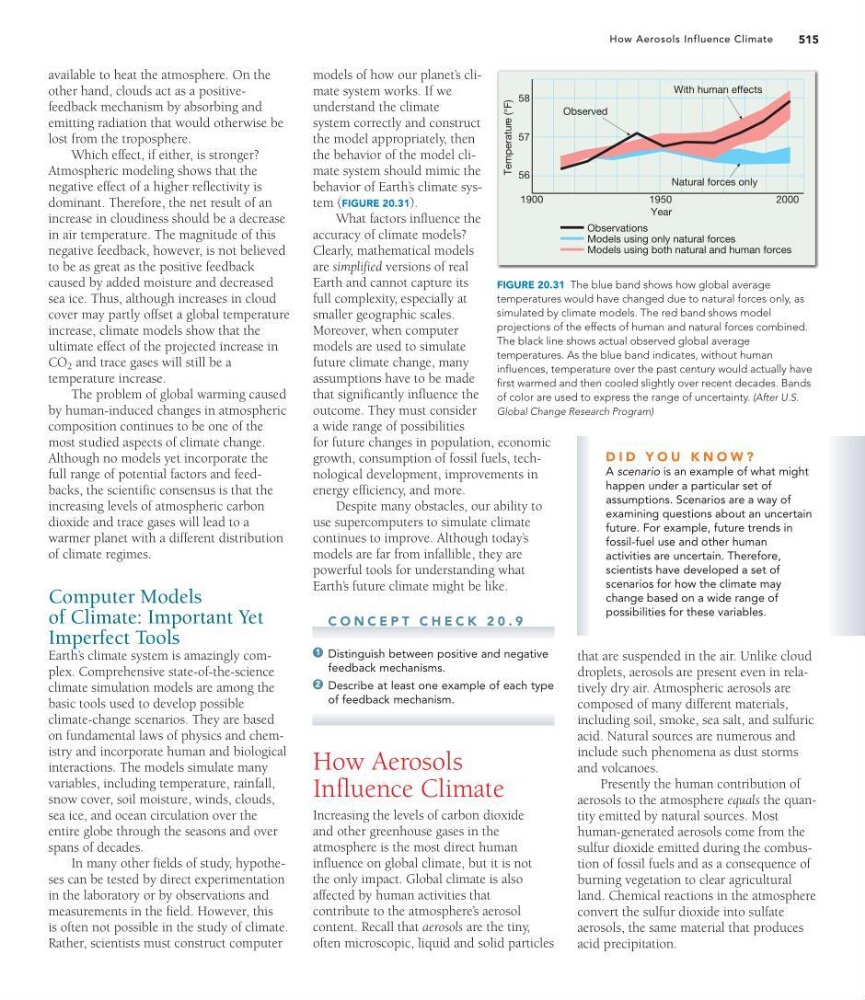
models of how our planet’ s climate system works. If we
understand the climate
system correctly and construct
the model appropriately, then
the behavior of the model climate system should mimic the
behavior of Earth’ s climate system (FIGURE 20.31).
What factors influence the
accuracy of climate models?
Clearly, mathematical models
are simplified versions of real
Earth and cannot capture its
full complexity, especially at
smaller geographic scales.
Moreover, when computer
models are used to simulate
future climate change, many
assumptions have to be made
that significantly influence the
outcome. They must consider
a wide range of possibilities
for future changes in population, economic
growth, consumption of fossil fuels, technological development, improvements in
energy efficiency, and more.
Despite many obstacles, our ability to
use supercomputers to simulate climate
continues to improve. Although today’ s
models are far from infallible, they are
powerful tools for understanding what
Earth’ s future climate might be like.
C O N C E P T C H E C K 2 0 . 9
Distinguish between positive and negative
feedback mechanisms.
Describe at least one example of each type
of feedback mechanism.
How Aerosols
Influence Climate
Increasing the levels of carbon dioxide
and other greenhouse gases in the
atmosphere is the most direct human
influence on global climate, but it is not
the only impact. Global climate is also
affected by human activities that
contribute to the atmosphere’ s aerosol
content. Recall that aerosols are the tiny,
often microscopic, liquid and solid particles
2
1
that are suspended in the air. Unlike cloud
droplets, aerosols are present even in relatively dry air. Atmospheric aerosols are
composed of many different materials,
including soil, smoke, sea salt, and sulfuric
acid. Natural sources are numerous and
include such phenomena as dust storms
and volcanoes.
Presently the human contribution of
aerosols to the atmosphere equals the quantity emitted by natural sources. Most
human-generated aerosols come from the
sulfur dioxide emitted during the combustion of fossil fuels and as a consequence of
burning vegetation to clear agricultural
land. Chemical reactions in the atmosphere
convert the sulfur dioxide into sulfate
aerosols, the same material that produces
acid precipitation.
Temperature (°F)
Observed
Year
Observations
Models using only natural forces
Models using both natural and human forces
With human effects
Natural forces only
1900
1950
2000
58
57
56
FIGURE 20.31 The blue band shows how global average
temperatures would have changed due to natural forces only, as
simulated by climate models. The red band shows model
projections of the effects of human and natural forces combined.
The black line shows actual observed global average
temperatures. As the blue band indicates, without human
influences, temperature over the past century would actually have
first warmed and then cooled slightly over recent decades. Bands
of color are used to express the range of uncertainty. (After U.S.
Global Change Research Program)
D I D Y O U K N O W ?
A scenario is an example of what might
happen under a particular set of
assumptions. Scenarios are a way of
examining questions about an uncertain
future. For example, future trends in
fossil-fuel use and other human
activities are uncertain. Therefore,
scientists have developed a set of
scenarios for how the climate may
change based on a wide range of
possibilities for these variables.
How Aerosols Influence Climate
available to heat the atmosphere. On the
other hand, clouds act as a positivefeedback mechanism by absorbing and
emitting radiation that would otherwise be
lost from the troposphere.
Which effect, if either, is stronger?
Atmospheric modeling shows that the
negative effect of a higher reflectivity is
dominant. Therefore, the net result of an
increase in cloudiness should be a decrease
in air temperature. The magnitude of this
negative feedback, however, is not believed
to be as great as the positive feedback
caused by added moisture and decreased
sea ice. Thus, although increases in cloud
cover may partly offset a global temperature
increase, climate models show that the
ultimate effect of the projected increase in
CO 2 and trace gases will still be a
temperature increase.
The problem of global warming caused
by human-induced changes in atmospheric
composition continues to be one of the
most studied aspects of climate change.
Although no models yet incorporate the
full range of potential factors and feedbacks, the scientific consensus is that the
increasing levels of atmospheric carbon
dioxide and trace gases will lead to a
warmer planet with a different distribution
of climate regimes.
Computer Models
of Climate: Important Yet
Imperfect Tools
Earth’ s climate system is amazingly complex. Comprehensive state-of-the-science
climate simulation models are among the
basic tools used to develop possible
climate-change scenarios. They are based
on fundamental laws of physics and chemistry and incorporate human and biological
interactions. The models simulate many
variables, including temperature, rainfall,
snow cover, soil moisture, winds, clouds,
sea ice, and ocean circulation over the
entire globe through the seasons and over
spans of decades.
In many other fields of study, hypotheses can be tested by direct experimentation
in the laboratory or by observations and
measurements in the field. However, this
is often not possible in the study of climate.
Rather, scientists must construct computer
models of how our planet’ s climate system works. If we
understand the climate
system correctly and construct
the model appropriately, then
the behavior of the model climate system should mimic the
behavior of Earth’ s climate system (FIGURE 20.31).
What factors influence the
accuracy of climate models?
Clearly, mathematical models
are simplified versions of real
Earth and cannot capture its
full complexity, especially at
smaller geographic scales.
Moreover, when computer
models are used to simulate
future climate change, many
assumptions have to be made
that significantly influence the
outcome. They must consider
a wide range of possibilities
for future changes in population, economic
growth, consumption of fossil fuels, technological development, improvements in
energy efficiency, and more.
Despite many obstacles, our ability to
use supercomputers to simulate climate
continues to improve. Although today’ s
models are far from infallible, they are
powerful tools for understanding what
Earth’ s future climate might be like.
C O N C E P T C H E C K 2 0 . 9
Distinguish between positive and negative
feedback mechanisms.
Describe at least one example of each type
of feedback mechanism.
How Aerosols
Influence Climate
Increasing the levels of carbon dioxide
and other greenhouse gases in the
atmosphere is the most direct human
influence on global climate, but it is not
the only impact. Global climate is also
affected by human activities that
contribute to the atmosphere’ s aerosol
content. Recall that aerosols are the tiny,
often microscopic, liquid and solid particles
2
1
that are suspended in the air. Unlike cloud
droplets, aerosols are present even in relatively dry air. Atmospheric aerosols are
composed of many different materials,
including soil, smoke, sea salt, and sulfuric
acid. Natural sources are numerous and
include such phenomena as dust storms
and volcanoes.
Presently the human contribution of
aerosols to the atmosphere equals the quantity emitted by natural sources. Most
human-generated aerosols come from the
sulfur dioxide emitted during the combustion of fossil fuels and as a consequence of
burning vegetation to clear agricultural
land. Chemical reactions in the atmosphere
convert the sulfur dioxide into sulfate
aerosols, the same material that produces
acid precipitation.
Temperature (°F)
Observed
Year
Observations
Models using only natural forces
Models using both natural and human forces
With human effects
Natural forces only
1900
1950
2000
58
57
56
FIGURE 20.31 The blue band shows how global average
temperatures would have changed due to natural forces only, as
simulated by climate models. The red band shows model
projections of the effects of human and natural forces combined.
The black line shows actual observed global average
temperatures. As the blue band indicates, without human
influences, temperature over the past century would actually have
first warmed and then cooled slightly over recent decades. Bands
of color are used to express the range of uncertainty. (After U.S.
Global Change Research Program)
D I D Y O U K N O W ?
A scenario is an example of what might
happen under a particular set of
assumptions. Scenarios are a way of
examining questions about an uncertain
future. For example, future trends in
fossil-fuel use and other human
activities are uncertain. Therefore,
scientists have developed a set of
scenarios for how the climate may
change based on a wide range of
possibilities for these variables.