

CHAPTER 20 Global Climate Change
514
the atmosphere would not be free of them
for many years.
Carbon dioxide is clearly the most
important single cause for the projected
global greenhouse warming. However, it is
not the only contributor. When the effects
of all human-generated greenhouse gases
other than CO 2 are added together and
projected into the future, their collective
impact significantly increases the impact of
CO 2 alone.
Sophisticated computer models show
that the warming of the lower atmosphere
caused by CO 2 and trace gases will not be
the same everywhere. Rather, the temperature response in polar regions could be two
to three times greater than the global average. One reason is that the polar troposphere is very stable, which suppresses
vertical mixing and thus limits the amount
of surface heat that is transferred upward.
In addition, the expected reduction in sea
ice will also contribute to the greater temperature increase. This topic will be
explored more fully in the next section.
C O N C E P T C H E C K 2 0 . 8
Why has the CO 2 level of the atmosphere
been increasing for more than 150 years?
How are temperatures in the lower
atmosphere likely to change as CO 2
levels continue to increase?
Aside from CO 2 , what trace gases are contributing to global temperature change?
Climate-Feedback
Mechanisms
Climate is a very complex interactive physical system. Thus, when any component of
the climate system is altered, scientists
must consider many possible outcomes.
These possible outcomes are called climatefeedback mechanisms. They complicate
climate-modeling efforts and add greater
uncertainty to climate predictions.
Types of Feedback
Mechanisms
What climate-feedback mechanisms are
related to carbon dioxide and other greenhouse gases? One important mechanism is
3
2
1
that warmer surface temperatures increase
evaporation rates. This in turn increases the
atmosphere’ s water vapor content. Remember that water vapor is an even more
powerful absorber of radiation emitted by
Earth than is carbon dioxide. Therefore,
with more water vapor in the air, the
temperature increase caused by carbon
dioxide and the trace gases is reinforced.
Figure 20.25B showed that highlatitude regions warmed more in 2009 than
lower-latitude areas. This was not just the
case in 2009; it has been true for many
years. Scientists who model global climate
change indicate that the temperature
increase at high latitudes may be two to
three times greater than the global average.
This assumption is based in part on the
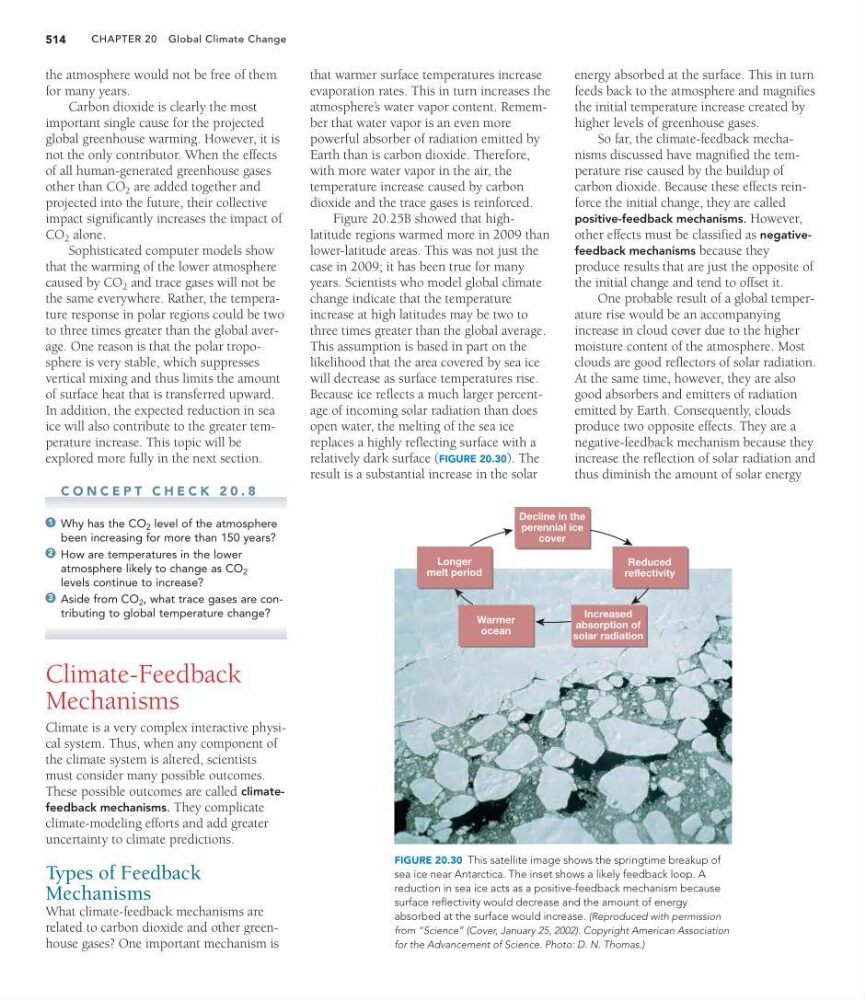
likelihood that the area covered by sea ice
will decrease as surface temperatures rise.
Because ice reflects a much larger percentage of incoming solar radiation than does
open water, the melting of the sea ice
replaces a highly reflecting surface with a
relatively dark surface (FIGURE 20.30). The
result is a substantial increase in the solar
energy absorbed at the surface. This in turn
feeds back to the atmosphere and magnifies
the initial temperature increase created by
higher levels of greenhouse gases.
So far, the climate-feedback mechanisms discussed have magnified the temperature rise caused by the buildup of
carbon dioxide. Because these effects reinforce the initial change, they are called
positive-feedback mechanisms. However,
other effects must be classified as negativefeedback mechanisms because they
produce results that are just the opposite of
the initial change and tend to offset it.
One probable result of a global temperature rise would be an accompanying
increase in cloud cover due to the higher
moisture content of the atmosphere. Most
clouds are good reflectors of solar radiation.
At the same time, however, they are also
good absorbers and emitters of radiation
emitted by Earth. Consequently, clouds
produce two opposite effects. They are a
negative-feedback mechanism because they
increase the reflection of solar radiation and
thus diminish the amount of solar energy
FIGURE 20.30 This satellite image shows the springtime breakup of
sea ice near Antarctica. The inset shows a likely feedback loop. A
reduction in sea ice acts as a positive-feedback mechanism because
surface reflectivity would decrease and the amount of energy
absorbed at the surface would increase. (Reproduced with permission
from “Science” (Cover, January 25, 2002). Copyright American Association
for the Advancement of Science. Photo: D. N. Thomas.)
Decline in the
perennial ice
cover
Longer
melt period
Warmer
ocean
Reduced
reflectivity
Increased
absorption of
solar radiation
514
the atmosphere would not be free of them
for many years.
Carbon dioxide is clearly the most
important single cause for the projected
global greenhouse warming. However, it is
not the only contributor. When the effects
of all human-generated greenhouse gases
other than CO 2 are added together and
projected into the future, their collective
impact significantly increases the impact of
CO 2 alone.
Sophisticated computer models show
that the warming of the lower atmosphere
caused by CO 2 and trace gases will not be
the same everywhere. Rather, the temperature response in polar regions could be two
to three times greater than the global average. One reason is that the polar troposphere is very stable, which suppresses
vertical mixing and thus limits the amount
of surface heat that is transferred upward.
In addition, the expected reduction in sea
ice will also contribute to the greater temperature increase. This topic will be
explored more fully in the next section.
C O N C E P T C H E C K 2 0 . 8
Why has the CO 2 level of the atmosphere
been increasing for more than 150 years?
How are temperatures in the lower
atmosphere likely to change as CO 2
levels continue to increase?
Aside from CO 2 , what trace gases are contributing to global temperature change?
Climate-Feedback
Mechanisms
Climate is a very complex interactive physical system. Thus, when any component of
the climate system is altered, scientists
must consider many possible outcomes.
These possible outcomes are called climatefeedback mechanisms. They complicate
climate-modeling efforts and add greater
uncertainty to climate predictions.
Types of Feedback
Mechanisms
What climate-feedback mechanisms are
related to carbon dioxide and other greenhouse gases? One important mechanism is
3
2
1
that warmer surface temperatures increase
evaporation rates. This in turn increases the
atmosphere’ s water vapor content. Remember that water vapor is an even more
powerful absorber of radiation emitted by
Earth than is carbon dioxide. Therefore,
with more water vapor in the air, the
temperature increase caused by carbon
dioxide and the trace gases is reinforced.
Figure 20.25B showed that highlatitude regions warmed more in 2009 than
lower-latitude areas. This was not just the
case in 2009; it has been true for many
years. Scientists who model global climate
change indicate that the temperature
increase at high latitudes may be two to
three times greater than the global average.
This assumption is based in part on the
likelihood that the area covered by sea ice
will decrease as surface temperatures rise.
Because ice reflects a much larger percentage of incoming solar radiation than does
open water, the melting of the sea ice
replaces a highly reflecting surface with a
relatively dark surface (FIGURE 20.30). The
result is a substantial increase in the solar
energy absorbed at the surface. This in turn
feeds back to the atmosphere and magnifies
the initial temperature increase created by
higher levels of greenhouse gases.
So far, the climate-feedback mechanisms discussed have magnified the temperature rise caused by the buildup of
carbon dioxide. Because these effects reinforce the initial change, they are called
positive-feedback mechanisms. However,
other effects must be classified as negativefeedback mechanisms because they
produce results that are just the opposite of
the initial change and tend to offset it.
One probable result of a global temperature rise would be an accompanying
increase in cloud cover due to the higher
moisture content of the atmosphere. Most
clouds are good reflectors of solar radiation.
At the same time, however, they are also
good absorbers and emitters of radiation
emitted by Earth. Consequently, clouds
produce two opposite effects. They are a
negative-feedback mechanism because they
increase the reflection of solar radiation and
thus diminish the amount of solar energy
FIGURE 20.30 This satellite image shows the springtime breakup of
sea ice near Antarctica. The inset shows a likely feedback loop. A
reduction in sea ice acts as a positive-feedback mechanism because
surface reflectivity would decrease and the amount of energy
absorbed at the surface would increase. (Reproduced with permission
from “Science” (Cover, January 25, 2002). Copyright American Association
for the Advancement of Science. Photo: D. N. Thomas.)
Decline in the
perennial ice
cover
Longer
melt period
Warmer
ocean
Reduced
reflectivity
Increased
absorption of
solar radiation