

CHAPTER 20 Global Climate Change
506
THE BASIC PREMISE. The basic premise
is that this suspended volcanic material
will filter out a portion of the incoming
solar radiation, which in turn will
lower temperatures in the troposphere.
More than 200 years ago Benjamin
Franklin used this idea to argue that
material from the eruption of a large
Icelandic volcano could have reflected
sunlight back to space and therefore
might have been responsible for the
unusually cold winter of 1783–1784.
Perhaps the most notable cool period
linked to a volcanic event is the “year
without a summer” that followed the 1815
eruption of Mount Tambora in Indonesia.
The eruption of Tambora is the largest of
modern times. During April 7–12, 1815,
this nearly 4000-meter-high (13,000-foot)
volcano violently expelled an estimated
100 cubic kilometers (24 cubic miles) of
volcanic debris. The impact of the volcanic
aerosols on climate is believed to have been
widespread in the Northern Hemisphere.
From May through September 1816 an
unprecedented series of cold spells
affected the northeastern United States
and adjacent portions of Canada. There
was heavy snow in June and frost in July
and August. Abnormal cold was also
experienced in much of Western Europe.
Similar, although apparently less dramatic,
effects were associated with other great
explosive volcanoes, including Indonesia’ s
Krakatoa in 1883.
Three major volcanic events have
provided considerable data and insight
regarding the impact of volcanoes on
global temperatures. The eruptions of
Washington state’ s Mount St. Helens in
1980, the Mexican volcano El Chichón in
1982, and the Philippines’ Mount Pinatubo
in 1991 have given scientists an opportunity to study the atmospheric effects of
volcanic eruptions with the aid of more
sophisticated technology than had been
available in the past. Satellite images and
remote-sensing instruments allowed
scientists to monitor closely the effects
of the clouds of gases and ash that these
volcanoes emitted.
MOUNT ST. HELENS. When Mount St.
Helens erupted, there was immediate
speculation about the possible effects on
our climate. Could such an eruption cause
our climate to change? There is no doubt
that the large quantity of volcanic ash
emitted by the explosive eruption had
significant local and regional effects for
a short period. Still, studies indicated
that any longer-term lowering of hemispheric temperatures was negligible. The
cooling was so slight, probably less than
0.1 °C (0.2 °F), that it could not be
distinguished from other natural
temperature fluctuations.
EL CHICHÓN. Two years of monitoring
and studies following the 1982 El Chichón
eruption indicated that its cooling effect on
global mean temperature was greater than
that of Mount St. Helens, on the order of
0.3 to 0.5 °C (0.5 to 0.9 °F). The eruption
of El Chichón was less explosive than the
Mount St. Helens blast, so why did it have
a greater impact on global temperatures?
The reason is that the material emitted by
Mount St. Helens was largely fine ash that
settled out in a relatively short time. El
Chichón, on the other hand, emitted far
greater quantities of sulfur dioxide gas
(an estimated 40 times more) than Mount
St. Helens. This gas combines with water
vapor in the stratosphere to produce a
dense cloud of tiny sulfuric acid particles
(FIGURE 20.19A). The particles, called
aerosols, take several years to settle out
completely. They lower the troposphere’ s
mean temperature because they reflect
solar radiation back into space
(FIGURE 20.19B).
We now understand that volcanic
clouds that remain in the stratosphere for a
year or more are composed largely of sulfuricacid droplets and not of dust, as was once
thought. Thus, the volume of fine debris
A.
B.
Mount Etna
Italy
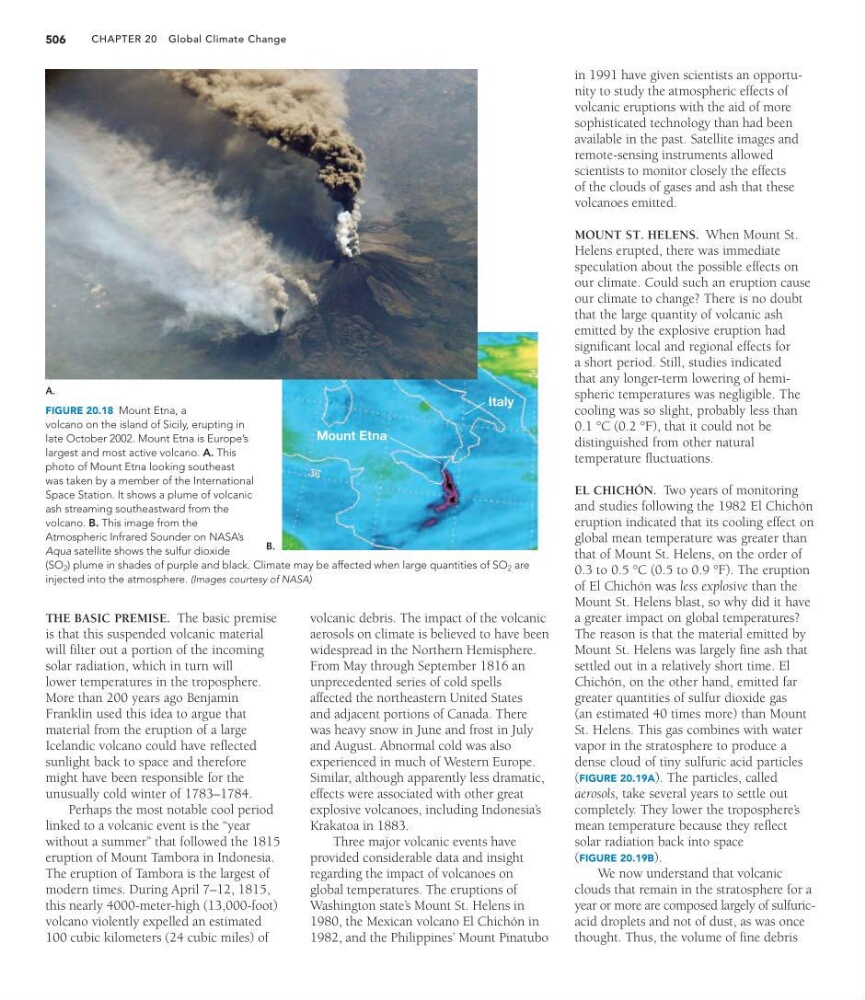
FIGURE 20.18 Mount Etna, a
volcano on the island of Sicily, erupting in
late October 2002. Mount Etna is Europe’s
largest and most active volcano. A. This
photo of Mount Etna looking southeast
was taken by a member of the International
Space Station. It shows a plume of volcanic
ash streaming southeastward from the
volcano. B. This image from the
Atmospheric Infrared Sounder on NASA’s
Aqua satellite shows the sulfur dioxide
(SO 2 ) plume in shades of purple and black. Climate may be affected when large quantities of SO 2 are
injected into the atmosphere. (Images courtesy of NASA)
506
THE BASIC PREMISE. The basic premise
is that this suspended volcanic material
will filter out a portion of the incoming
solar radiation, which in turn will
lower temperatures in the troposphere.
More than 200 years ago Benjamin
Franklin used this idea to argue that
material from the eruption of a large
Icelandic volcano could have reflected
sunlight back to space and therefore
might have been responsible for the
unusually cold winter of 1783–1784.
Perhaps the most notable cool period
linked to a volcanic event is the “year
without a summer” that followed the 1815
eruption of Mount Tambora in Indonesia.
The eruption of Tambora is the largest of
modern times. During April 7–12, 1815,
this nearly 4000-meter-high (13,000-foot)
volcano violently expelled an estimated
100 cubic kilometers (24 cubic miles) of
volcanic debris. The impact of the volcanic
aerosols on climate is believed to have been
widespread in the Northern Hemisphere.
From May through September 1816 an
unprecedented series of cold spells
affected the northeastern United States
and adjacent portions of Canada. There
was heavy snow in June and frost in July
and August. Abnormal cold was also
experienced in much of Western Europe.
Similar, although apparently less dramatic,
effects were associated with other great
explosive volcanoes, including Indonesia’ s
Krakatoa in 1883.
Three major volcanic events have
provided considerable data and insight
regarding the impact of volcanoes on
global temperatures. The eruptions of
Washington state’ s Mount St. Helens in
1980, the Mexican volcano El Chichón in
1982, and the Philippines’ Mount Pinatubo
in 1991 have given scientists an opportunity to study the atmospheric effects of
volcanic eruptions with the aid of more
sophisticated technology than had been
available in the past. Satellite images and
remote-sensing instruments allowed
scientists to monitor closely the effects
of the clouds of gases and ash that these
volcanoes emitted.
MOUNT ST. HELENS. When Mount St.
Helens erupted, there was immediate
speculation about the possible effects on
our climate. Could such an eruption cause
our climate to change? There is no doubt
that the large quantity of volcanic ash
emitted by the explosive eruption had
significant local and regional effects for
a short period. Still, studies indicated
that any longer-term lowering of hemispheric temperatures was negligible. The
cooling was so slight, probably less than
0.1 °C (0.2 °F), that it could not be
distinguished from other natural
temperature fluctuations.
EL CHICHÓN. Two years of monitoring
and studies following the 1982 El Chichón
eruption indicated that its cooling effect on
global mean temperature was greater than
that of Mount St. Helens, on the order of
0.3 to 0.5 °C (0.5 to 0.9 °F). The eruption
of El Chichón was less explosive than the
Mount St. Helens blast, so why did it have
a greater impact on global temperatures?
The reason is that the material emitted by
Mount St. Helens was largely fine ash that
settled out in a relatively short time. El
Chichón, on the other hand, emitted far
greater quantities of sulfur dioxide gas
(an estimated 40 times more) than Mount
St. Helens. This gas combines with water
vapor in the stratosphere to produce a
dense cloud of tiny sulfuric acid particles
(FIGURE 20.19A). The particles, called
aerosols, take several years to settle out
completely. They lower the troposphere’ s
mean temperature because they reflect
solar radiation back into space
(FIGURE 20.19B).
We now understand that volcanic
clouds that remain in the stratosphere for a
year or more are composed largely of sulfuricacid droplets and not of dust, as was once
thought. Thus, the volume of fine debris
A.
B.
Mount Etna
Italy
FIGURE 20.18 Mount Etna, a
volcano on the island of Sicily, erupting in
late October 2002. Mount Etna is Europe’s
largest and most active volcano. A. This
photo of Mount Etna looking southeast
was taken by a member of the International
Space Station. It shows a plume of volcanic
ash streaming southeastward from the
volcano. B. This image from the
Atmospheric Infrared Sounder on NASA’s
Aqua satellite shows the sulfur dioxide
(SO 2 ) plume in shades of purple and black. Climate may be affected when large quantities of SO 2 are
injected into the atmosphere. (Images courtesy of NASA)