

505
Natural Causes of Climate Change
Natural Causes of Climate Change
A great variety of hypotheses have been proposed to explain climate change. Several have
gained wide support, only to lose it and then sometimes regain it again. Some explanations
are controversial. This is to be expected, because planetary atmospheric processes are so
large-scale and complex that they cannot be reproduced physically in laboratory experiments. Rather, climate and its changes must be simulated mathematically (modeled) using
powerful computers.
In Chapter 11, the section on “Causes of Glaciation” (pp. 281–283) described two “natural” mechanisms of climate change. Recall that the movement of lithospheric plates gradually moves Earth’ s continents closer to or farther from the equator. Although these shifts in
latitude are slow, they can have a dramatic impact on climate over spans of millions of
years. Moving landmasses can also lead to significant shifts in ocean circulation, which
influences heat transport around the globe.*
A second natural mechanism of climate change discussed in Chapter 11 involved variations in Earth’ s orbit. Changes in the shape of the orbit (eccentricity), variations in the angle
that Earth’ s axis makes with the plane of its orbit (obliquity), and the wobbling of the axis
(precession) cause fluctuations in the seasonal and latitudinal distribution of solar radiation.
These variations, in turn, contributed to the alternating glacial–interglacial episodes of the
Ice Age.
In this section, we describe two additional hypotheses that have earned serious consideration from the scientific community. One involves the role of volcanic activity. How do
the gases and particles emitted by volcanoes impact climate? A second natural cause of climate change discussed in this section involves solar variability. Does the Sun vary in its
radiation output? Do sunspots affect the output?
After this look at natural factors, we will examine human-made climate changes,
including the effects of rising levels of carbon dioxide and other trace gases.
*For more on this, see the section titled “Supercontinents and Climate” in Chapter 19, pp. 472–473.
Short-wave solar
radiation passes
through the
atmosphere
and is absorbed
by Earth’s surface.
Earth’s surface emits
longwave radiation
which is absorbed by
greenhouse gases.
Greenhouse gases reradiate
some energy Earthward,
thus trapping heat in the
lower atmosphere.
H 2 O
CO 2
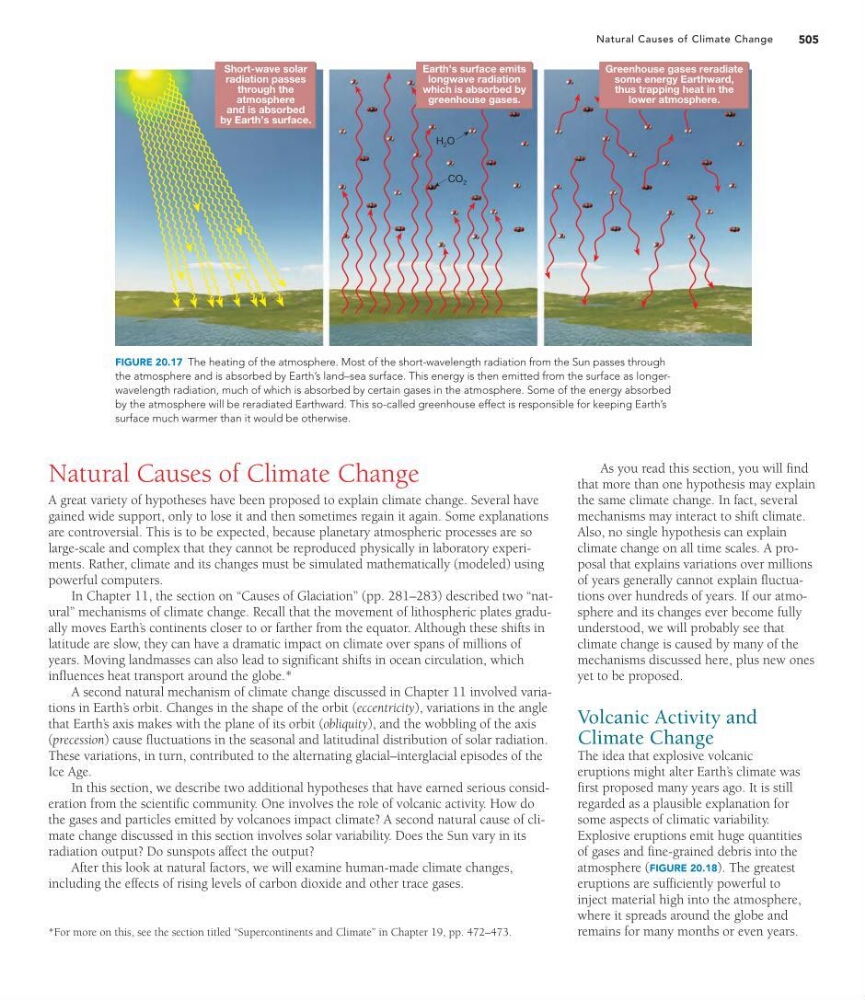
FIGURE 20.17 The heating of the atmosphere. Most of the short-wavelength radiation from the Sun passes through
the atmosphere and is absorbed by Earth’s land–sea surface. This energy is then emitted from the surface as longerwavelength radiation, much of which is absorbed by certain gases in the atmosphere. Some of the energy absorbed
by the atmosphere will be reradiated Earthward. This so-called greenhouse effect is responsible for keeping Earth’s
surface much warmer than it would be otherwise.
As you read this section, you will find
that more than one hypothesis may explain
the same climate change. In fact, several
mechanisms may interact to shift climate.
Also, no single hypothesis can explain
climate change on all time scales. A proposal that explains variations over millions
of years generally cannot explain fluctuations over hundreds of years. If our atmosphere and its changes ever become fully
understood, we will probably see that
climate change is caused by many of the
mechanisms discussed here, plus new ones
yet to be proposed.
Volcanic Activity and
Climate Change
The idea that explosive volcanic
eruptions might alter Earth’ s climate was
first proposed many years ago. It is still
regarded as a plausible explanation for
some aspects of climatic variability.
Explosive eruptions emit huge quantities
of gases and fine-grained debris into the
atmosphere (FIGURE 20.18). The greatest
eruptions are sufficiently powerful to
inject material high into the atmosphere,
where it spreads around the globe and
remains for many months or even years.
Natural Causes of Climate Change
Natural Causes of Climate Change
A great variety of hypotheses have been proposed to explain climate change. Several have
gained wide support, only to lose it and then sometimes regain it again. Some explanations
are controversial. This is to be expected, because planetary atmospheric processes are so
large-scale and complex that they cannot be reproduced physically in laboratory experiments. Rather, climate and its changes must be simulated mathematically (modeled) using
powerful computers.
In Chapter 11, the section on “Causes of Glaciation” (pp. 281–283) described two “natural” mechanisms of climate change. Recall that the movement of lithospheric plates gradually moves Earth’ s continents closer to or farther from the equator. Although these shifts in
latitude are slow, they can have a dramatic impact on climate over spans of millions of
years. Moving landmasses can also lead to significant shifts in ocean circulation, which
influences heat transport around the globe.*
A second natural mechanism of climate change discussed in Chapter 11 involved variations in Earth’ s orbit. Changes in the shape of the orbit (eccentricity), variations in the angle
that Earth’ s axis makes with the plane of its orbit (obliquity), and the wobbling of the axis
(precession) cause fluctuations in the seasonal and latitudinal distribution of solar radiation.
These variations, in turn, contributed to the alternating glacial–interglacial episodes of the
Ice Age.
In this section, we describe two additional hypotheses that have earned serious consideration from the scientific community. One involves the role of volcanic activity. How do
the gases and particles emitted by volcanoes impact climate? A second natural cause of climate change discussed in this section involves solar variability. Does the Sun vary in its
radiation output? Do sunspots affect the output?
After this look at natural factors, we will examine human-made climate changes,
including the effects of rising levels of carbon dioxide and other trace gases.
*For more on this, see the section titled “Supercontinents and Climate” in Chapter 19, pp. 472–473.
Short-wave solar
radiation passes
through the
atmosphere
and is absorbed
by Earth’s surface.
Earth’s surface emits
longwave radiation
which is absorbed by
greenhouse gases.
Greenhouse gases reradiate
some energy Earthward,
thus trapping heat in the
lower atmosphere.
H 2 O
CO 2
FIGURE 20.17 The heating of the atmosphere. Most of the short-wavelength radiation from the Sun passes through
the atmosphere and is absorbed by Earth’s land–sea surface. This energy is then emitted from the surface as longerwavelength radiation, much of which is absorbed by certain gases in the atmosphere. Some of the energy absorbed
by the atmosphere will be reradiated Earthward. This so-called greenhouse effect is responsible for keeping Earth’s
surface much warmer than it would be otherwise.
As you read this section, you will find
that more than one hypothesis may explain
the same climate change. In fact, several
mechanisms may interact to shift climate.
Also, no single hypothesis can explain
climate change on all time scales. A proposal that explains variations over millions
of years generally cannot explain fluctuations over hundreds of years. If our atmosphere and its changes ever become fully
understood, we will probably see that
climate change is caused by many of the
mechanisms discussed here, plus new ones
yet to be proposed.
Volcanic Activity and
Climate Change
The idea that explosive volcanic
eruptions might alter Earth’ s climate was
first proposed many years ago. It is still
regarded as a plausible explanation for
some aspects of climatic variability.
Explosive eruptions emit huge quantities
of gases and fine-grained debris into the
atmosphere (FIGURE 20.18). The greatest
eruptions are sufficiently powerful to
inject material high into the atmosphere,
where it spreads around the globe and
remains for many months or even years.