

CHAPTER 20 Global Climate Change
504
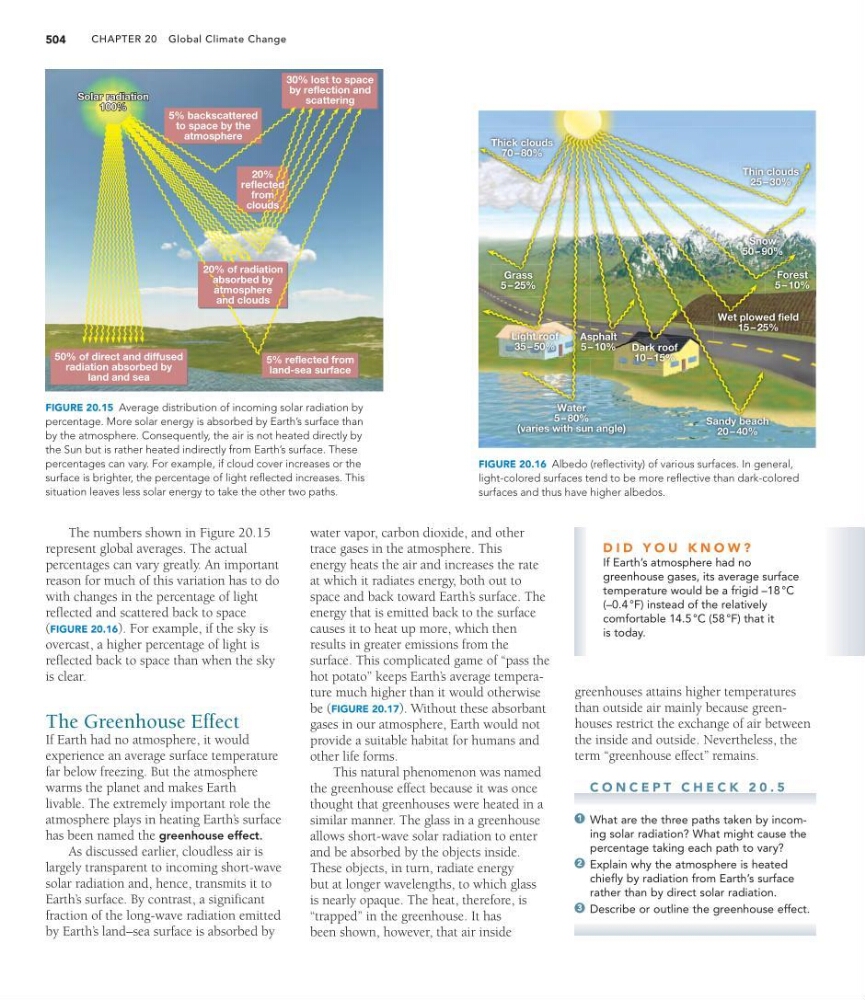
The numbers shown in Figure 20.15
represent global averages. The actual
percentages can vary greatly. An important
reason for much of this variation has to do
with changes in the percentage of light
reflected and scattered back to space
(FIGURE 20.16). For example, if the sky is
overcast, a higher percentage of light is
reflected back to space than when the sky
is clear.
The Greenhouse Effect
If Earth had no atmosphere, it would
experience an average surface temperature
far below freezing. But the atmosphere
warms the planet and makes Earth
livable. The extremely important role the
atmosphere plays in heating Earth’ s surface
has been named the greenhouse effect.
As discussed earlier, cloudless air is
largely transparent to incoming short-wave
solar radiation and, hence, transmits it to
Earth’ s surface. By contrast, a significant
fraction of the long-wave radiation emitted
by Earth’ s land–sea surface is absorbed by
water vapor, carbon dioxide, and other
trace gases in the atmosphere. This
energy heats the air and increases the rate
at which it radiates energy, both out to
space and back toward Earth’ s surface. The
energy that is emitted back to the surface
causes it to heat up more, which then
results in greater emissions from the
surface. This complicated game of “pass the
hot potato” keeps Earth’ s average temperature much higher than it would otherwise
be (FIGURE 20.17). Without these absorbant
gases in our atmosphere, Earth would not
provide a suitable habitat for humans and
other life forms.
This natural phenomenon was named
the greenhouse effect because it was once
thought that greenhouses were heated in a
similar manner. The glass in a greenhouse
allows short-wave solar radiation to enter
and be absorbed by the objects inside.
These objects, in turn, radiate energy
but at longer wavelengths, to which glass
is nearly opaque. The heat, therefore, is
“trapped” in the greenhouse. It has
been shown, however, that air inside
greenhouses attains higher temperatures
than outside air mainly because greenhouses restrict the exchange of air between
the inside and outside. Nevertheless, the
term “greenhouse effect” remains.
C O N C E P T C H E C K 2 0 . 5
What are the three paths taken by incoming solar radiation? What might cause the
percentage taking each path to vary?
Explain why the atmosphere is heated
chiefly by radiation from Earth’s surface
rather than by direct solar radiation.
Describe or outline the greenhouse effect.
3
2
1
Solar radiation
Solar radiation
100% 100%
Solar radiation
100%
30% lost to space
by reflection and
scattering
5% backscattered
to space by the
atmosphere
20%
20%
reflected reflected
from from
clouds clouds
20% of radiation
20% of radiation
absorbed by
absorbed by
atmosphere atmosphere
and clouds
and clouds
20%
reflected
from
clouds
20% of radiation
absorbed by
atmosphere
and clouds
50% of direct and diffused
radiation absorbed by
land and sea
5% reflected from
land-sea surface
FIGURE 20.15 Average distribution of incoming solar radiation by
percentage. More solar energy is absorbed by Earth’s surface than
by the atmosphere. Consequently, the air is not heated directly by
the Sun but is rather heated indirectly from Earth’s surface. These
percentages can vary. For example, if cloud cover increases or the
surface is brighter, the percentage of light reflected increases. This
situation leaves less solar energy to take the other two paths.
Thick clouds
70 – 80%
Wet plowed field
15 – 25%
Water
5 – 80%
(varies with sun angle)
Light roof
35 – 50%
Dark roof
10 – 15%
Sandy beach
20 – 40%
Thin clouds
25 – 30%
Snow
50 – 90%
Grass
5 – 25%
Forest
5 – 10%
Asphalt
5 – 10%
FIGURE 20.16 Albedo (reflectivity) of various surfaces. In general,
light-colored surfaces tend to be more reflective than dark-colored
surfaces and thus have higher albedos.
D I D Y O U K N O W ?
If Earth’s atmosphere had no
greenhouse gases, its average surface
temperature would be a frigid –18 °C
(–0.4 °F) instead of the relatively
comfortable 14.5 °C (58 °F) that it
is today.
504
The numbers shown in Figure 20.15
represent global averages. The actual
percentages can vary greatly. An important
reason for much of this variation has to do
with changes in the percentage of light
reflected and scattered back to space
(FIGURE 20.16). For example, if the sky is
overcast, a higher percentage of light is
reflected back to space than when the sky
is clear.
The Greenhouse Effect
If Earth had no atmosphere, it would
experience an average surface temperature
far below freezing. But the atmosphere
warms the planet and makes Earth
livable. The extremely important role the
atmosphere plays in heating Earth’ s surface
has been named the greenhouse effect.
As discussed earlier, cloudless air is
largely transparent to incoming short-wave
solar radiation and, hence, transmits it to
Earth’ s surface. By contrast, a significant
fraction of the long-wave radiation emitted
by Earth’ s land–sea surface is absorbed by
water vapor, carbon dioxide, and other
trace gases in the atmosphere. This
energy heats the air and increases the rate
at which it radiates energy, both out to
space and back toward Earth’ s surface. The
energy that is emitted back to the surface
causes it to heat up more, which then
results in greater emissions from the
surface. This complicated game of “pass the
hot potato” keeps Earth’ s average temperature much higher than it would otherwise
be (FIGURE 20.17). Without these absorbant
gases in our atmosphere, Earth would not
provide a suitable habitat for humans and
other life forms.
This natural phenomenon was named
the greenhouse effect because it was once
thought that greenhouses were heated in a
similar manner. The glass in a greenhouse
allows short-wave solar radiation to enter
and be absorbed by the objects inside.
These objects, in turn, radiate energy
but at longer wavelengths, to which glass
is nearly opaque. The heat, therefore, is
“trapped” in the greenhouse. It has
been shown, however, that air inside
greenhouses attains higher temperatures
than outside air mainly because greenhouses restrict the exchange of air between
the inside and outside. Nevertheless, the
term “greenhouse effect” remains.
C O N C E P T C H E C K 2 0 . 5
What are the three paths taken by incoming solar radiation? What might cause the
percentage taking each path to vary?
Explain why the atmosphere is heated
chiefly by radiation from Earth’s surface
rather than by direct solar radiation.
Describe or outline the greenhouse effect.
3
2
1
Solar radiation
Solar radiation
100% 100%
Solar radiation
100%
30% lost to space
by reflection and
scattering
5% backscattered
to space by the
atmosphere
20%
20%
reflected reflected
from from
clouds clouds
20% of radiation
20% of radiation
absorbed by
absorbed by
atmosphere atmosphere
and clouds
and clouds
20%
reflected
from
clouds
20% of radiation
absorbed by
atmosphere
and clouds
50% of direct and diffused
radiation absorbed by
land and sea
5% reflected from
land-sea surface
FIGURE 20.15 Average distribution of incoming solar radiation by
percentage. More solar energy is absorbed by Earth’s surface than
by the atmosphere. Consequently, the air is not heated directly by
the Sun but is rather heated indirectly from Earth’s surface. These
percentages can vary. For example, if cloud cover increases or the
surface is brighter, the percentage of light reflected increases. This
situation leaves less solar energy to take the other two paths.
Thick clouds
70 – 80%
Wet plowed field
15 – 25%
Water
5 – 80%
(varies with sun angle)
Light roof
35 – 50%
Dark roof
10 – 15%
Sandy beach
20 – 40%
Thin clouds
25 – 30%
Snow
50 – 90%
Grass
5 – 25%
Forest
5 – 10%
Asphalt
5 – 10%
FIGURE 20.16 Albedo (reflectivity) of various surfaces. In general,
light-colored surfaces tend to be more reflective than dark-colored
surfaces and thus have higher albedos.
D I D Y O U K N O W ?
If Earth’s atmosphere had no
greenhouse gases, its average surface
temperature would be a frigid –18 °C
(–0.4 °F) instead of the relatively
comfortable 14.5 °C (58 °F) that it
is today.