

501
Some Atmospheric Basics
Extent and Structure
of the Atmosphere
To say that the atmosphere begins at Earth’ s surface and extends upward is
obvious. However, where does the atmosphere end and outer space begin?
There is no sharp boundary; the atmosphere rapidly thins as you travel away
from Earth, until there are too few gas molecules to detect.
PRESSURE CHANGES WITH HEIGHT. To understand the vertical extent of
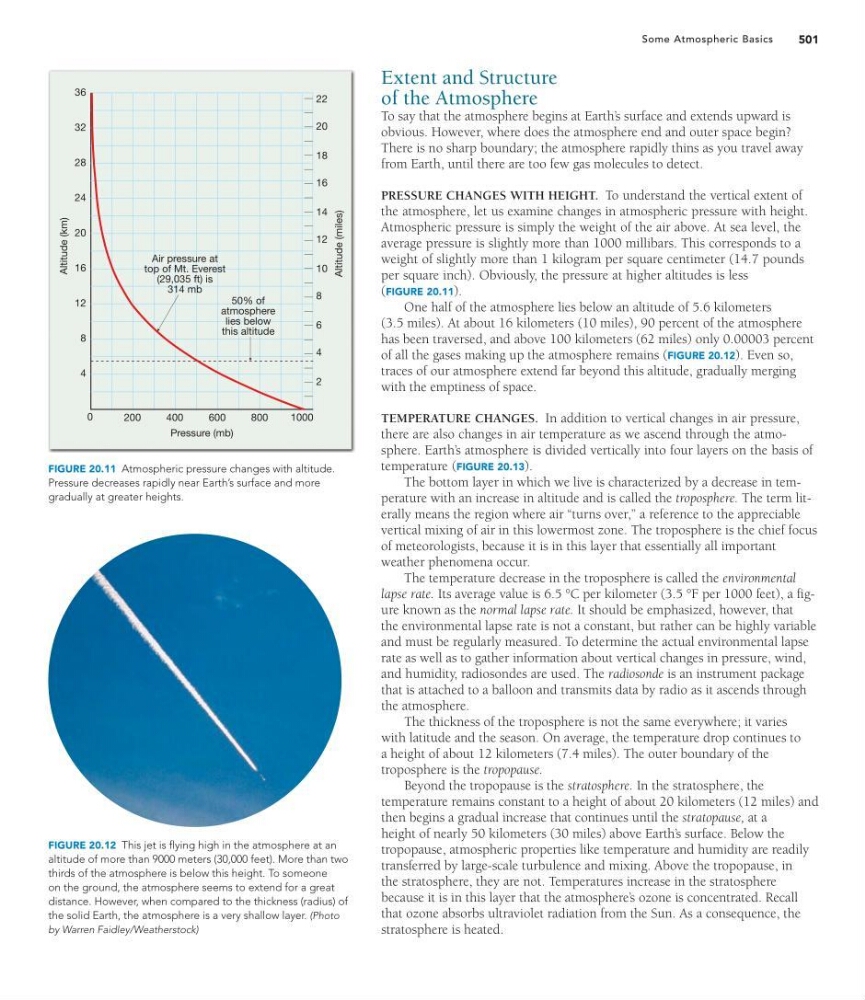
the atmosphere, let us examine changes in atmospheric pressure with height.
Atmospheric pressure is simply the weight of the air above. At sea level, the
average pressure is slightly more than 1000 millibars. This corresponds to a
weight of slightly more than 1 kilogram per square centimeter (14.7 pounds
per square inch). Obviously, the pressure at higher altitudes is less
(FIGURE 20.11).
One half of the atmosphere lies below an altitude of 5.6 kilometers
(3.5 miles). At about 16 kilometers (10 miles), 90 percent of the atmosphere
has been traversed, and above 100 kilometers (62 miles) only 0.00003 percent
of all the gases making up the atmosphere remains (FIGURE 20.12). Even so,
traces of our atmosphere extend far beyond this altitude, gradually merging
with the emptiness of space.
TEMPERATURE CHANGES. In addition to vertical changes in air pressure,
there are also changes in air temperature as we ascend through the atmosphere. Earth’ s atmosphere is divided vertically into four layers on the basis of
temperature (FIGURE 20.13).
The bottom layer in which we live is characterized by a decrease in temperature with an increase in altitude and is called the troposphere. The term literally means the region where air “turns over,” a reference to the appreciable
vertical mixing of air in this lowermost zone. The troposphere is the chief focus
of meteorologists, because it is in this layer that essentially all important
weather phenomena occur.
The temperature decrease in the troposphere is called the environmental
lapse rate. Its average value is 6.5 °C per kilometer (3.5 °F per 1000 feet), a figure known as the normal lapse rate. It should be emphasized, however, that
the environmental lapse rate is not a constant, but rather can be highly variable
and must be regularly measured. To determine the actual environmental lapse
rate as well as to gather information about vertical changes in pressure, wind,
and humidity, radiosondes are used. The radiosonde is an instrument package
that is attached to a balloon and transmits data by radio as it ascends through
the atmosphere.
The thickness of the troposphere is not the same everywhere; it varies
with latitude and the season. On average, the temperature drop continues to
a height of about 12 kilometers (7.4 miles). The outer boundary of the
troposphere is the tropopause.
Beyond the tropopause is the stratosphere. In the stratosphere, the
temperature remains constant to a height of about 20 kilometers (12 miles) and
then begins a gradual increase that continues until the stratopause, at a
height of nearly 50 kilometers (30 miles) above Earth’ s surface. Below the
tropopause, atmospheric properties like temperature and humidity are readily
transferred by large-scale turbulence and mixing. Above the tropopause, in
the stratosphere, they are not. Temperatures increase in the stratosphere
because it is in this layer that the atmosphere’ s ozone is concentrated. Recall
that ozone absorbs ultraviolet radiation from the Sun. As a consequence, the
stratosphere is heated.
36
32
28
24
20
16
12
8
4
0
200
400
600
800
1000
Pressure (mb)
Altitude (km)
50% of
atmosphere
lies below
this altitude
Air pressure at
top of Mt. Everest
(29,035 ft) is
314 mb
20
16
12
8
4
Altitude (miles)
22
18
14
10
6
2
FIGURE 20.11 Atmospheric pressure changes with altitude.
Pressure decreases rapidly near Earth’s surface and more
gradually at greater heights.
FIGURE 20.12 This jet is flying high in the atmosphere at an
altitude of more than 9000 meters (30,000 feet). More than two
thirds of the atmosphere is below this height. To someone
on the ground, the atmosphere seems to extend for a great
distance. However, when compared to the thickness (radius) of
the solid Earth, the atmosphere is a very shallow layer. (Photo
by Warren Faidley/Weatherstock)
Some Atmospheric Basics
Extent and Structure
of the Atmosphere
To say that the atmosphere begins at Earth’ s surface and extends upward is
obvious. However, where does the atmosphere end and outer space begin?
There is no sharp boundary; the atmosphere rapidly thins as you travel away
from Earth, until there are too few gas molecules to detect.
PRESSURE CHANGES WITH HEIGHT. To understand the vertical extent of
the atmosphere, let us examine changes in atmospheric pressure with height.
Atmospheric pressure is simply the weight of the air above. At sea level, the
average pressure is slightly more than 1000 millibars. This corresponds to a
weight of slightly more than 1 kilogram per square centimeter (14.7 pounds
per square inch). Obviously, the pressure at higher altitudes is less
(FIGURE 20.11).
One half of the atmosphere lies below an altitude of 5.6 kilometers
(3.5 miles). At about 16 kilometers (10 miles), 90 percent of the atmosphere
has been traversed, and above 100 kilometers (62 miles) only 0.00003 percent
of all the gases making up the atmosphere remains (FIGURE 20.12). Even so,
traces of our atmosphere extend far beyond this altitude, gradually merging
with the emptiness of space.
TEMPERATURE CHANGES. In addition to vertical changes in air pressure,
there are also changes in air temperature as we ascend through the atmosphere. Earth’ s atmosphere is divided vertically into four layers on the basis of
temperature (FIGURE 20.13).
The bottom layer in which we live is characterized by a decrease in temperature with an increase in altitude and is called the troposphere. The term literally means the region where air “turns over,” a reference to the appreciable
vertical mixing of air in this lowermost zone. The troposphere is the chief focus
of meteorologists, because it is in this layer that essentially all important
weather phenomena occur.
The temperature decrease in the troposphere is called the environmental
lapse rate. Its average value is 6.5 °C per kilometer (3.5 °F per 1000 feet), a figure known as the normal lapse rate. It should be emphasized, however, that
the environmental lapse rate is not a constant, but rather can be highly variable
and must be regularly measured. To determine the actual environmental lapse
rate as well as to gather information about vertical changes in pressure, wind,
and humidity, radiosondes are used. The radiosonde is an instrument package
that is attached to a balloon and transmits data by radio as it ascends through
the atmosphere.
The thickness of the troposphere is not the same everywhere; it varies
with latitude and the season. On average, the temperature drop continues to
a height of about 12 kilometers (7.4 miles). The outer boundary of the
troposphere is the tropopause.
Beyond the tropopause is the stratosphere. In the stratosphere, the
temperature remains constant to a height of about 20 kilometers (12 miles) and
then begins a gradual increase that continues until the stratopause, at a
height of nearly 50 kilometers (30 miles) above Earth’ s surface. Below the
tropopause, atmospheric properties like temperature and humidity are readily
transferred by large-scale turbulence and mixing. Above the tropopause, in
the stratosphere, they are not. Temperatures increase in the stratosphere
because it is in this layer that the atmosphere’ s ozone is concentrated. Recall
that ozone absorbs ultraviolet radiation from the Sun. As a consequence, the
stratosphere is heated.
36
32
28
24
20
16
12
8
4
0
200
400
600
800
1000
Pressure (mb)
Altitude (km)
50% of
atmosphere
lies below
this altitude
Air pressure at
top of Mt. Everest
(29,035 ft) is
314 mb
20
16
12
8
4
Altitude (miles)
22
18
14
10
6
2
FIGURE 20.11 Atmospheric pressure changes with altitude.
Pressure decreases rapidly near Earth’s surface and more
gradually at greater heights.
FIGURE 20.12 This jet is flying high in the atmosphere at an
altitude of more than 9000 meters (30,000 feet). More than two
thirds of the atmosphere is below this height. To someone
on the ground, the atmosphere seems to extend for a great
distance. However, when compared to the thickness (radius) of
the solid Earth, the atmosphere is a very shallow layer. (Photo
by Warren Faidley/Weatherstock)