

Height (km)
100
90
80
70
60
50
40
30
20
10
60
50
40
30
20
10
T e m p e r a t u r e
THERMOSPHERE
Mesopause
MESOSPHERE
Stratopause
STRATOSPHERE
Tropopause
TROPOSPHERE
–100 –90 –80 –70 –60 –50 –40 –30 –20 –10 0 10 20
50˚C
–140 –120 –100 –80 –60 –40 –20 0 20
32
40 60
120˚F
Temperature
Height (miles)
80 100
30 40
110
120
130
140
70
80
90
Maximum ozone
CHAPTER 20 Global Climate Change
502
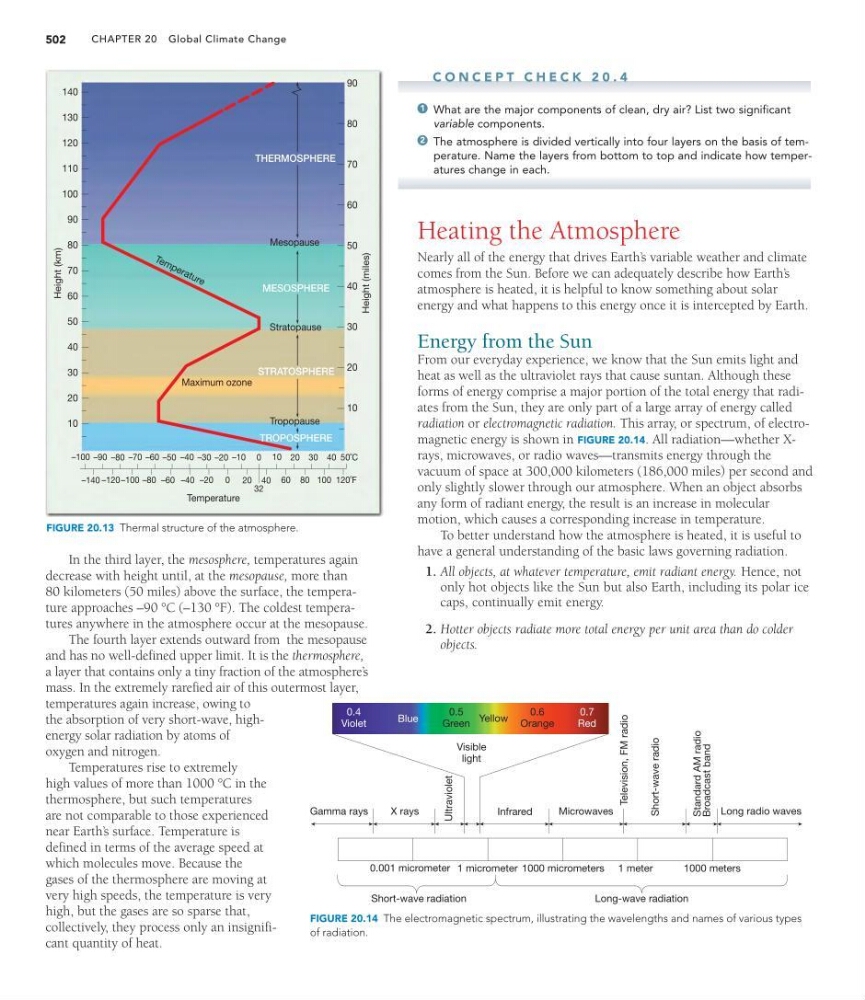
In the third layer, the mesosphere, temperatures again
decrease with height until, at the mesopause, more than
80 kilometers (50 miles) above the surface, the temperature approaches –90 °C (–130 °F). The coldest temperatures anywhere in the atmosphere occur at the mesopause.
The fourth layer extends outward from the mesopause
and has no well-defined upper limit. It is the thermosphere,
a layer that contains only a tiny fraction of the atmosphere’ s
mass. In the extremely rarefied air of this outermost layer,
temperatures again increase, owing to
the absorption of very short-wave, highenergy solar radiation by atoms of
oxygen and nitrogen.
Temperatures rise to extremely
high values of more than 1000 °C in the
thermosphere, but such temperatures
are not comparable to those experienced
near Earth’ s surface. Temperature is
defined in terms of the average speed at
which molecules move. Because the
gases of the thermosphere are moving at
very high speeds, the temperature is very
high, but the gases are so sparse that,
collectively, they process only an insignificant quantity of heat.
Long radio waves
Standard AM radio
Broadcast band
Short-wave radio
Television, FM radio
Microwaves
Infrared
Visible
light
Ultraviolet
X rays
Gamma rays
1000 meters
1 meter
1000 micrometers
1 micrometer
0.001 micrometer
Long-wave radiation
Short-wave radiation
0.7
Red
0.6
Orange
Yellow
0.5
Green
Blue
0.4
Violet
FIGURE 20.13 Thermal structure of the atmosphere.
FIGURE 20.14 The electromagnetic spectrum, illustrating the wavelengths and names of various types
of radiation.
C O N C E P T C H E C K 2 0 . 4
What are the major components of clean, dry air? List two significant
variable components.
The atmosphere is divided vertically into four layers on the basis of temperature. Name the layers from bottom to top and indicate how temperatures change in each.
Heating the Atmosphere
Nearly all of the energy that drives Earth’ s variable weather and climate
comes from the Sun. Before we can adequately describe how Earth’ s
atmosphere is heated, it is helpful to know something about solar
energy and what happens to this energy once it is intercepted by Earth.
Energy from the Sun
From our everyday experience, we know that the Sun emits light and
heat as well as the ultraviolet rays that cause suntan. Although these
forms of energy comprise a major portion of the total energy that radiates from the Sun, they are only part of a large array of energy called
radiation or electromagnetic radiation. This array, or spectrum, of electromagnetic energy is shown in FIGURE 20.14. All radiation—whether Xrays, microwaves, or radio waves—transmits energy through the
vacuum of space at 300,000 kilometers (186,000 miles) per second and
only slightly slower through our atmosphere. When an object absorbs
any form of radiant energy, the result is an increase in molecular
motion, which causes a corresponding increase in temperature.
To better understand how the atmosphere is heated, it is useful to
have a general understanding of the basic laws governing radiation.
1. All objects, at whatever temperature, emit radiant energy. Hence, not
only hot objects like the Sun but also Earth, including its polar ice
caps, continually emit energy.
2. Hotter objects radiate more total energy per unit area than do colder
objects.
2
1
100
90
80
70
60
50
40
30
20
10
60
50
40
30
20
10
T e m p e r a t u r e
THERMOSPHERE
Mesopause
MESOSPHERE
Stratopause
STRATOSPHERE
Tropopause
TROPOSPHERE
–100 –90 –80 –70 –60 –50 –40 –30 –20 –10 0 10 20
50˚C
–140 –120 –100 –80 –60 –40 –20 0 20
32
40 60
120˚F
Temperature
Height (miles)
80 100
30 40
110
120
130
140
70
80
90
Maximum ozone
CHAPTER 20 Global Climate Change
502
In the third layer, the mesosphere, temperatures again
decrease with height until, at the mesopause, more than
80 kilometers (50 miles) above the surface, the temperature approaches –90 °C (–130 °F). The coldest temperatures anywhere in the atmosphere occur at the mesopause.
The fourth layer extends outward from the mesopause
and has no well-defined upper limit. It is the thermosphere,
a layer that contains only a tiny fraction of the atmosphere’ s
mass. In the extremely rarefied air of this outermost layer,
temperatures again increase, owing to
the absorption of very short-wave, highenergy solar radiation by atoms of
oxygen and nitrogen.
Temperatures rise to extremely
high values of more than 1000 °C in the
thermosphere, but such temperatures
are not comparable to those experienced
near Earth’ s surface. Temperature is
defined in terms of the average speed at
which molecules move. Because the
gases of the thermosphere are moving at
very high speeds, the temperature is very
high, but the gases are so sparse that,
collectively, they process only an insignificant quantity of heat.
Long radio waves
Standard AM radio
Broadcast band
Short-wave radio
Television, FM radio
Microwaves
Infrared
Visible
light
Ultraviolet
X rays
Gamma rays
1000 meters
1 meter
1000 micrometers
1 micrometer
0.001 micrometer
Long-wave radiation
Short-wave radiation
0.7
Red
0.6
Orange
Yellow
0.5
Green
Blue
0.4
Violet
FIGURE 20.13 Thermal structure of the atmosphere.
FIGURE 20.14 The electromagnetic spectrum, illustrating the wavelengths and names of various types
of radiation.
C O N C E P T C H E C K 2 0 . 4
What are the major components of clean, dry air? List two significant
variable components.
The atmosphere is divided vertically into four layers on the basis of temperature. Name the layers from bottom to top and indicate how temperatures change in each.
Heating the Atmosphere
Nearly all of the energy that drives Earth’ s variable weather and climate
comes from the Sun. Before we can adequately describe how Earth’ s
atmosphere is heated, it is helpful to know something about solar
energy and what happens to this energy once it is intercepted by Earth.
Energy from the Sun
From our everyday experience, we know that the Sun emits light and
heat as well as the ultraviolet rays that cause suntan. Although these
forms of energy comprise a major portion of the total energy that radiates from the Sun, they are only part of a large array of energy called
radiation or electromagnetic radiation. This array, or spectrum, of electromagnetic energy is shown in FIGURE 20.14. All radiation—whether Xrays, microwaves, or radio waves—transmits energy through the
vacuum of space at 300,000 kilometers (186,000 miles) per second and
only slightly slower through our atmosphere. When an object absorbs
any form of radiant energy, the result is an increase in molecular
motion, which causes a corresponding increase in temperature.
To better understand how the atmosphere is heated, it is useful to
have a general understanding of the basic laws governing radiation.
1. All objects, at whatever temperature, emit radiant energy. Hence, not
only hot objects like the Sun but also Earth, including its polar ice
caps, continually emit energy.
2. Hotter objects radiate more total energy per unit area than do colder
objects.
2
1