

aerosols
CHAPTER 20 Global Climate Change
500
only minute amounts (0.0389 percent, or
389 parts per million), is nevertheless an
important constituent of air because it has
the ability to absorb heat energy radiated
by Earth and thus influences the heating
of the atmosphere.
Air includes many gases and particles
that vary significantly from time to time
and from place to place. Important examples include water vapor, ozone, and tiny
solid and liquid particles.
WATER VAPOR. The amount of water
vapor in the air varies considerably,
from practically none at all up to about
4 percent by volume. Why is such a
small fraction of the atmosphere so
significant? Certainly the fact that water
vapor is the source of all clouds and
precipitation would be enough to
explain its importance. However, water
vapor has other roles. Like carbon
dioxide, it has the ability to absorb heat
energy given off by Earth as well as
some solar energy. It is, therefore,
important when we examine the heating
of the atmosphere.
OZONE. Another important component
of the atmosphere is ozone. It is a form of
oxygen that combines three oxygen atoms
into each molecule (O 3 ). Ozone is not the
same as the oxygen we breathe, which has
two atoms per molecule (O 2 ). There is
very little ozone in the atmosphere, and its
distribution is not uniform. It is concentrated well above Earth’ s surface in a layer
called the stratosphere, at an altitude
of between 10 and 50 kilometers (6 and
31 miles). The presence of the ozone layer
in our atmosphere is crucial to those of us
Carbon dioxide
(0.0389% or 389 ppm)
Argon (0.934%)
All others
Oxygen
(20.946%)
Nitrogen
(78.084%)
Neon (Ne)
18.2
Helium (He)
5.24
Methane (CH 4 ) 1.5
Krypton (Kr)
1.14
Hydrogen (H 2 ) 0.5
Concentration
in parts per
million (ppm)
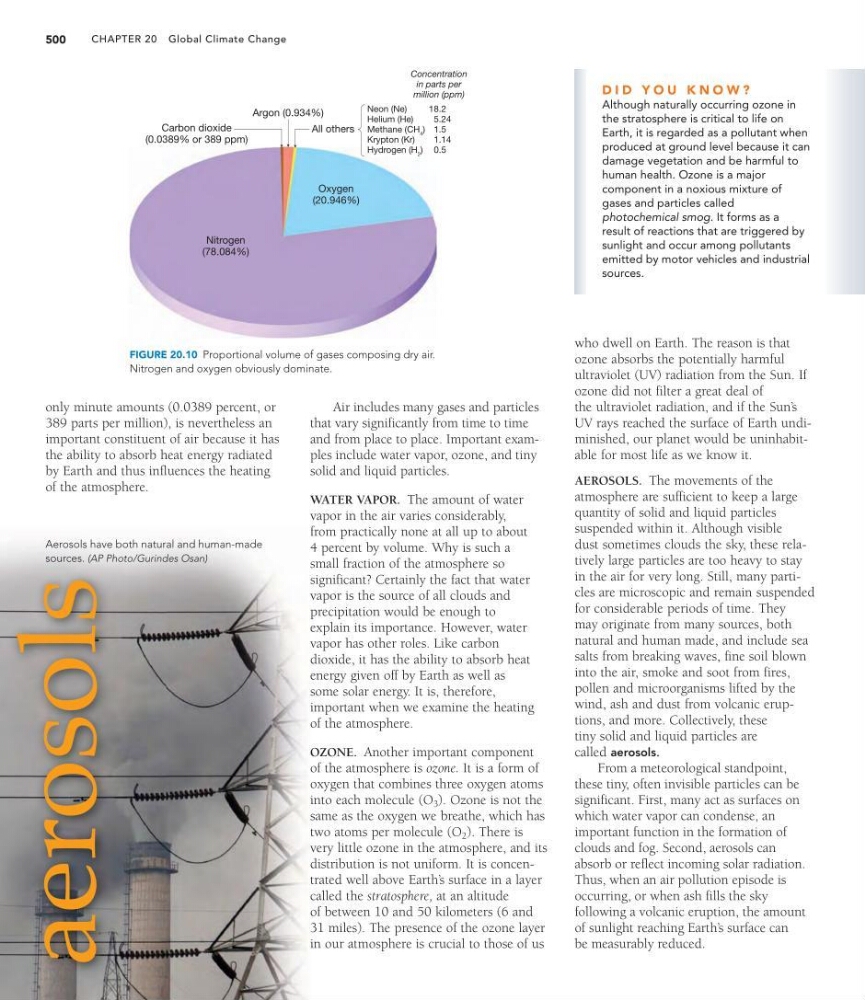
FIGURE 20.10 Proportional volume of gases composing dry air.
Nitrogen and oxygen obviously dominate.
D I D Y O U K N O W ?
Although naturally occurring ozone in
the stratosphere is critical to life on
Earth, it is regarded as a pollutant when
produced at ground level because it can
damage vegetation and be harmful to
human health. Ozone is a major
component in a noxious mixture of
gases and particles called
photochemical smog. It forms as a
result of reactions that are triggered by
sunlight and occur among pollutants
emitted by motor vehicles and industrial
sources.
Aerosols have both natural and human-made
sources. (AP Photo/Gurindes Osan)
who dwell on Earth. The reason is that
ozone absorbs the potentially harmful
ultraviolet (UV) radiation from the Sun. If
ozone did not filter a great deal of
the ultraviolet radiation, and if the Sun’ s
UV rays reached the surface of Earth undiminished, our planet would be uninhabitable for most life as we know it.
AEROSOLS. The movements of the
atmosphere are sufficient to keep a large
quantity of solid and liquid particles
suspended within it. Although visible
dust sometimes clouds the sky, these relatively large particles are too heavy to stay
in the air for very long. Still, many particles are microscopic and remain suspended
for considerable periods of time. They
may originate from many sources, both
natural and human made, and include sea
salts from breaking waves, fine soil blown
into the air, smoke and soot from fires,
pollen and microorganisms lifted by the
wind, ash and dust from volcanic eruptions, and more. Collectively, these
tiny solid and liquid particles are
called aerosols.
From a meteorological standpoint,
these tiny, often invisible particles can be
significant. First, many act as surfaces on
which water vapor can condense, an
important function in the formation of
clouds and fog. Second, aerosols can
absorb or reflect incoming solar radiation.
Thus, when an air pollution episode is
occurring, or when ash fills the sky
following a volcanic eruption, the amount
of sunlight reaching Earth’ s surface can
be measurably reduced.
CHAPTER 20 Global Climate Change
500
only minute amounts (0.0389 percent, or
389 parts per million), is nevertheless an
important constituent of air because it has
the ability to absorb heat energy radiated
by Earth and thus influences the heating
of the atmosphere.
Air includes many gases and particles
that vary significantly from time to time
and from place to place. Important examples include water vapor, ozone, and tiny
solid and liquid particles.
WATER VAPOR. The amount of water
vapor in the air varies considerably,
from practically none at all up to about
4 percent by volume. Why is such a
small fraction of the atmosphere so
significant? Certainly the fact that water
vapor is the source of all clouds and
precipitation would be enough to
explain its importance. However, water
vapor has other roles. Like carbon
dioxide, it has the ability to absorb heat
energy given off by Earth as well as
some solar energy. It is, therefore,
important when we examine the heating
of the atmosphere.
OZONE. Another important component
of the atmosphere is ozone. It is a form of
oxygen that combines three oxygen atoms
into each molecule (O 3 ). Ozone is not the
same as the oxygen we breathe, which has
two atoms per molecule (O 2 ). There is
very little ozone in the atmosphere, and its
distribution is not uniform. It is concentrated well above Earth’ s surface in a layer
called the stratosphere, at an altitude
of between 10 and 50 kilometers (6 and
31 miles). The presence of the ozone layer
in our atmosphere is crucial to those of us
Carbon dioxide
(0.0389% or 389 ppm)
Argon (0.934%)
All others
Oxygen
(20.946%)
Nitrogen
(78.084%)
Neon (Ne)
18.2
Helium (He)
5.24
Methane (CH 4 ) 1.5
Krypton (Kr)
1.14
Hydrogen (H 2 ) 0.5
Concentration
in parts per
million (ppm)
FIGURE 20.10 Proportional volume of gases composing dry air.
Nitrogen and oxygen obviously dominate.
D I D Y O U K N O W ?
Although naturally occurring ozone in
the stratosphere is critical to life on
Earth, it is regarded as a pollutant when
produced at ground level because it can
damage vegetation and be harmful to
human health. Ozone is a major
component in a noxious mixture of
gases and particles called
photochemical smog. It forms as a
result of reactions that are triggered by
sunlight and occur among pollutants
emitted by motor vehicles and industrial
sources.
Aerosols have both natural and human-made
sources. (AP Photo/Gurindes Osan)
who dwell on Earth. The reason is that
ozone absorbs the potentially harmful
ultraviolet (UV) radiation from the Sun. If
ozone did not filter a great deal of
the ultraviolet radiation, and if the Sun’ s
UV rays reached the surface of Earth undiminished, our planet would be uninhabitable for most life as we know it.
AEROSOLS. The movements of the
atmosphere are sufficient to keep a large
quantity of solid and liquid particles
suspended within it. Although visible
dust sometimes clouds the sky, these relatively large particles are too heavy to stay
in the air for very long. Still, many particles are microscopic and remain suspended
for considerable periods of time. They
may originate from many sources, both
natural and human made, and include sea
salts from breaking waves, fine soil blown
into the air, smoke and soot from fires,
pollen and microorganisms lifted by the
wind, ash and dust from volcanic eruptions, and more. Collectively, these
tiny solid and liquid particles are
called aerosols.
From a meteorological standpoint,
these tiny, often invisible particles can be
significant. First, many act as surfaces on
which water vapor can condense, an
important function in the formation of
clouds and fog. Second, aerosols can
absorb or reflect incoming solar radiation.
Thus, when an air pollution episode is
occurring, or when ash fills the sky
following a volcanic eruption, the amount
of sunlight reaching Earth’ s surface can
be measurably reduced.