

499
Some Atmospheric Basics
records to coral records for the same
period. Oxygen-isotope analysis of coral
growth rings can also serve as a proxy
measurement for precipitation, particularly
in areas where large variations in annual
rainfall occur.
Think of coral as a paleothermometer
that enables us to answer important
questions about climate variability in the
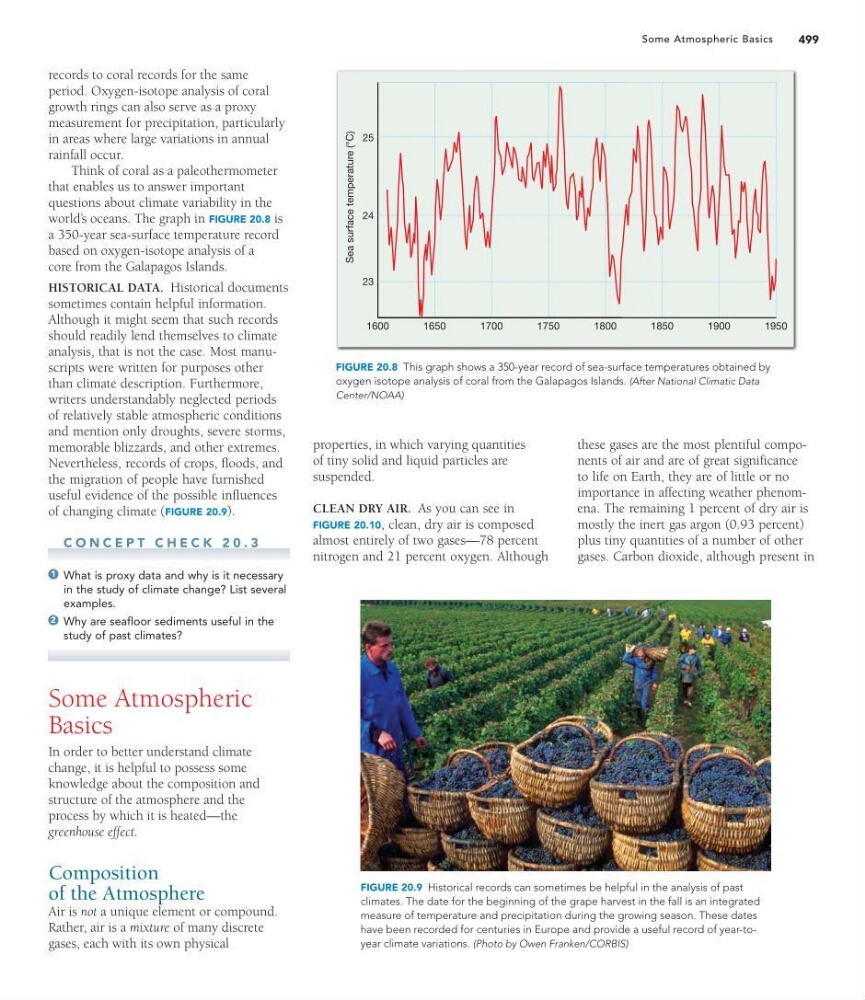
world’ s oceans. The graph in FIGURE 20.8 is
a 350-year sea-surface temperature record
based on oxygen-isotope analysis of a
core from the Galapagos Islands.
HISTORICAL DATA. Historical documents
sometimes contain helpful information.
Although it might seem that such records
should readily lend themselves to climate
analysis, that is not the case. Most manuscripts were written for purposes other
than climate description. Furthermore,
writers understandably neglected periods
of relatively stable atmospheric conditions
and mention only droughts, severe storms,
memorable blizzards, and other extremes.
Nevertheless, records of crops, floods, and
the migration of people have furnished
useful evidence of the possible influences
of changing climate (FIGURE 20.9).
C O N C E P T C H E C K 2 0 . 3
What is proxy data and why is it necessary
in the study of climate change? List several
examples.
Why are seafloor sediments useful in the
study of past climates?
Some Atmospheric
Basics
In order to better understand climate
change, it is helpful to possess some
knowledge about the composition and
structure of the atmosphere and the
process by which it is heated—the
greenhouse effect.
Composition
of the Atmosphere
Air is not a unique element or compound.
Rather, air is a mixture of many discrete
gases, each with its own physical
2
1
properties, in which varying quantities
of tiny solid and liquid particles are
suspended.
CLEAN DRY AIR. As you can see in
FIGURE 20.10, clean, dry air is composed
almost entirely of two gases—78 percent
nitrogen and 21 percent oxygen. Although
these gases are the most plentiful components of air and are of great significance
to life on Earth, they are of little or no
importance in affecting weather phenomena. The remaining 1 percent of dry air is
mostly the inert gas argon (0.93 percent)
plus tiny quantities of a number of other
gases. Carbon dioxide, although present in
Sea surface temperature (°C)
25
1600
1650
1700
1750
1800
1850
1900
1950
24
23
FIGURE 20.8 This graph shows a 350-year record of sea-surface temperatures obtained by
oxygen isotope analysis of coral from the Galapagos Islands. (After National Climatic Data
Center/NOAA)
FIGURE 20.9 Historical records can sometimes be helpful in the analysis of past
climates. The date for the beginning of the grape harvest in the fall is an integrated
measure of temperature and precipitation during the growing season. These dates
have been recorded for centuries in Europe and provide a useful record of year-toyear climate variations. (Photo by Owen Franken/CORBIS)
Some Atmospheric Basics
records to coral records for the same
period. Oxygen-isotope analysis of coral
growth rings can also serve as a proxy
measurement for precipitation, particularly
in areas where large variations in annual
rainfall occur.
Think of coral as a paleothermometer
that enables us to answer important
questions about climate variability in the
world’ s oceans. The graph in FIGURE 20.8 is
a 350-year sea-surface temperature record
based on oxygen-isotope analysis of a
core from the Galapagos Islands.
HISTORICAL DATA. Historical documents
sometimes contain helpful information.
Although it might seem that such records
should readily lend themselves to climate
analysis, that is not the case. Most manuscripts were written for purposes other
than climate description. Furthermore,
writers understandably neglected periods
of relatively stable atmospheric conditions
and mention only droughts, severe storms,
memorable blizzards, and other extremes.
Nevertheless, records of crops, floods, and
the migration of people have furnished
useful evidence of the possible influences
of changing climate (FIGURE 20.9).
C O N C E P T C H E C K 2 0 . 3
What is proxy data and why is it necessary
in the study of climate change? List several
examples.
Why are seafloor sediments useful in the
study of past climates?
Some Atmospheric
Basics
In order to better understand climate
change, it is helpful to possess some
knowledge about the composition and
structure of the atmosphere and the
process by which it is heated—the
greenhouse effect.
Composition
of the Atmosphere
Air is not a unique element or compound.
Rather, air is a mixture of many discrete
gases, each with its own physical
2
1
properties, in which varying quantities
of tiny solid and liquid particles are
suspended.
CLEAN DRY AIR. As you can see in
FIGURE 20.10, clean, dry air is composed
almost entirely of two gases—78 percent
nitrogen and 21 percent oxygen. Although
these gases are the most plentiful components of air and are of great significance
to life on Earth, they are of little or no
importance in affecting weather phenomena. The remaining 1 percent of dry air is
mostly the inert gas argon (0.93 percent)
plus tiny quantities of a number of other
gases. Carbon dioxide, although present in
Sea surface temperature (°C)
25
1600
1650
1700
1750
1800
1850
1900
1950
24
23
FIGURE 20.8 This graph shows a 350-year record of sea-surface temperatures obtained by
oxygen isotope analysis of coral from the Galapagos Islands. (After National Climatic Data
Center/NOAA)
FIGURE 20.9 Historical records can sometimes be helpful in the analysis of past
climates. The date for the beginning of the grape harvest in the fall is an integrated
measure of temperature and precipitation during the growing season. These dates
have been recorded for centuries in Europe and provide a useful record of year-toyear climate variations. (Photo by Owen Franken/CORBIS)