

497
How Is Climate Change Detected?
Thus, in seeking to understand climate
change as well as other environmental
transformations, scientists are tapping the
huge reservoir of data in seafloor sediments. The sediment cores gathered by
drilling ships and other research vessels
have provided invaluable data that have
significantly expanded our knowledge
and understanding of past climates
(FIGURE 20.5).
One notable example of the importance
of seafloor sediments to our understanding
of climate change relates to unraveling the
fluctuating atmospheric conditions of the
Ice Age. The records of temperature
changes contained in cores of sediment
from the ocean floor have proven critical to
our present understanding of this recent
span of Earth history.*
Oxygen Isotope Analysis
Oxygen isotope analysis is based on precise
measurement of the ratio between two
isotopes of oxygen:
16 O, which is the most
common, and the heavier
18 O. A molecule
of H 2 O can form from either
16 O or
18 O.
The lighter isotope,
16 O, evaporates more
readily from the oceans. Because of this,
precipitation (and hence the glacial ice that
it may form) is enriched in
16 O. This leaves
a greater concentration of the heavier isotope,
18 O, in the ocean water. Thus, during
periods when glaciers are extensive, more
of the lighter
16 O is tied up in ice, so the
concentration of
18 O in seawater increases.
Conversely, during warmer interglacial
periods when the amount of glacial ice
decreases dramatically, more
16 O is
returned to the sea, so the proportion of
18 O relative to
16
O in ocean water also
drops. Now, if we had some ancient recording of the changes of the
18 O/
16
O ratio, we
could determine when there were glacial
periods and, therefore, when the climate
grew cooler.
Fortunately, we do have such a recording. As certain microorganisms secrete their
shells of calcium carbonate (CaCO 3 ), the
prevailing
18 O/
16 O ratio is reflected in the
composition of these hard parts. When the
organisms die, their hard parts settle to the
ocean floor, becoming part of the sediment
layers there. Consequently, periods of glacial activity can be determined from variations in the oxygen–isotope ratio found in
shells of certain microorganisms buried in
deep-sea sediments.
The
18 O/
16 O ratio also varies with
temperature. More
18 O is evaporated
from the oceans when temperatures are
high, and less is evaporated when
temperatures are low. Therefore, the
heavy isotope is more abundant in the
precipitation of warm eras and less
abundant during colder periods. Using
this principle, scientists studying the layers
of ice and snow in glaciers have been able
to produce a record of past temperature
changes.
Climate Change Recorded
in Glacial Ice
Ice cores are an indispensable source of
data for reconstructing past climates (see
Figure 11.35, p. 283). Research based on
vertical cores taken from the Greenland
and Antarctic ice sheets has changed our
basic understanding of how the climate
system works.
FIGURE 20.4 Image of the shell of a foraminifera
using a scanning electron microscope. These tiny,
single-celled organisms are sensitive to even
small fluctuations in temperature. Seafloor
sediments containing fossils such as this are
useful recorders of climate change. (Photo by
Andrew Syred/Photo Researchers, Inc.)
*For more information on this topic, see “Causes
of Glaciation” in Chapter 11, pages 281–283.
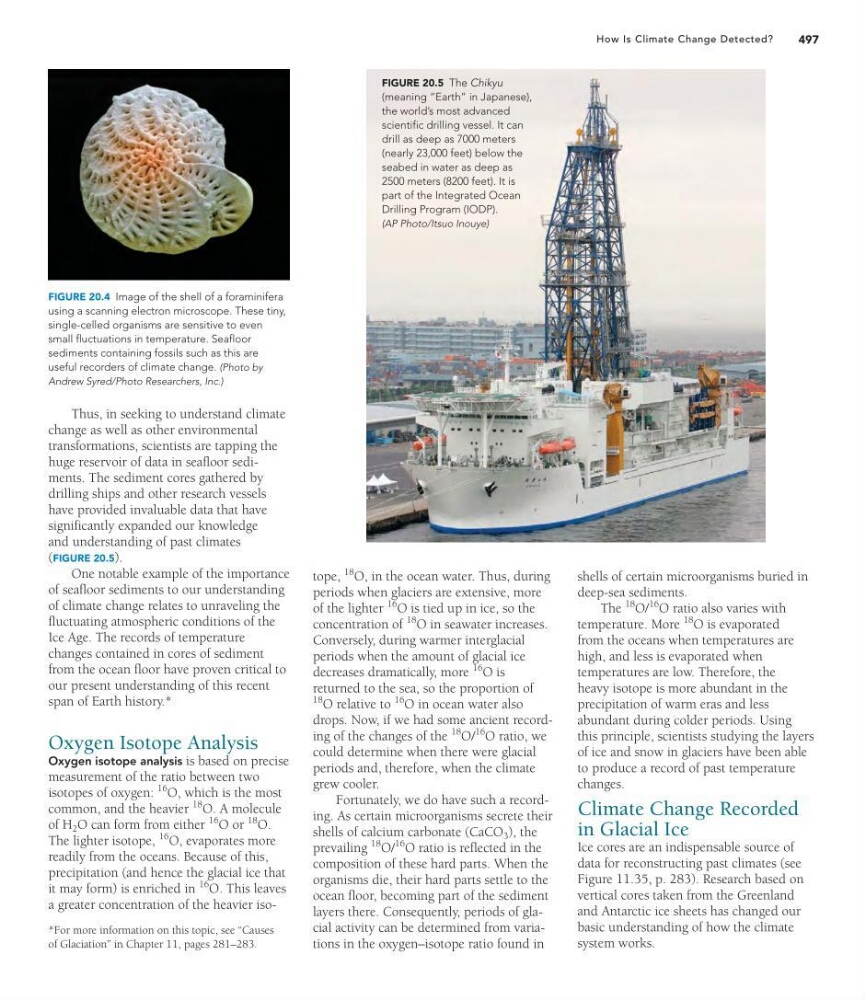
FIGURE 20.5 The Chikyu
(meaning “Earth” in Japanese),
the world’s most advanced
scientific drilling vessel. It can
drill as deep as 7000 meters
(nearly 23,000 feet) below the
seabed in water as deep as
2500 meters (8200 feet). It is
part of the Integrated Ocean
Drilling Program (IODP).
(AP Photo/Itsuo Inouye)
How Is Climate Change Detected?
Thus, in seeking to understand climate
change as well as other environmental
transformations, scientists are tapping the
huge reservoir of data in seafloor sediments. The sediment cores gathered by
drilling ships and other research vessels
have provided invaluable data that have
significantly expanded our knowledge
and understanding of past climates
(FIGURE 20.5).
One notable example of the importance
of seafloor sediments to our understanding
of climate change relates to unraveling the
fluctuating atmospheric conditions of the
Ice Age. The records of temperature
changes contained in cores of sediment
from the ocean floor have proven critical to
our present understanding of this recent
span of Earth history.*
Oxygen Isotope Analysis
Oxygen isotope analysis is based on precise
measurement of the ratio between two
isotopes of oxygen:
16 O, which is the most
common, and the heavier
18 O. A molecule
of H 2 O can form from either
16 O or
18 O.
The lighter isotope,
16 O, evaporates more
readily from the oceans. Because of this,
precipitation (and hence the glacial ice that
it may form) is enriched in
16 O. This leaves
a greater concentration of the heavier isotope,
18 O, in the ocean water. Thus, during
periods when glaciers are extensive, more
of the lighter
16 O is tied up in ice, so the
concentration of
18 O in seawater increases.
Conversely, during warmer interglacial
periods when the amount of glacial ice
decreases dramatically, more
16 O is
returned to the sea, so the proportion of
18 O relative to
16
O in ocean water also
drops. Now, if we had some ancient recording of the changes of the
18 O/
16
O ratio, we
could determine when there were glacial
periods and, therefore, when the climate
grew cooler.
Fortunately, we do have such a recording. As certain microorganisms secrete their
shells of calcium carbonate (CaCO 3 ), the
prevailing
18 O/
16 O ratio is reflected in the
composition of these hard parts. When the
organisms die, their hard parts settle to the
ocean floor, becoming part of the sediment
layers there. Consequently, periods of glacial activity can be determined from variations in the oxygen–isotope ratio found in
shells of certain microorganisms buried in
deep-sea sediments.
The
18 O/
16 O ratio also varies with
temperature. More
18 O is evaporated
from the oceans when temperatures are
high, and less is evaporated when
temperatures are low. Therefore, the
heavy isotope is more abundant in the
precipitation of warm eras and less
abundant during colder periods. Using
this principle, scientists studying the layers
of ice and snow in glaciers have been able
to produce a record of past temperature
changes.
Climate Change Recorded
in Glacial Ice
Ice cores are an indispensable source of
data for reconstructing past climates (see
Figure 11.35, p. 283). Research based on
vertical cores taken from the Greenland
and Antarctic ice sheets has changed our
basic understanding of how the climate
system works.
FIGURE 20.4 Image of the shell of a foraminifera
using a scanning electron microscope. These tiny,
single-celled organisms are sensitive to even
small fluctuations in temperature. Seafloor
sediments containing fossils such as this are
useful recorders of climate change. (Photo by
Andrew Syred/Photo Researchers, Inc.)
*For more information on this topic, see “Causes
of Glaciation” in Chapter 11, pages 281–283.
FIGURE 20.5 The Chikyu
(meaning “Earth” in Japanese),
the world’s most advanced
scientific drilling vessel. It can
drill as deep as 7000 meters
(nearly 23,000 feet) below the
seabed in water as deep as
2500 meters (8200 feet). It is
part of the Integrated Ocean
Drilling Program (IODP).
(AP Photo/Itsuo Inouye)