

CHAPTER 20 Global Climate Change
496
How Is Climate
Change Detected?
High-technology and precision instrumentation are now available to study the
composition and dynamics of the atmosphere. Such tools are recent inventions,
however, and have been providing data
for only a short time span. To understand
fully the behavior of the atmosphere
and to anticipate future climate change,
we must somehow discover how
climate has changed over broad expanses
of time.
Instrumental records go back only a
couple of centuries at best, and the further
back we go, the less complete and more
unreliable the data become. To overcome
this lack of direct measurements, scientists
must decipher and reconstruct past climates by using indirect evidence. Such
proxy data come from natural recorders of
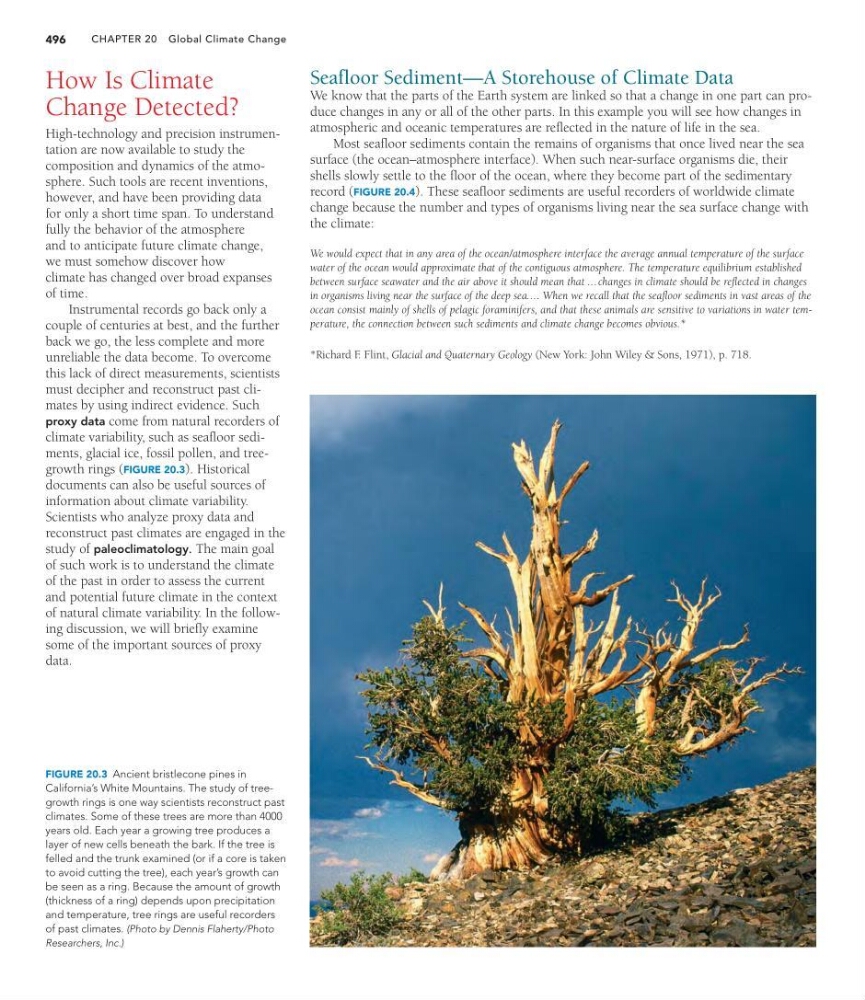
climate variability, such as seafloor sediments, glacial ice, fossil pollen, and treegrowth rings (FIGURE 20.3). Historical
documents can also be useful sources of
information about climate variability.
Scientists who analyze proxy data and
reconstruct past climates are engaged in the
study of paleoclimatology. The main goal
of such work is to understand the climate
of the past in order to assess the current
and potential future climate in the context
of natural climate variability. In the following discussion, we will briefly examine
some of the important sources of proxy
data.
Seafloor Sediment—A Storehouse of Climate Data
We know that the parts of the Earth system are linked so that a change in one part can produce changes in any or all of the other parts. In this example you will see how changes in
atmospheric and oceanic temperatures are reflected in the nature of life in the sea.
Most seafloor sediments contain the remains of organisms that once lived near the sea
surface (the ocean–atmosphere interface). When such near-surface organisms die, their
shells slowly settle to the floor of the ocean, where they become part of the sedimentary
record (FIGURE 20.4). These seafloor sediments are useful recorders of worldwide climate
change because the number and types of organisms living near the sea surface change with
the climate:
We would expect that in any area of the ocean/atmosphere interface the average annual temperature of the surface
water of the ocean would approximate that of the contiguous atmosphere. The temperature equilibrium established
between surface seawater and the air above it should mean that ...changes in climate should be reflected in changes
in organisms living near the surface of the deep sea.... When we recall that the seafloor sediments in vast areas of the
ocean consist mainly of shells of pelagic foraminifers, and that these animals are sensitive to variations in water temperature, the connection between such sediments and climate change becomes obvious.*
FIGURE 20.3 Ancient bristlecone pines in
California’s White Mountains. The study of treegrowth rings is one way scientists reconstruct past
climates. Some of these trees are more than 4000
years old. Each year a growing tree produces a
layer of new cells beneath the bark. If the tree is
felled and the trunk examined (or if a core is taken
to avoid cutting the tree), each year’s growth can
be seen as a ring. Because the amount of growth
(thickness of a ring) depends upon precipitation
and temperature, tree rings are useful recorders
of past climates. (Photo by Dennis Flaherty/Photo
Researchers, Inc.)
*Richard F. Flint, Glacial and Quaternary Geology (New York: John Wiley & Sons, 1971), p. 718.
496
How Is Climate
Change Detected?
High-technology and precision instrumentation are now available to study the
composition and dynamics of the atmosphere. Such tools are recent inventions,
however, and have been providing data
for only a short time span. To understand
fully the behavior of the atmosphere
and to anticipate future climate change,
we must somehow discover how
climate has changed over broad expanses
of time.
Instrumental records go back only a
couple of centuries at best, and the further
back we go, the less complete and more
unreliable the data become. To overcome
this lack of direct measurements, scientists
must decipher and reconstruct past climates by using indirect evidence. Such
proxy data come from natural recorders of
climate variability, such as seafloor sediments, glacial ice, fossil pollen, and treegrowth rings (FIGURE 20.3). Historical
documents can also be useful sources of
information about climate variability.
Scientists who analyze proxy data and
reconstruct past climates are engaged in the
study of paleoclimatology. The main goal
of such work is to understand the climate
of the past in order to assess the current
and potential future climate in the context
of natural climate variability. In the following discussion, we will briefly examine
some of the important sources of proxy
data.
Seafloor Sediment—A Storehouse of Climate Data
We know that the parts of the Earth system are linked so that a change in one part can produce changes in any or all of the other parts. In this example you will see how changes in
atmospheric and oceanic temperatures are reflected in the nature of life in the sea.
Most seafloor sediments contain the remains of organisms that once lived near the sea
surface (the ocean–atmosphere interface). When such near-surface organisms die, their
shells slowly settle to the floor of the ocean, where they become part of the sedimentary
record (FIGURE 20.4). These seafloor sediments are useful recorders of worldwide climate
change because the number and types of organisms living near the sea surface change with
the climate:
We would expect that in any area of the ocean/atmosphere interface the average annual temperature of the surface
water of the ocean would approximate that of the contiguous atmosphere. The temperature equilibrium established
between surface seawater and the air above it should mean that ...changes in climate should be reflected in changes
in organisms living near the surface of the deep sea.... When we recall that the seafloor sediments in vast areas of the
ocean consist mainly of shells of pelagic foraminifers, and that these animals are sensitive to variations in water temperature, the connection between such sediments and climate change becomes obvious.*
FIGURE 20.3 Ancient bristlecone pines in
California’s White Mountains. The study of treegrowth rings is one way scientists reconstruct past
climates. Some of these trees are more than 4000
years old. Each year a growing tree produces a
layer of new cells beneath the bark. If the tree is
felled and the trunk examined (or if a core is taken
to avoid cutting the tree), each year’s growth can
be seen as a ring. Because the amount of growth
(thickness of a ring) depends upon precipitation
and temperature, tree rings are useful recorders
of past climates. (Photo by Dennis Flaherty/Photo
Researchers, Inc.)
*Richard F. Flint, Glacial and Quaternary Geology (New York: John Wiley & Sons, 1971), p. 718.