

Changes
in amount
of outgoing
radiation
Changes
in
atmospheric
composition
Changes
in solar
imputs
Changes
in amount
and type
of cloud
cover
Changes in
atmospheric
circulation
Changes
in amount
of icecovered
land
Changes
in amount
of evaporationprecipitation
Biosphereatmosphere
interactions
Human
influences
(burning,
land use)
Human
influences
(cities)
Atmosphere-ice
interactions
Changes
in amount
of sea ice
Biosphereatmosphere
interactions
Changes
in ocean
circulation
Ocean
Oceanatmosphere
interaction
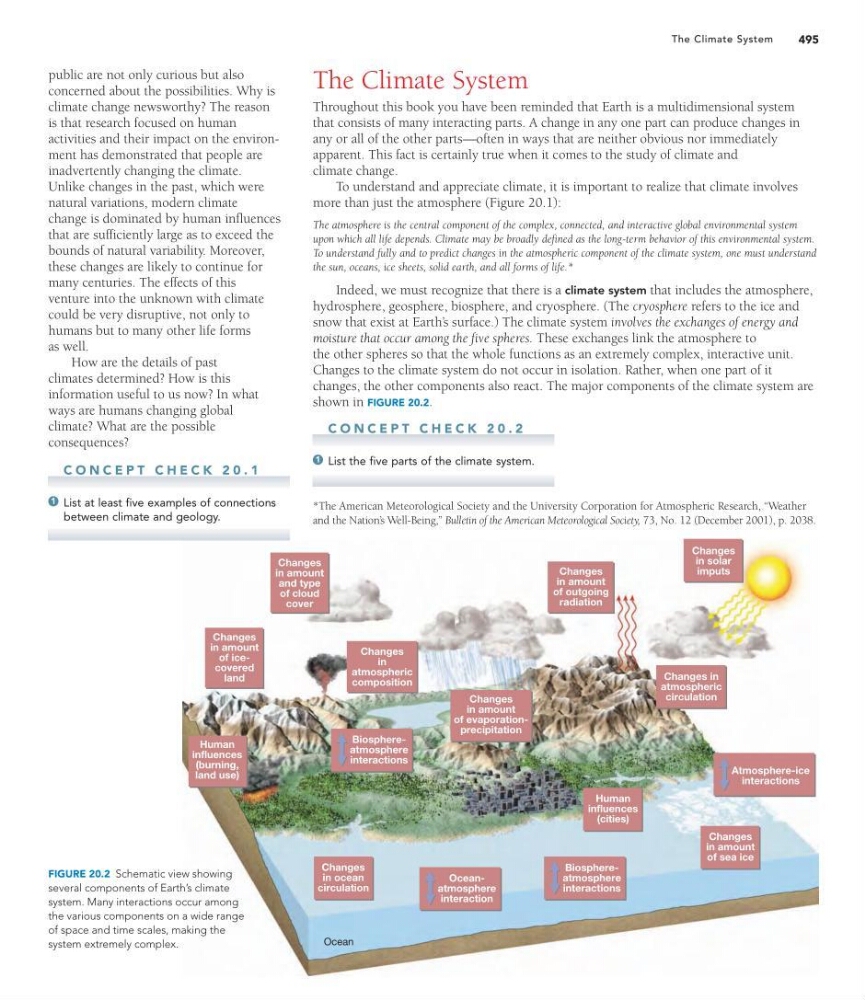
FIGURE 20.2 Schematic view showing
several components of Earth’s climate
system. Many interactions occur among
the various components on a wide range
of space and time scales, making the
system extremely complex.
495
The Climate System
*The American Meteorological Society and the University Corporation for Atmospheric Research, “Weather
and the Nation’ s Well-Being,” Bulletin of the American Meteorological Society, 73, No. 12 (December 2001), p. 2038.
public are not only curious but also
concerned about the possibilities. Why is
climate change newsworthy? The reason
is that research focused on human
activities and their impact on the environment has demonstrated that people are
inadvertently changing the climate.
Unlike changes in the past, which were
natural variations, modern climate
change is dominated by human influences
that are sufficiently large as to exceed the
bounds of natural variability. Moreover,
these changes are likely to continue for
many centuries. The effects of this
venture into the unknown with climate
could be very disruptive, not only to
humans but to many other life forms
as well.
How are the details of past
climates determined? How is this
information useful to us now? In what
ways are humans changing global
climate? What are the possible
consequences?
C O N C E P T C H E C K 2 0 . 1
List at least five examples of connections
between climate and geology.
1
The Climate System
Throughout this book you have been reminded that Earth is a multidimensional system
that consists of many interacting parts. A change in any one part can produce changes in
any or all of the other parts—often in ways that are neither obvious nor immediately
apparent. This fact is certainly true when it comes to the study of climate and
climate change.
To understand and appreciate climate, it is important to realize that climate involves
more than just the atmosphere (Figure 20.1):
The atmosphere is the central component of the complex, connected, and interactive global environmental system
upon which all life depends. Climate may be broadly defined as the long-term behavior of this environmental system.
To understand fully and to predict changes in the atmospheric component of the climate system, one must understand
the sun, oceans, ice sheets, solid earth, and all forms of life.*
Indeed, we must recognize that there is a climate system that includes the atmosphere,
hydrosphere, geosphere, biosphere, and cryosphere. (The cryosphere refers to the ice and
snow that exist at Earth’ s surface.) The climate system involves the exchanges of energy and
moisture that occur among the five spheres. These exchanges link the atmosphere to
the other spheres so that the whole functions as an extremely complex, interactive unit.
Changes to the climate system do not occur in isolation. Rather, when one part of it
changes, the other components also react. The major components of the climate system are
shown in FIGURE 20.2.
C O N C E P T C H E C K 2 0 . 2
List the five parts of the climate system.
1
in amount
of outgoing
radiation
Changes
in
atmospheric
composition
Changes
in solar
imputs
Changes
in amount
and type
of cloud
cover
Changes in
atmospheric
circulation
Changes
in amount
of icecovered
land
Changes
in amount
of evaporationprecipitation
Biosphereatmosphere
interactions
Human
influences
(burning,
land use)
Human
influences
(cities)
Atmosphere-ice
interactions
Changes
in amount
of sea ice
Biosphereatmosphere
interactions
Changes
in ocean
circulation
Ocean
Oceanatmosphere
interaction
FIGURE 20.2 Schematic view showing
several components of Earth’s climate
system. Many interactions occur among
the various components on a wide range
of space and time scales, making the
system extremely complex.
495
The Climate System
*The American Meteorological Society and the University Corporation for Atmospheric Research, “Weather
and the Nation’ s Well-Being,” Bulletin of the American Meteorological Society, 73, No. 12 (December 2001), p. 2038.
public are not only curious but also
concerned about the possibilities. Why is
climate change newsworthy? The reason
is that research focused on human
activities and their impact on the environment has demonstrated that people are
inadvertently changing the climate.
Unlike changes in the past, which were
natural variations, modern climate
change is dominated by human influences
that are sufficiently large as to exceed the
bounds of natural variability. Moreover,
these changes are likely to continue for
many centuries. The effects of this
venture into the unknown with climate
could be very disruptive, not only to
humans but to many other life forms
as well.
How are the details of past
climates determined? How is this
information useful to us now? In what
ways are humans changing global
climate? What are the possible
consequences?
C O N C E P T C H E C K 2 0 . 1
List at least five examples of connections
between climate and geology.
1
The Climate System
Throughout this book you have been reminded that Earth is a multidimensional system
that consists of many interacting parts. A change in any one part can produce changes in
any or all of the other parts—often in ways that are neither obvious nor immediately
apparent. This fact is certainly true when it comes to the study of climate and
climate change.
To understand and appreciate climate, it is important to realize that climate involves
more than just the atmosphere (Figure 20.1):
The atmosphere is the central component of the complex, connected, and interactive global environmental system
upon which all life depends. Climate may be broadly defined as the long-term behavior of this environmental system.
To understand fully and to predict changes in the atmospheric component of the climate system, one must understand
the sun, oceans, ice sheets, solid earth, and all forms of life.*
Indeed, we must recognize that there is a climate system that includes the atmosphere,
hydrosphere, geosphere, biosphere, and cryosphere. (The cryosphere refers to the ice and
snow that exist at Earth’ s surface.) The climate system involves the exchanges of energy and
moisture that occur among the five spheres. These exchanges link the atmosphere to
the other spheres so that the whole functions as an extremely complex, interactive unit.
Changes to the climate system do not occur in isolation. Rather, when one part of it
changes, the other components also react. The major components of the climate system are
shown in FIGURE 20.2.
C O N C E P T C H E C K 2 0 . 2
List the five parts of the climate system.
1