

CHAPTER 20 Global Climate Change
494
Climate and Geology Are Linked
Anyone who has the opportunity to travel around the world will find such an incredible
variety of climates that it is hard to believe they could all occur on the same planet. Climate
strongly influences plant and animal life, the soil, and many of Earth’ s surface processes
(FIGURE 20.1). Climate influences people as well.
Climate has a profound impact on many geologic processes. When climate changes,
these processes respond. A glance back at the rock cycle in Chapter 1 (p. 19) reminds us
about many of the connections. Of course rock weathering has an obvious climate connection, as do processes that operate in arid, tropical, and glacial landscapes. Events such as
debris flows and river flooding are often triggered by atmospheric happenings such as periods of extraordinary rainfall. Clearly the atmosphere is a basic link in the hydrologic cycle.
Other climate–geology connections involve the impact of internal processes on the atmosphere. For example, the particles and gases emitted by volcanoes can change the composition of the atmosphere, and mountain building can have a significant impact on regional
temperature, precipitation, and wind patterns.
Climate not only varies from place to place, but it is also naturally variable over time.
Over the great expanse of Earth history, and long before humans were roaming the planet,
there were many shifts—from warm to cold and from wet to dry, and back again. The geologic record is a storehouse of data that confirms this fact.
The study of sediments, sedimentary rocks, and fossils clearly demonstrates
that, through the ages, practically every place on our planet has experienced wide swings in
climate, such as from ice ages to conditions associated with subtropical coal swamps or
desert dunes. Chapter 19, “Earth’s Evolution through Geologic Time,” reinforces this fact. Time
scales for climate change vary from decades to millions of years.
What factors have been responsible
for climate variations during Earth history?
One of the topics treated in this
chapter involves natural causes of
climate change.
Today, global climate change is more
than just a topic of academic interest to
a group of scientists curious about Earth
history. Rather, the subject is making
headlines. Many members of the general
D I D Y O U K N O W ?
The term weather refers to the state of
the atmosphere at a given time and
place. Changes in the weather are
frequent and sometimes seemingly
erratic. Climate is a description of
aggregate weather conditions based on
observations over many decades.
Climate is often defined simply as
“average weather,” but this definition is
inadequate because variations and
extremes are also part of a climate
description.
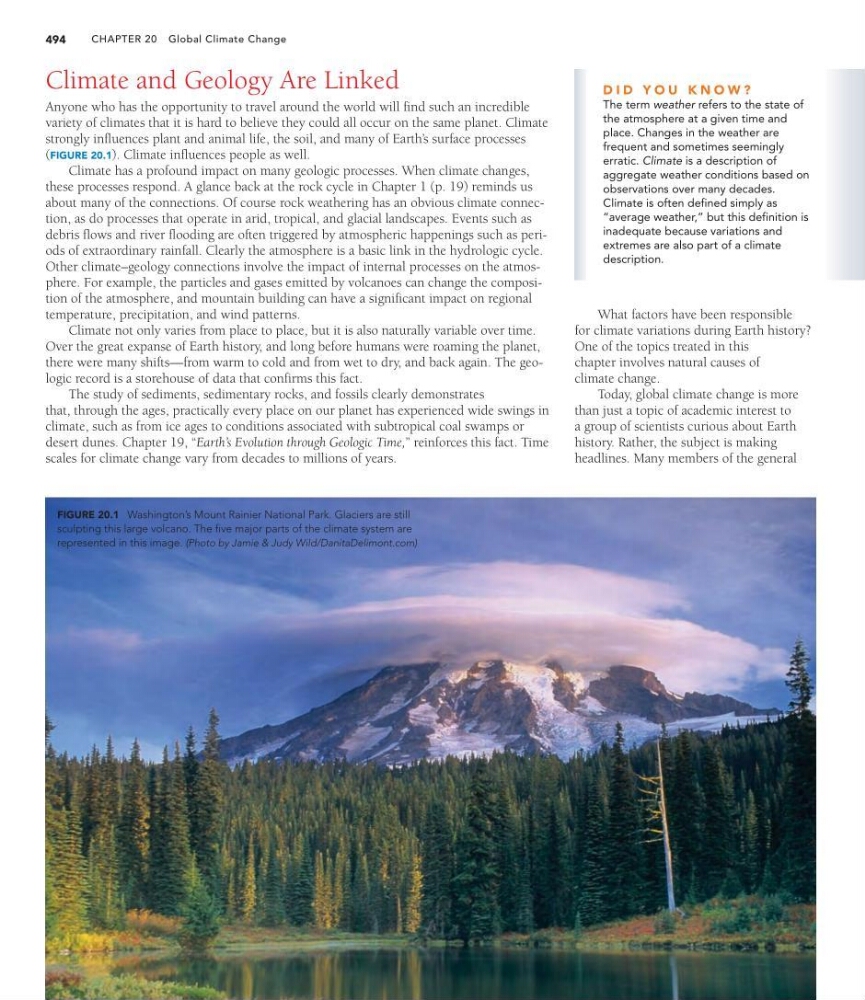
FIGURE 20.1 Washington’s Mount Rainier National Park. Glaciers are still
sculpting this large volcano. The five major parts of the climate system are
represented in this image. (Photo by Jamie & Judy Wild/DanitaDelimont.com)
494
Climate and Geology Are Linked
Anyone who has the opportunity to travel around the world will find such an incredible
variety of climates that it is hard to believe they could all occur on the same planet. Climate
strongly influences plant and animal life, the soil, and many of Earth’ s surface processes
(FIGURE 20.1). Climate influences people as well.
Climate has a profound impact on many geologic processes. When climate changes,
these processes respond. A glance back at the rock cycle in Chapter 1 (p. 19) reminds us
about many of the connections. Of course rock weathering has an obvious climate connection, as do processes that operate in arid, tropical, and glacial landscapes. Events such as
debris flows and river flooding are often triggered by atmospheric happenings such as periods of extraordinary rainfall. Clearly the atmosphere is a basic link in the hydrologic cycle.
Other climate–geology connections involve the impact of internal processes on the atmosphere. For example, the particles and gases emitted by volcanoes can change the composition of the atmosphere, and mountain building can have a significant impact on regional
temperature, precipitation, and wind patterns.
Climate not only varies from place to place, but it is also naturally variable over time.
Over the great expanse of Earth history, and long before humans were roaming the planet,
there were many shifts—from warm to cold and from wet to dry, and back again. The geologic record is a storehouse of data that confirms this fact.
The study of sediments, sedimentary rocks, and fossils clearly demonstrates
that, through the ages, practically every place on our planet has experienced wide swings in
climate, such as from ice ages to conditions associated with subtropical coal swamps or
desert dunes. Chapter 19, “Earth’s Evolution through Geologic Time,” reinforces this fact. Time
scales for climate change vary from decades to millions of years.
What factors have been responsible
for climate variations during Earth history?
One of the topics treated in this
chapter involves natural causes of
climate change.
Today, global climate change is more
than just a topic of academic interest to
a group of scientists curious about Earth
history. Rather, the subject is making
headlines. Many members of the general
D I D Y O U K N O W ?
The term weather refers to the state of
the atmosphere at a given time and
place. Changes in the weather are
frequent and sometimes seemingly
erratic. Climate is a description of
aggregate weather conditions based on
observations over many decades.
Climate is often defined simply as
“average weather,” but this definition is
inadequate because variations and
extremes are also part of a climate
description.
FIGURE 20.1 Washington’s Mount Rainier National Park. Glaciers are still
sculpting this large volcano. The five major parts of the climate system are
represented in this image. (Photo by Jamie & Judy Wild/DanitaDelimont.com)