

487
Cenozoic Era: Age of Mammals
A.
B.
This fostered the emergence of herbivorous
(plant-eating) mammals, which, in turn,
provided the evolutionary foundation for
large, predatory mammals.
During the Cenozoic, the ocean was
teeming with modern fish such as tuna,
swordfish, and barracuda. In addition,
some mammals, including seals, whales,
and walruses returned to the sea.
From Reptiles to Mammals
The earliest mammals coexisted with
dinosaurs for nearly 100 million years
but were small rodentlike creatures that
gathered food at night when dinosaurs
were less active. Then, about 65 million
years ago, fate intervened when a large
asteroid collided with Earth and dealt a
crashing blow to the reign of the dinosaurs.
This transition, during which one dominant group is replaced by another, is clearly
visible in the fossil record.
Mammals are distinct from reptiles in
that they give birth to live young that
suckle on milk and are warm-blooded.
This latter adaptation allowed mammals to
lead more active lives and to occupy more
diverse habitats than reptiles because they
could survive in cold regions. (Most
modern reptiles are dormant during cold
weather.) Other mammalian adaptations
included the development of insulating
body hair and more efficient organs such
as hearts and lungs.
With the demise of the large Mesozoic
reptiles, Cenozoic mammals diversified
rapidly. The many forms that exist today
evolved from small primitive mammals
that were characterized by short legs; flat,
five-toed feet; and small brains. Their
development and specialization took four
valuable lessons in understanding the role that catastrophic events play in shaping our
planet’ s physical landscape and life-forms.
C O N C E P T C H E C K 1 9 . 8
What major development allowed reptiles to move inland?
What event is thought to have ended the reign of the dinosaurs?
Cenozoic Era: Age of Mammals
During the Cenozoic, mammals replaced reptiles as the dominant land animals. At nearly
the same time, angiosperms (flowering plants with covered seeds) replaced gymnosperms
as the dominant plants. The Cenozoic is often called the “Age of Mammals” but can also be
considered the “Age of Flowering Plants” because, in the plant world, angiosperms enjoy a
status similar to that of mammals in the animal world.
The development of flowering plants strongly influenced the evolution of both birds
and mammals that feed on seeds and fruits. During the middle of the Cenozoic, another
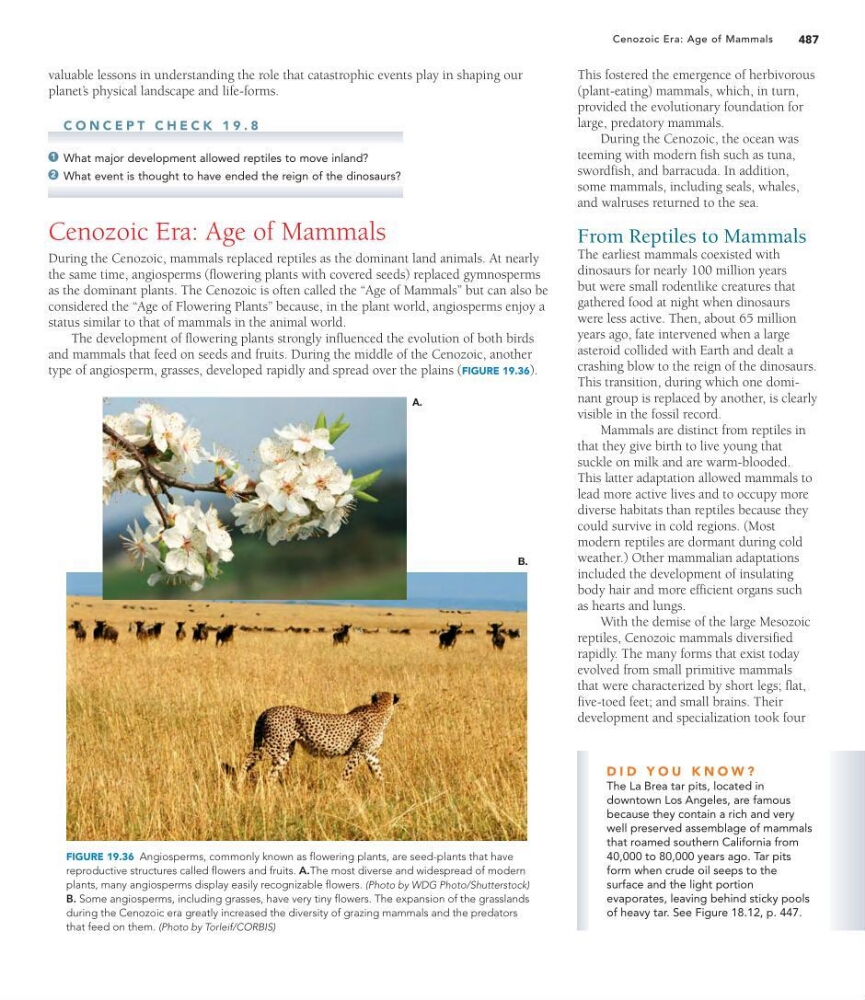
type of angiosperm, grasses, developed rapidly and spread over the plains (FIGURE 19.36).
2
1
D I D Y O U K N O W ?
The La Brea tar pits, located in
downtown Los Angeles, are famous
because they contain a rich and very
well preserved assemblage of mammals
that roamed southern California from
40,000 to 80,000 years ago. Tar pits
form when crude oil seeps to the
surface and the light portion
evaporates, leaving behind sticky pools
of heavy tar. See Figure 18.12, p. 447.
FIGURE 19.36 Angiosperms, commonly known as flowering plants, are seed-plants that have
reproductive structures called flowers and fruits. A.The most diverse and widespread of modern
plants, many angiosperms display easily recognizable flowers. (Photo by WDG Photo/Shutterstock)
B. Some angiosperms, including grasses, have very tiny flowers. The expansion of the grasslands
during the Cenozoic era greatly increased the diversity of grazing mammals and the predators
that feed on them. (Photo by Torleif/CORBIS)
Cenozoic Era: Age of Mammals
A.
B.
This fostered the emergence of herbivorous
(plant-eating) mammals, which, in turn,
provided the evolutionary foundation for
large, predatory mammals.
During the Cenozoic, the ocean was
teeming with modern fish such as tuna,
swordfish, and barracuda. In addition,
some mammals, including seals, whales,
and walruses returned to the sea.
From Reptiles to Mammals
The earliest mammals coexisted with
dinosaurs for nearly 100 million years
but were small rodentlike creatures that
gathered food at night when dinosaurs
were less active. Then, about 65 million
years ago, fate intervened when a large
asteroid collided with Earth and dealt a
crashing blow to the reign of the dinosaurs.
This transition, during which one dominant group is replaced by another, is clearly
visible in the fossil record.
Mammals are distinct from reptiles in
that they give birth to live young that
suckle on milk and are warm-blooded.
This latter adaptation allowed mammals to
lead more active lives and to occupy more
diverse habitats than reptiles because they
could survive in cold regions. (Most
modern reptiles are dormant during cold
weather.) Other mammalian adaptations
included the development of insulating
body hair and more efficient organs such
as hearts and lungs.
With the demise of the large Mesozoic
reptiles, Cenozoic mammals diversified
rapidly. The many forms that exist today
evolved from small primitive mammals
that were characterized by short legs; flat,
five-toed feet; and small brains. Their
development and specialization took four
valuable lessons in understanding the role that catastrophic events play in shaping our
planet’ s physical landscape and life-forms.
C O N C E P T C H E C K 1 9 . 8
What major development allowed reptiles to move inland?
What event is thought to have ended the reign of the dinosaurs?
Cenozoic Era: Age of Mammals
During the Cenozoic, mammals replaced reptiles as the dominant land animals. At nearly
the same time, angiosperms (flowering plants with covered seeds) replaced gymnosperms
as the dominant plants. The Cenozoic is often called the “Age of Mammals” but can also be
considered the “Age of Flowering Plants” because, in the plant world, angiosperms enjoy a
status similar to that of mammals in the animal world.
The development of flowering plants strongly influenced the evolution of both birds
and mammals that feed on seeds and fruits. During the middle of the Cenozoic, another
type of angiosperm, grasses, developed rapidly and spread over the plains (FIGURE 19.36).
2
1
D I D Y O U K N O W ?
The La Brea tar pits, located in
downtown Los Angeles, are famous
because they contain a rich and very
well preserved assemblage of mammals
that roamed southern California from
40,000 to 80,000 years ago. Tar pits
form when crude oil seeps to the
surface and the light portion
evaporates, leaving behind sticky pools
of heavy tar. See Figure 18.12, p. 447.
FIGURE 19.36 Angiosperms, commonly known as flowering plants, are seed-plants that have
reproductive structures called flowers and fruits. A.The most diverse and widespread of modern
plants, many angiosperms display easily recognizable flowers. (Photo by WDG Photo/Shutterstock)
B. Some angiosperms, including grasses, have very tiny flowers. The expansion of the grasslands
during the Cenozoic era greatly increased the diversity of grazing mammals and the predators
that feed on them. (Photo by Torleif/CORBIS)