

The extinction of the dinosaurs
opened habitats for the small mammals that
survived. These new habitats, along with
evolutionary forces, led to the development
of the large mammals that occupy our
modern world.
What evidence points to such a
catastrophic collision 65 million years ago?
First, a thin layer of sediment nearly 1
centimeter thick has been discovered at
the KT boundary worldwide. This sediment
contains a high level of the element iridium,
rare in Earth’ s crust but found in high
proportions in stony meteorites. Could
this layer be the scattered remains of the
meteorite responsible for the environmental
changes that led to the demise of many
reptile groups?
Despite substantial evidence and
significant scientific support, some
researchers disagree with the impact
hypothesis. They suggest instead that
huge volcanic eruptions may have led to a
breakdown in the food chain. To support
A.
B.
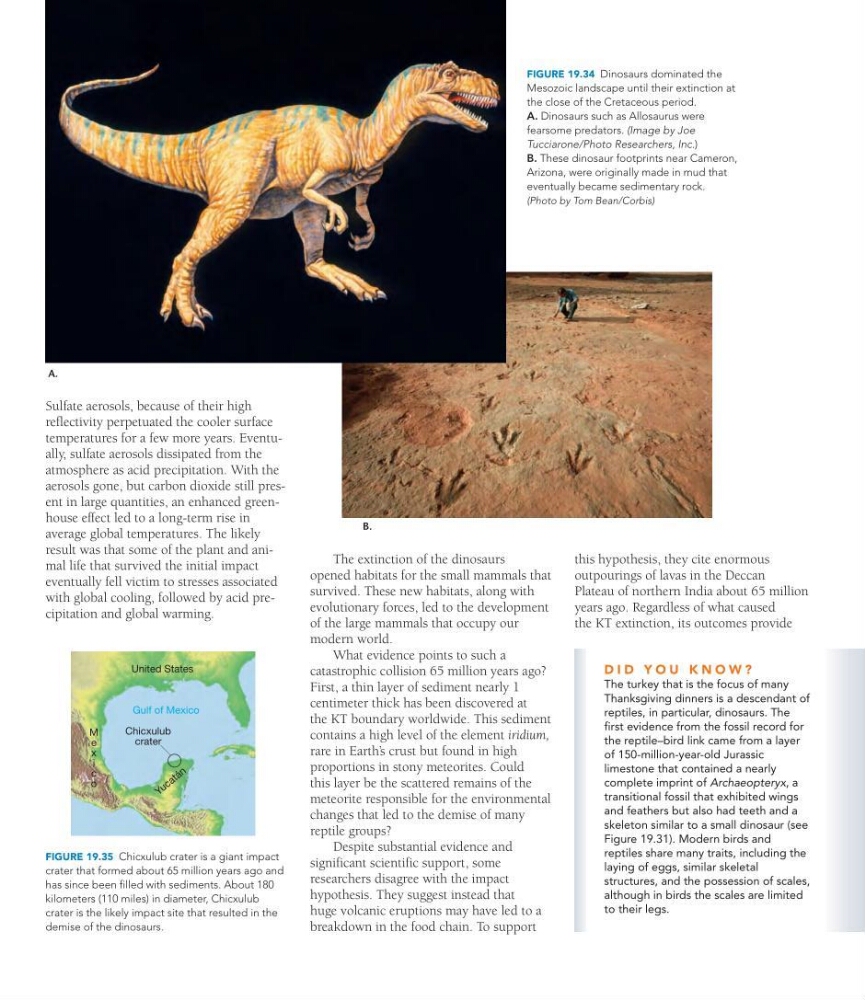
FIGURE 19.34 Dinosaurs dominated the
Mesozoic landscape until their extinction at
the close of the Cretaceous period.
A. Dinosaurs such as Allosaurus were
fearsome predators. (Image by Joe
Tucciarone/Photo Researchers, Inc.)
B. These dinosaur footprints near Cameron,
Arizona, were originally made in mud that
eventually became sedimentary rock.
(Photo by Tom Bean/Corbis)
United States
M
e
x
i
c
o
Chicxulub
crater
Y u c a t á n
Gulf of Mexico
FIGURE 19.35 Chicxulub crater is a giant impact
crater that formed about 65 million years ago and
has since been filled with sediments. About 180
kilometers (110 miles) in diameter, Chicxulub
crater is the likely impact site that resulted in the
demise of the dinosaurs.
D I D Y O U K N O W ?
The turkey that is the focus of many
Thanksgiving dinners is a descendant of
reptiles, in particular, dinosaurs. The
first evidence from the fossil record for
the reptile–bird link came from a layer
of 150-million-year-old Jurassic
limestone that contained a nearly
complete imprint of Archaeopteryx, a
transitional fossil that exhibited wings
and feathers but also had teeth and a
skeleton similar to a small dinosaur (see
Figure 19.31). Modern birds and
reptiles share many traits, including the
laying of eggs, similar skeletal
structures, and the possession of scales,
although in birds the scales are limited
to their legs.
Sulfate aerosols, because of their high
reflectivity perpetuated the cooler surface
temperatures for a few more years. Eventually, sulfate aerosols dissipated from the
atmosphere as acid precipitation. With the
aerosols gone, but carbon dioxide still present in large quantities, an enhanced greenhouse effect led to a long-term rise in
average global temperatures. The likely
result was that some of the plant and animal life that survived the initial impact
eventually fell victim to stresses associated
with global cooling, followed by acid precipitation and global warming.
this hypothesis, they cite enormous
outpourings of lavas in the Deccan
Plateau of northern India about 65 million
years ago. Regardless of what caused
the KT extinction, its outcomes provide
opened habitats for the small mammals that
survived. These new habitats, along with
evolutionary forces, led to the development
of the large mammals that occupy our
modern world.
What evidence points to such a
catastrophic collision 65 million years ago?
First, a thin layer of sediment nearly 1
centimeter thick has been discovered at
the KT boundary worldwide. This sediment
contains a high level of the element iridium,
rare in Earth’ s crust but found in high
proportions in stony meteorites. Could
this layer be the scattered remains of the
meteorite responsible for the environmental
changes that led to the demise of many
reptile groups?
Despite substantial evidence and
significant scientific support, some
researchers disagree with the impact
hypothesis. They suggest instead that
huge volcanic eruptions may have led to a
breakdown in the food chain. To support
A.
B.
FIGURE 19.34 Dinosaurs dominated the
Mesozoic landscape until their extinction at
the close of the Cretaceous period.
A. Dinosaurs such as Allosaurus were
fearsome predators. (Image by Joe
Tucciarone/Photo Researchers, Inc.)
B. These dinosaur footprints near Cameron,
Arizona, were originally made in mud that
eventually became sedimentary rock.
(Photo by Tom Bean/Corbis)
United States
M
e
x
i
c
o
Chicxulub
crater
Y u c a t á n
Gulf of Mexico
FIGURE 19.35 Chicxulub crater is a giant impact
crater that formed about 65 million years ago and
has since been filled with sediments. About 180
kilometers (110 miles) in diameter, Chicxulub
crater is the likely impact site that resulted in the
demise of the dinosaurs.
D I D Y O U K N O W ?
The turkey that is the focus of many
Thanksgiving dinners is a descendant of
reptiles, in particular, dinosaurs. The
first evidence from the fossil record for
the reptile–bird link came from a layer
of 150-million-year-old Jurassic
limestone that contained a nearly
complete imprint of Archaeopteryx, a
transitional fossil that exhibited wings
and feathers but also had teeth and a
skeleton similar to a small dinosaur (see
Figure 19.31). Modern birds and
reptiles share many traits, including the
laying of eggs, similar skeletal
structures, and the possession of scales,
although in birds the scales are limited
to their legs.
Sulfate aerosols, because of their high
reflectivity perpetuated the cooler surface
temperatures for a few more years. Eventually, sulfate aerosols dissipated from the
atmosphere as acid precipitation. With the
aerosols gone, but carbon dioxide still present in large quantities, an enhanced greenhouse effect led to a long-term rise in
average global temperatures. The likely
result was that some of the plant and animal life that survived the initial impact
eventually fell victim to stresses associated
with global cooling, followed by acid precipitation and global warming.
this hypothesis, they cite enormous
outpourings of lavas in the Deccan
Plateau of northern India about 65 million
years ago. Regardless of what caused
the KT extinction, its outcomes provide