

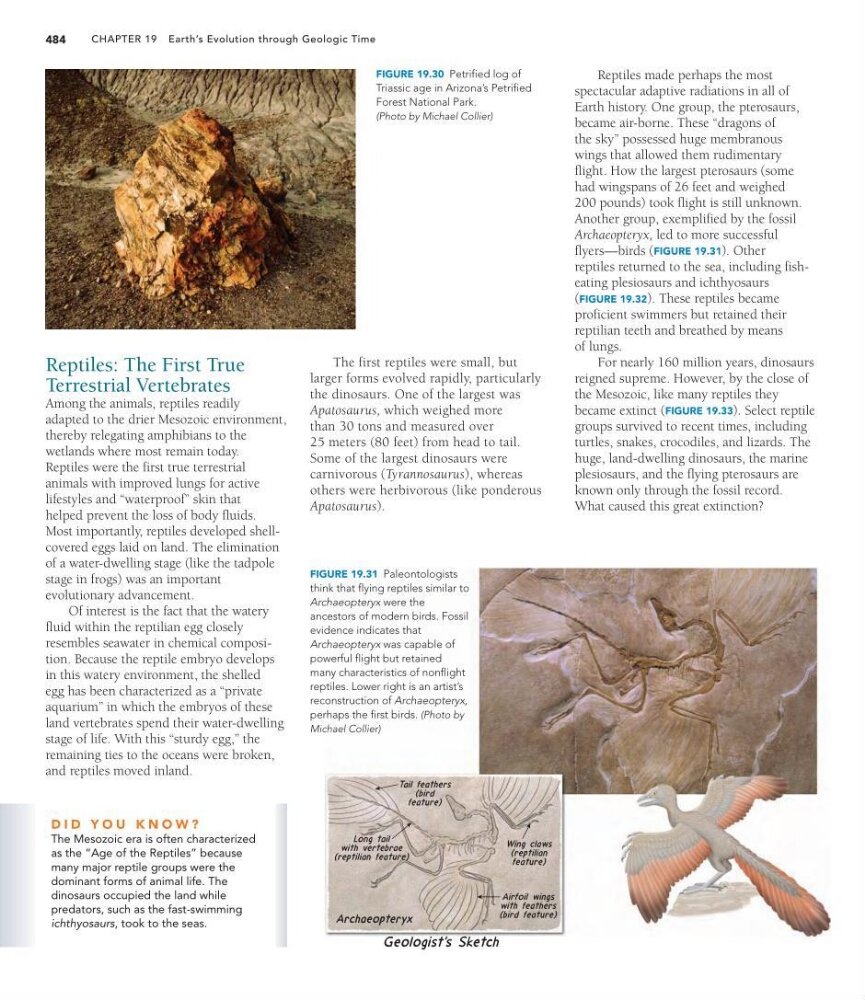
FIGURE 19.30 Petrified log of
Triassic age in Arizona’s Petrified
Forest National Park.
(Photo by Michael Collier)
CHAPTER 19 Earth’s Evolution through Geologic Time
484
Reptiles: The First True
Terrestrial Vertebrates
Among the animals, reptiles readily
adapted to the drier Mesozoic environment,
thereby relegating amphibians to the
wetlands where most remain today.
Reptiles were the first true terrestrial
animals with improved lungs for active
lifestyles and “waterproof” skin that
helped prevent the loss of body fluids.
Most importantly, reptiles developed shellcovered eggs laid on land. The elimination
of a water-dwelling stage (like the tadpole
stage in frogs) was an important
evolutionary advancement.
Of interest is the fact that the watery
fluid within the reptilian egg closely
resembles seawater in chemical composition. Because the reptile embryo develops
in this watery environment, the shelled
egg has been characterized as a “private
aquarium” in which the embryos of these
land vertebrates spend their water-dwelling
stage of life. With this “sturdy egg,” the
remaining ties to the oceans were broken,
and reptiles moved inland.
The first reptiles were small, but
larger forms evolved rapidly, particularly
the dinosaurs. One of the largest was
Apatosaurus, which weighed more
than 30 tons and measured over
25 meters (80 feet) from head to tail.
Some of the largest dinosaurs were
carnivorous (Tyrannosaurus), whereas
others were herbivorous (like ponderous
Apatosaurus).
Reptiles made perhaps the most
spectacular adaptive radiations in all of
Earth history. One group, the pterosaurs,
became air-borne. These “dragons of
the sky” possessed huge membranous
wings that allowed them rudimentary
flight. How the largest pterosaurs (some
had wingspans of 26 feet and weighed
200 pounds) took flight is still unknown.
Another group, exemplified by the fossil
Archaeopteryx, led to more successful
flyers—birds (FIGURE 19.31). Other
reptiles returned to the sea, including fisheating plesiosaurs and ichthyosaurs
(FIGURE 19.32). These reptiles became
proficient swimmers but retained their
reptilian teeth and breathed by means
of lungs.
For nearly 160 million years, dinosaurs
reigned supreme. However, by the close of
the Mesozoic, like many reptiles they
became extinct (FIGURE 19.33). Select reptile
groups survived to recent times, including
turtles, snakes, crocodiles, and lizards. The
huge, land-dwelling dinosaurs, the marine
plesiosaurs, and the flying pterosaurs are
known only through the fossil record.
What caused this great extinction?
FIGURE 19.31 Paleontologists
think that flying reptiles similar to
Archaeopteryx were the
ancestors of modern birds. Fossil
evidence indicates that
Archaeopteryx was capable of
powerful flight but retained
many characteristics of nonflight
reptiles. Lower right is an artist’s
reconstruction of Archaeopteryx,
perhaps the first birds. (Photo by
Michael Collier)
D I D Y O U K N O W ?
The Mesozoic era is often characterized
as the “Age of the Reptiles” because
many major reptile groups were the
dominant forms of animal life. The
dinosaurs occupied the land while
predators, such as the fast-swimming
ichthyosaurs, took to the seas.
Triassic age in Arizona’s Petrified
Forest National Park.
(Photo by Michael Collier)
CHAPTER 19 Earth’s Evolution through Geologic Time
484
Reptiles: The First True
Terrestrial Vertebrates
Among the animals, reptiles readily
adapted to the drier Mesozoic environment,
thereby relegating amphibians to the
wetlands where most remain today.
Reptiles were the first true terrestrial
animals with improved lungs for active
lifestyles and “waterproof” skin that
helped prevent the loss of body fluids.
Most importantly, reptiles developed shellcovered eggs laid on land. The elimination
of a water-dwelling stage (like the tadpole
stage in frogs) was an important
evolutionary advancement.
Of interest is the fact that the watery
fluid within the reptilian egg closely
resembles seawater in chemical composition. Because the reptile embryo develops
in this watery environment, the shelled
egg has been characterized as a “private
aquarium” in which the embryos of these
land vertebrates spend their water-dwelling
stage of life. With this “sturdy egg,” the
remaining ties to the oceans were broken,
and reptiles moved inland.
The first reptiles were small, but
larger forms evolved rapidly, particularly
the dinosaurs. One of the largest was
Apatosaurus, which weighed more
than 30 tons and measured over
25 meters (80 feet) from head to tail.
Some of the largest dinosaurs were
carnivorous (Tyrannosaurus), whereas
others were herbivorous (like ponderous
Apatosaurus).
Reptiles made perhaps the most
spectacular adaptive radiations in all of
Earth history. One group, the pterosaurs,
became air-borne. These “dragons of
the sky” possessed huge membranous
wings that allowed them rudimentary
flight. How the largest pterosaurs (some
had wingspans of 26 feet and weighed
200 pounds) took flight is still unknown.
Another group, exemplified by the fossil
Archaeopteryx, led to more successful
flyers—birds (FIGURE 19.31). Other
reptiles returned to the sea, including fisheating plesiosaurs and ichthyosaurs
(FIGURE 19.32). These reptiles became
proficient swimmers but retained their
reptilian teeth and breathed by means
of lungs.
For nearly 160 million years, dinosaurs
reigned supreme. However, by the close of
the Mesozoic, like many reptiles they
became extinct (FIGURE 19.33). Select reptile
groups survived to recent times, including
turtles, snakes, crocodiles, and lizards. The
huge, land-dwelling dinosaurs, the marine
plesiosaurs, and the flying pterosaurs are
known only through the fossil record.
What caused this great extinction?
FIGURE 19.31 Paleontologists
think that flying reptiles similar to
Archaeopteryx were the
ancestors of modern birds. Fossil
evidence indicates that
Archaeopteryx was capable of
powerful flight but retained
many characteristics of nonflight
reptiles. Lower right is an artist’s
reconstruction of Archaeopteryx,
perhaps the first birds. (Photo by
Michael Collier)
D I D Y O U K N O W ?
The Mesozoic era is often characterized
as the “Age of the Reptiles” because
many major reptile groups were the
dominant forms of animal life. The
dinosaurs occupied the land while
predators, such as the fast-swimming
ichthyosaurs, took to the seas.