

A. Lobe-finned fish
B. Early amphibian
h
h
r
r
u
u
SILU RIAN PER IOD
SILU RIAN PER IOD
DEV ONIA N PER IOD
DEV ONIA N PER IOD
PEN NSY LVAN IAN PER IOD
PEN NSY LVAN IAN PER IOD
SILU RIAN PER IOD
DEV ONIA N PER IOD
PEN NSY LVAN IAN PER IOD
Tiny,
upright-growing
land plants
First
tree-sized
land plants
T
I
M
E
Extensive forests,
which formed
coal deposits
FIGURE 19.25 Land plants of the Paleozoic. The
Silurian saw the first upright-growing (vascular)
plants. Plant fossils became increasingly
common from the Devonian onward.
481
Paleozoic Era: Life Explodes
Other fishes
evolved during the Devonian, including
primitive sharks
with cartilage skeletons, and bony fishes—
the groups in which many
modern fishes are classified.
Fishes, the first large vertebrates, proved to be faster
swimmers than invertebrates and
possessed more acute senses and larger brains. They became the dominant predators of the
sea, which is why the Devonian period is often referred to as the “Age of the Fishes.”
Vertebrates Move to Land
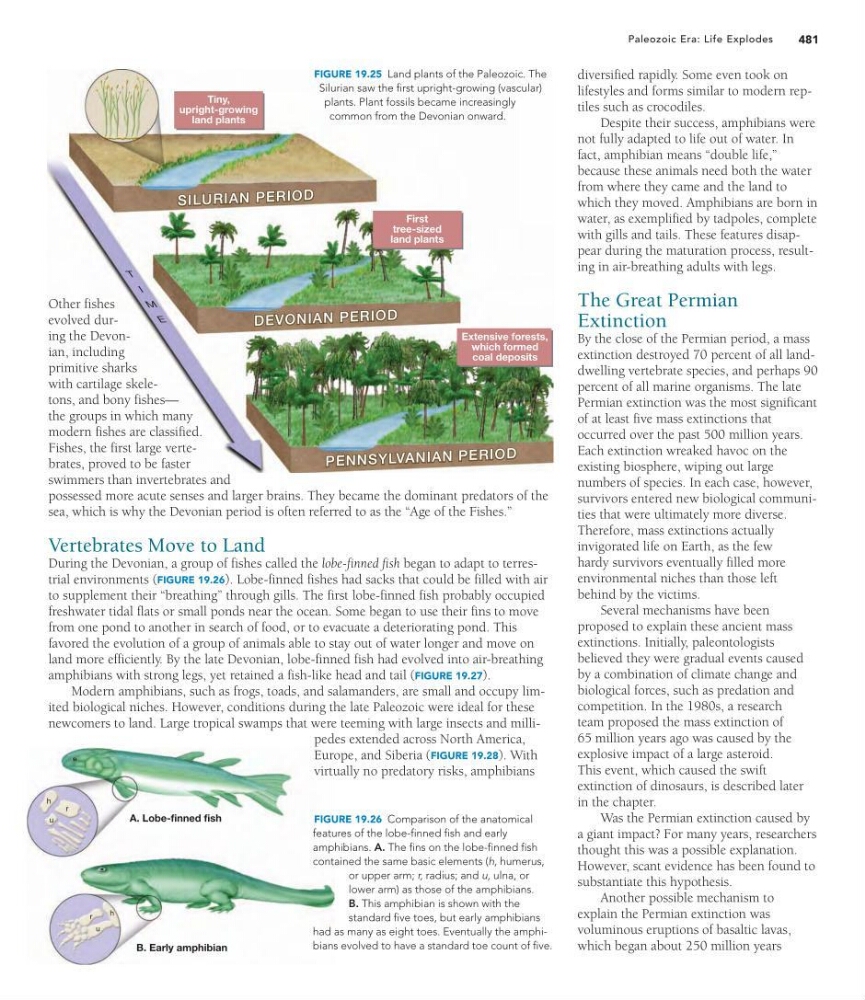
During the Devonian, a group of fishes called the lobe-finned fish began to adapt to terrestrial environments (FIGURE 19.26). Lobe-finned fishes had sacks that could be filled with air
to supplement their “breathing” through gills. The first lobe-finned fish probably occupied
freshwater tidal flats or small ponds near the ocean. Some began to use their fins to move
from one pond to another in search of food, or to evacuate a deteriorating pond. This
favored the evolution of a group of animals able to stay out of water longer and move on
land more efficiently. By the late Devonian, lobe-finned fish had evolved into air-breathing
amphibians with strong legs, yet retained a fish-like head and tail (FIGURE 19.27).
Modern amphibians, such as frogs, toads, and salamanders, are small and occupy limited biological niches. However, conditions during the late Paleozoic were ideal for these
newcomers to land. Large tropical swamps that were teeming with large insects and millipedes extended across North America,
Europe, and Siberia (FIGURE 19.28). With
virtually no predatory risks, amphibians
FIGURE 19.26 Comparison of the anatomical
features of the lobe-finned fish and early
amphibians. A. The fins on the lobe-finned fish
contained the same basic elements (h, humerus,
or upper arm; r, radius; and u, ulna, or
lower arm) as those of the amphibians.
B. This amphibian is shown with the
standard five toes, but early amphibians
had as many as eight toes. Eventually the amphibians evolved to have a standard toe count of five.
diversified rapidly. Some even took on
lifestyles and forms similar to modern reptiles such as crocodiles.
Despite their success, amphibians were
not fully adapted to life out of water. In
fact, amphibian means “double life,”
because these animals need both the water
from where they came and the land to
which they moved. Amphibians are born in
water, as exemplified by tadpoles, complete
with gills and tails. These features disappear during the maturation process, resulting in air-breathing adults with legs.
The Great Permian
Extinction
By the close of the Permian period, a mass
extinction destroyed 70 percent of all landdwelling vertebrate species, and perhaps 90
percent of all marine organisms. The late
Permian extinction was the most significant
of at least five mass extinctions that
occurred over the past 500 million years.
Each extinction wreaked havoc on the
existing biosphere, wiping out large
numbers of species. In each case, however,
survivors entered new biological communities that were ultimately more diverse.
Therefore, mass extinctions actually
invigorated life on Earth, as the few
hardy survivors eventually filled more
environmental niches than those left
behind by the victims.
Several mechanisms have been
proposed to explain these ancient mass
extinctions. Initially, paleontologists
believed they were gradual events caused
by a combination of climate change and
biological forces, such as predation and
competition. In the 1980s, a research
team proposed the mass extinction of
65 million years ago was caused by the
explosive impact of a large asteroid.
This event, which caused the swift
extinction of dinosaurs, is described later
in the chapter.
Was the Permian extinction caused by
a giant impact? For many years, researchers
thought this was a possible explanation.
However, scant evidence has been found to
substantiate this hypothesis.
Another possible mechanism to
explain the Permian extinction was
voluminous eruptions of basaltic lavas,
which began about 250 million years
B. Early amphibian
h
h
r
r
u
u
SILU RIAN PER IOD
SILU RIAN PER IOD
DEV ONIA N PER IOD
DEV ONIA N PER IOD
PEN NSY LVAN IAN PER IOD
PEN NSY LVAN IAN PER IOD
SILU RIAN PER IOD
DEV ONIA N PER IOD
PEN NSY LVAN IAN PER IOD
Tiny,
upright-growing
land plants
First
tree-sized
land plants
T
I
M
E
Extensive forests,
which formed
coal deposits
FIGURE 19.25 Land plants of the Paleozoic. The
Silurian saw the first upright-growing (vascular)
plants. Plant fossils became increasingly
common from the Devonian onward.
481
Paleozoic Era: Life Explodes
Other fishes
evolved during the Devonian, including
primitive sharks
with cartilage skeletons, and bony fishes—
the groups in which many
modern fishes are classified.
Fishes, the first large vertebrates, proved to be faster
swimmers than invertebrates and
possessed more acute senses and larger brains. They became the dominant predators of the
sea, which is why the Devonian period is often referred to as the “Age of the Fishes.”
Vertebrates Move to Land
During the Devonian, a group of fishes called the lobe-finned fish began to adapt to terrestrial environments (FIGURE 19.26). Lobe-finned fishes had sacks that could be filled with air
to supplement their “breathing” through gills. The first lobe-finned fish probably occupied
freshwater tidal flats or small ponds near the ocean. Some began to use their fins to move
from one pond to another in search of food, or to evacuate a deteriorating pond. This
favored the evolution of a group of animals able to stay out of water longer and move on
land more efficiently. By the late Devonian, lobe-finned fish had evolved into air-breathing
amphibians with strong legs, yet retained a fish-like head and tail (FIGURE 19.27).
Modern amphibians, such as frogs, toads, and salamanders, are small and occupy limited biological niches. However, conditions during the late Paleozoic were ideal for these
newcomers to land. Large tropical swamps that were teeming with large insects and millipedes extended across North America,
Europe, and Siberia (FIGURE 19.28). With
virtually no predatory risks, amphibians
FIGURE 19.26 Comparison of the anatomical
features of the lobe-finned fish and early
amphibians. A. The fins on the lobe-finned fish
contained the same basic elements (h, humerus,
or upper arm; r, radius; and u, ulna, or
lower arm) as those of the amphibians.
B. This amphibian is shown with the
standard five toes, but early amphibians
had as many as eight toes. Eventually the amphibians evolved to have a standard toe count of five.
diversified rapidly. Some even took on
lifestyles and forms similar to modern reptiles such as crocodiles.
Despite their success, amphibians were
not fully adapted to life out of water. In
fact, amphibian means “double life,”
because these animals need both the water
from where they came and the land to
which they moved. Amphibians are born in
water, as exemplified by tadpoles, complete
with gills and tails. These features disappear during the maturation process, resulting in air-breathing adults with legs.
The Great Permian
Extinction
By the close of the Permian period, a mass
extinction destroyed 70 percent of all landdwelling vertebrate species, and perhaps 90
percent of all marine organisms. The late
Permian extinction was the most significant
of at least five mass extinctions that
occurred over the past 500 million years.
Each extinction wreaked havoc on the
existing biosphere, wiping out large
numbers of species. In each case, however,
survivors entered new biological communities that were ultimately more diverse.
Therefore, mass extinctions actually
invigorated life on Earth, as the few
hardy survivors eventually filled more
environmental niches than those left
behind by the victims.
Several mechanisms have been
proposed to explain these ancient mass
extinctions. Initially, paleontologists
believed they were gradual events caused
by a combination of climate change and
biological forces, such as predation and
competition. In the 1980s, a research
team proposed the mass extinction of
65 million years ago was caused by the
explosive impact of a large asteroid.
This event, which caused the swift
extinction of dinosaurs, is described later
in the chapter.
Was the Permian extinction caused by
a giant impact? For many years, researchers
thought this was a possible explanation.
However, scant evidence has been found to
substantiate this hypothesis.
Another possible mechanism to
explain the Permian extinction was
voluminous eruptions of basaltic lavas,
which began about 250 million years