

CHAPTER 18 Geologic Time
454
A.
B.
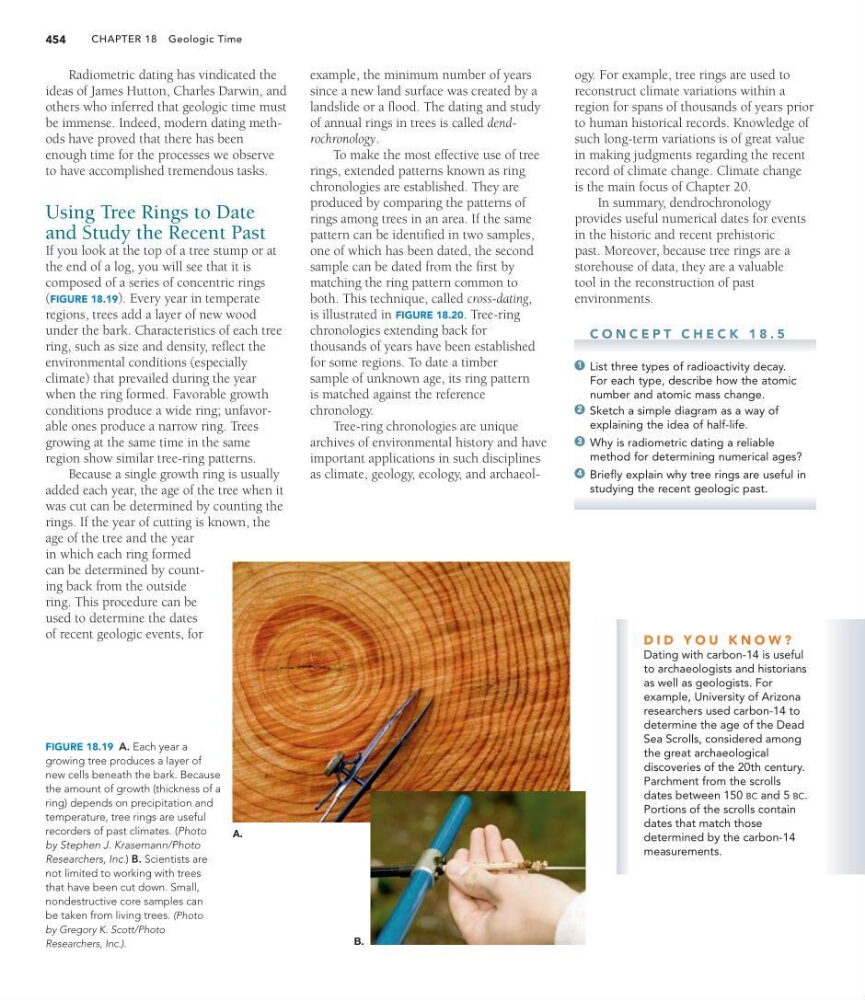
FIGURE 18.19 A. Each year a
growing tree produces a layer of
new cells beneath the bark. Because
the amount of growth (thickness of a
ring) depends on precipitation and
temperature, tree rings are useful
recorders of past climates. (Photo
by Stephen J. Krasemann/Photo
Researchers, Inc.) B. Scientists are
not limited to working with trees
that have been cut down. Small,
nondestructive core samples can
be taken from living trees. (Photo
by Gregory K. Scott/Photo
Researchers, Inc.).
D I D Y O U K N O W ?
Dating with carbon-14 is useful
to archaeologists and historians
as well as geologists. For
example, University of Arizona
researchers used carbon-14 to
determine the age of the Dead
Sea Scrolls, considered among
the great archaeological
discoveries of the 20th century.
Parchment from the scrolls
dates between 150 BC and 5 BC.
Portions of the scrolls contain
dates that match those
determined by the carbon-14
measurements.
Radiometric dating has vindicated the
ideas of James Hutton, Charles Darwin, and
others who inferred that geologic time must
be immense. Indeed, modern dating methods have proved that there has been
enough time for the processes we observe
to have accomplished tremendous tasks.
Using Tree Rings to Date
and Study the Recent Past
If you look at the top of a tree stump or at
the end of a log, you will see that it is
composed of a series of concentric rings
(FIGURE 18.19). Every year in temperate
regions, trees add a layer of new wood
under the bark. Characteristics of each tree
ring, such as size and density, reflect the
environmental conditions (especially
climate) that prevailed during the year
when the ring formed. Favorable growth
conditions produce a wide ring; unfavorable ones produce a narrow ring. Trees
growing at the same time in the same
region show similar tree-ring patterns.
Because a single growth ring is usually
added each year, the age of the tree when it
was cut can be determined by counting the
rings. If the year of cutting is known, the
age of the tree and the year
in which each ring formed
can be determined by counting back from the outside
ring. This procedure can be
used to determine the dates
of recent geologic events, for
example, the minimum number of years
since a new land surface was created by a
landslide or a flood. The dating and study
of annual rings in trees is called dendrochronology.
To make the most effective use of tree
rings, extended patterns known as ring
chronologies are established. They are
produced by comparing the patterns of
rings among trees in an area. If the same
pattern can be identified in two samples,
one of which has been dated, the second
sample can be dated from the first by
matching the ring pattern common to
both. This technique, called cross-dating,
is illustrated in FIGURE 18.20. Tree-ring
chronologies extending back for
thousands of years have been established
for some regions. To date a timber
sample of unknown age, its ring pattern
is matched against the reference
chronology.
Tree-ring chronologies are unique
archives of environmental history and have
important applications in such disciplines
as climate, geology, ecology, and archaeology. For example, tree rings are used to
reconstruct climate variations within a
region for spans of thousands of years prior
to human historical records. Knowledge of
such long-term variations is of great value
in making judgments regarding the recent
record of climate change. Climate change
is the main focus of Chapter 20.
In summary, dendrochronology
provides useful numerical dates for events
in the historic and recent prehistoric
past. Moreover, because tree rings are a
storehouse of data, they are a valuable
tool in the reconstruction of past
environments.
C O N C E P T C H E C K 1 8 . 5
List three types of radioactivity decay.
For each type, describe how the atomic
number and atomic mass change.
Sketch a simple diagram as a way of
explaining the idea of half-life.
Why is radiometric dating a reliable
method for determining numerical ages?
Briefly explain why tree rings are useful in
studying the recent geologic past.
4
3
2
1
454
A.
B.
FIGURE 18.19 A. Each year a
growing tree produces a layer of
new cells beneath the bark. Because
the amount of growth (thickness of a
ring) depends on precipitation and
temperature, tree rings are useful
recorders of past climates. (Photo
by Stephen J. Krasemann/Photo
Researchers, Inc.) B. Scientists are
not limited to working with trees
that have been cut down. Small,
nondestructive core samples can
be taken from living trees. (Photo
by Gregory K. Scott/Photo
Researchers, Inc.).
D I D Y O U K N O W ?
Dating with carbon-14 is useful
to archaeologists and historians
as well as geologists. For
example, University of Arizona
researchers used carbon-14 to
determine the age of the Dead
Sea Scrolls, considered among
the great archaeological
discoveries of the 20th century.
Parchment from the scrolls
dates between 150 BC and 5 BC.
Portions of the scrolls contain
dates that match those
determined by the carbon-14
measurements.
Radiometric dating has vindicated the
ideas of James Hutton, Charles Darwin, and
others who inferred that geologic time must
be immense. Indeed, modern dating methods have proved that there has been
enough time for the processes we observe
to have accomplished tremendous tasks.
Using Tree Rings to Date
and Study the Recent Past
If you look at the top of a tree stump or at
the end of a log, you will see that it is
composed of a series of concentric rings
(FIGURE 18.19). Every year in temperate
regions, trees add a layer of new wood
under the bark. Characteristics of each tree
ring, such as size and density, reflect the
environmental conditions (especially
climate) that prevailed during the year
when the ring formed. Favorable growth
conditions produce a wide ring; unfavorable ones produce a narrow ring. Trees
growing at the same time in the same
region show similar tree-ring patterns.
Because a single growth ring is usually
added each year, the age of the tree when it
was cut can be determined by counting the
rings. If the year of cutting is known, the
age of the tree and the year
in which each ring formed
can be determined by counting back from the outside
ring. This procedure can be
used to determine the dates
of recent geologic events, for
example, the minimum number of years
since a new land surface was created by a
landslide or a flood. The dating and study
of annual rings in trees is called dendrochronology.
To make the most effective use of tree
rings, extended patterns known as ring
chronologies are established. They are
produced by comparing the patterns of
rings among trees in an area. If the same
pattern can be identified in two samples,
one of which has been dated, the second
sample can be dated from the first by
matching the ring pattern common to
both. This technique, called cross-dating,
is illustrated in FIGURE 18.20. Tree-ring
chronologies extending back for
thousands of years have been established
for some regions. To date a timber
sample of unknown age, its ring pattern
is matched against the reference
chronology.
Tree-ring chronologies are unique
archives of environmental history and have
important applications in such disciplines
as climate, geology, ecology, and archaeology. For example, tree rings are used to
reconstruct climate variations within a
region for spans of thousands of years prior
to human historical records. Knowledge of
such long-term variations is of great value
in making judgments regarding the recent
record of climate change. Climate change
is the main focus of Chapter 20.
In summary, dendrochronology
provides useful numerical dates for events
in the historic and recent prehistoric
past. Moreover, because tree rings are a
storehouse of data, they are a valuable
tool in the reconstruction of past
environments.
C O N C E P T C H E C K 1 8 . 5
List three types of radioactivity decay.
For each type, describe how the atomic
number and atomic mass change.
Sketch a simple diagram as a way of
explaining the idea of half-life.
Why is radiometric dating a reliable
method for determining numerical ages?
Briefly explain why tree rings are useful in
studying the recent geologic past.
4
3
2
1