

fossil
453
Dating with Radioactivity
(FIGURE 18.18A). This isotope of carbon
quickly becomes incorporated into carbon
dioxide, which circulates in the atmosphere
and is absorbed by living matter. As a
result, all organisms contain a small
amount of carbon-14, including you.
While an organism is alive, the decaying radiocarbon is continually replaced,
and the proportions of carbon-14 and
carbon-12 remain constant. Carbon-12 is
the stable and most common isotope of
carbon. However, when any plant or
animal dies, the amount of carbon-14
gradually decreases as it decays to nitrogen14 by beta emission (FIGURE 18.18B). By
comparing the proportions of carbon-14
and carbon-12 in a sample, radiocarbon
dates can be determined. It is important to
emphasize that carbon-14 is only useful in
dating organic materials, such as wood,
charcoal, bones, flesh, and even cloth made
of cotton fibers.
Although carbon-14 is useful in dating
only the last small fraction of geologic time,
it has become a very valuable tool for
anthropologists, archeologists, and historians, as well as for geologists who study
very recent Earth history. In fact, the development of radiocarbon dating was considered so important that the chemist who
discovered this application, Willard F.
Libby, received a Nobel Prize in 1960.
Importance
of Radiometric Dating
Although the basic principle of radiometric
dating is simple, the actual procedure is
quite complex. The chemical analysis that
determines the quantities of parent and
daughter must be painstakingly precise. In
addition, some radioactive
materials do not decay
directly into the stable
daughter product. As you
saw in Figure 18.16, uranium-238 produces 13 intermediate unstable
daughter products before the 14th and final daughter product, the stable
isotope lead-206, is produced.
Radiometric dating methods have produced literally thousands of dates for events in Earth history.
Rocks exceeding 3.5 billion years in age are found
on all of the continents. Earth’ s oldest rocks (so far)
are gneisses from northern Canada near Great Slave
Lake that have been dated at 4.03 billion years
(b.y.). Rocks from western Greenland have been
dated at 3.7 to 3.8 b.y., and rocks nearly as old are
found in the Minnesota River valley and northern
Michigan (3.5 to 3.7 b.y.), in southern Africa (3.4 to
3.5 b.y.), and in western Australia (3.4 to 3.6 b.y.). It is important to point out that these
ancient rocks are not from any sort of “primordial crust” but originated as lava flows,
igneous intrusions, and sediments deposited in shallow water—an indication that Earth
history began before these rocks formed. Even older mineral grains have been dated. Tiny
crystals of the mineral zircon
having radiometric ages as
old as 4.3 b.y. have been
found in younger sedimentary rocks in western Australia. The source rocks
for these tiny durable
grains either no longer
exist or have not yet
been found.
D I D Y O U K N O W ?
Although movies and cartoons have
depicted humans and dinosaurs living
side by side, this was never the case.
Dinosaurs flourished during the
Mesozoic era and became extinct
about 65 million years ago. Humans
and their close ancestors did not
appear on the scene until the late
Cenozoic, more than 60 million years
after the demise of dinosaurs.
A. Production of carbon-14
B. Decay of carbon-14
Nitrogen-14
atomic number 7
atomic mass 14
Carbon-14
atomic number 6
atomic mass 14
+ –
+ –
+
+
Neutron capture
Proton emission
Neutron
Beta
(electron)
emission
Carbon-14
Nitrogen-14
Proton
(–)
FIGURE 18.18 A. Production
and B. decay of carbon-14.
These sketches represent the
nuclei of the respective atoms.
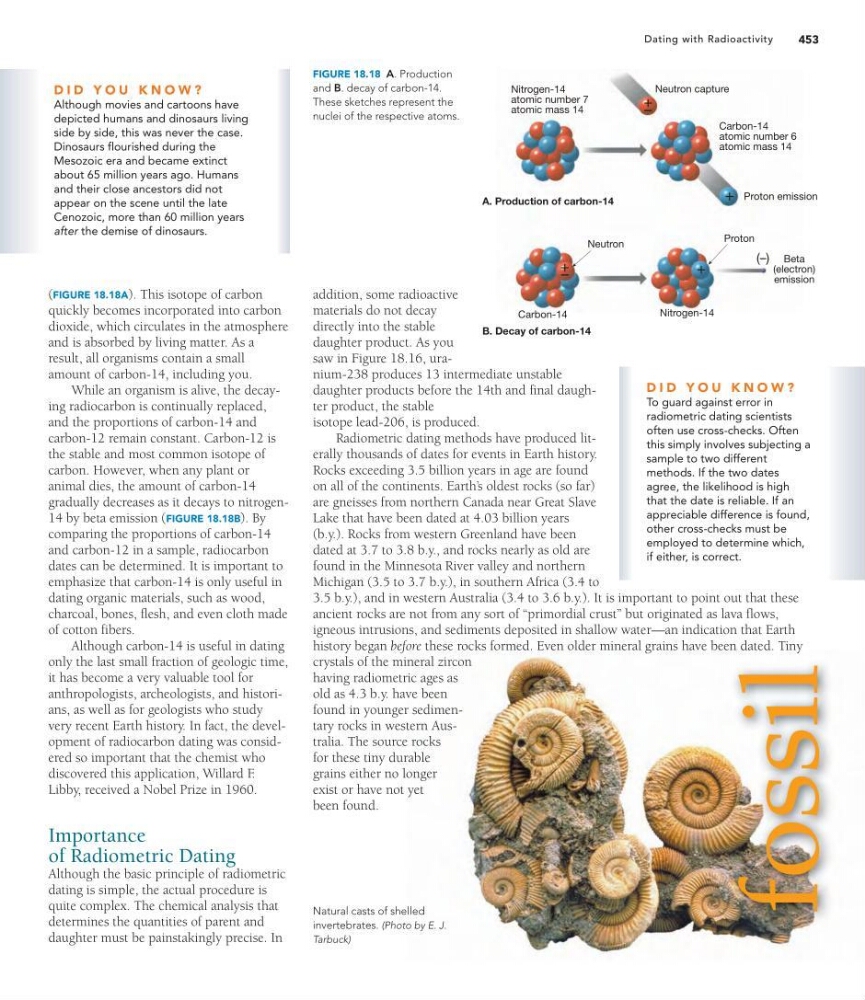
Natural casts of shelled
invertebrates. (Photo by E. J.
Tarbuck)
D I D Y O U K N O W ?
To guard against error in
radiometric dating scientists
often use cross-checks. Often
this simply involves subjecting a
sample to two different
methods. If the two dates
agree, the likelihood is high
that the date is reliable. If an
appreciable difference is found,
other cross-checks must be
employed to determine which,
if either, is correct.
453
Dating with Radioactivity
(FIGURE 18.18A). This isotope of carbon
quickly becomes incorporated into carbon
dioxide, which circulates in the atmosphere
and is absorbed by living matter. As a
result, all organisms contain a small
amount of carbon-14, including you.
While an organism is alive, the decaying radiocarbon is continually replaced,
and the proportions of carbon-14 and
carbon-12 remain constant. Carbon-12 is
the stable and most common isotope of
carbon. However, when any plant or
animal dies, the amount of carbon-14
gradually decreases as it decays to nitrogen14 by beta emission (FIGURE 18.18B). By
comparing the proportions of carbon-14
and carbon-12 in a sample, radiocarbon
dates can be determined. It is important to
emphasize that carbon-14 is only useful in
dating organic materials, such as wood,
charcoal, bones, flesh, and even cloth made
of cotton fibers.
Although carbon-14 is useful in dating
only the last small fraction of geologic time,
it has become a very valuable tool for
anthropologists, archeologists, and historians, as well as for geologists who study
very recent Earth history. In fact, the development of radiocarbon dating was considered so important that the chemist who
discovered this application, Willard F.
Libby, received a Nobel Prize in 1960.
Importance
of Radiometric Dating
Although the basic principle of radiometric
dating is simple, the actual procedure is
quite complex. The chemical analysis that
determines the quantities of parent and
daughter must be painstakingly precise. In
addition, some radioactive
materials do not decay
directly into the stable
daughter product. As you
saw in Figure 18.16, uranium-238 produces 13 intermediate unstable
daughter products before the 14th and final daughter product, the stable
isotope lead-206, is produced.
Radiometric dating methods have produced literally thousands of dates for events in Earth history.
Rocks exceeding 3.5 billion years in age are found
on all of the continents. Earth’ s oldest rocks (so far)
are gneisses from northern Canada near Great Slave
Lake that have been dated at 4.03 billion years
(b.y.). Rocks from western Greenland have been
dated at 3.7 to 3.8 b.y., and rocks nearly as old are
found in the Minnesota River valley and northern
Michigan (3.5 to 3.7 b.y.), in southern Africa (3.4 to
3.5 b.y.), and in western Australia (3.4 to 3.6 b.y.). It is important to point out that these
ancient rocks are not from any sort of “primordial crust” but originated as lava flows,
igneous intrusions, and sediments deposited in shallow water—an indication that Earth
history began before these rocks formed. Even older mineral grains have been dated. Tiny
crystals of the mineral zircon
having radiometric ages as
old as 4.3 b.y. have been
found in younger sedimentary rocks in western Australia. The source rocks
for these tiny durable
grains either no longer
exist or have not yet
been found.
D I D Y O U K N O W ?
Although movies and cartoons have
depicted humans and dinosaurs living
side by side, this was never the case.
Dinosaurs flourished during the
Mesozoic era and became extinct
about 65 million years ago. Humans
and their close ancestors did not
appear on the scene until the late
Cenozoic, more than 60 million years
after the demise of dinosaurs.
A. Production of carbon-14
B. Decay of carbon-14
Nitrogen-14
atomic number 7
atomic mass 14
Carbon-14
atomic number 6
atomic mass 14
+ –
+ –
+
+
Neutron capture
Proton emission
Neutron
Beta
(electron)
emission
Carbon-14
Nitrogen-14
Proton
(–)
FIGURE 18.18 A. Production
and B. decay of carbon-14.
These sketches represent the
nuclei of the respective atoms.
Natural casts of shelled
invertebrates. (Photo by E. J.
Tarbuck)
D I D Y O U K N O W ?
To guard against error in
radiometric dating scientists
often use cross-checks. Often
this simply involves subjecting a
sample to two different
methods. If the two dates
agree, the likelihood is high
that the date is reliable. If an
appreciable difference is found,
other cross-checks must be
employed to determine which,
if either, is correct.