

CHAPTER 18 Geologic Time
450
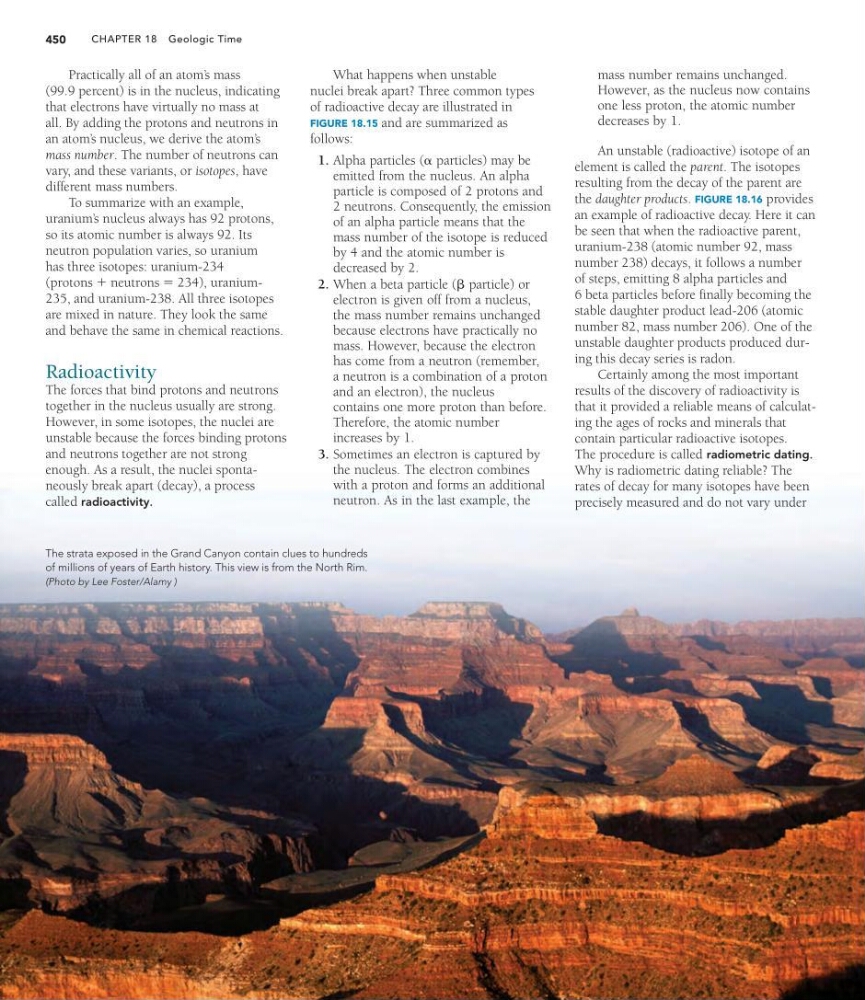
The strata exposed in the Grand Canyon contain clues to hundreds
of millions of years of Earth history. This view is from the North Rim.
(Photo by Lee Foster/Alamy )
Practically all of an atom’ s mass
(99.9 percent) is in the nucleus, indicating
that electrons have virtually no mass at
all. By adding the protons and neutrons in
an atom’ s nucleus, we derive the atom’ s
mass number. The number of neutrons can
vary, and these variants, or isotopes, have
different mass numbers.
To summarize with an example,
uranium’ s nucleus always has 92 protons,
so its atomic number is always 92. Its
neutron population varies, so uranium
has three isotopes: uranium-234
(
), uranium235, and uranium-238. All three isotopes
are mixed in nature. They look the same
and behave the same in chemical reactions.
Radioactivity
The forces that bind protons and neutrons
together in the nucleus usually are strong.
However, in some isotopes, the nuclei are
unstable because the forces binding protons
and neutrons together are not strong
enough. As a result, the nuclei spontaneously break apart (decay), a process
called radioactivity.
protons + neutrons = 234
What happens when unstable
nuclei break apart? Three common types
of radioactive decay are illustrated in
FIGURE 18.15 and are summarized as
follows:
1. Alpha particles (␣ particles) may be
emitted from the nucleus. An alpha
particle is composed of 2 protons and
2 neutrons. Consequently, the emission
of an alpha particle means that the
mass number of the isotope is reduced
by 4 and the atomic number is
decreased by 2.
2. When a beta particle ( particle) or
electron is given off from a nucleus,
the mass number remains unchanged
because electrons have practically no
mass. However, because the electron
has come from a neutron (remember,
a neutron is a combination of a proton
and an electron), the nucleus
contains one more proton than before.
Therefore, the atomic number
increases by 1.
3. Sometimes an electron is captured by
the nucleus. The electron combines
with a proton and forms an additional
neutron. As in the last example, the
mass number remains unchanged.
However, as the nucleus now contains
one less proton, the atomic number
decreases by 1.
An unstable (radioactive) isotope of an
element is called the parent. The isotopes
resulting from the decay of the parent are
the daughter products. FIGURE 18.16 provides
an example of radioactive decay. Here it can
be seen that when the radioactive parent,
uranium-238 (atomic number 92, mass
number 238) decays, it follows a number
of steps, emitting 8 alpha particles and
6 beta particles before finally becoming the
stable daughter product lead-206 (atomic
number 82, mass number 206). One of the
unstable daughter products produced during this decay series is radon.
Certainly among the most important
results of the discovery of radioactivity is
that it provided a reliable means of calculating the ages of rocks and minerals that
contain particular radioactive isotopes.
The procedure is called radiometric dating.
Why is radiometric dating reliable? The
rates of decay for many isotopes have been
precisely measured and do not vary under
450
The strata exposed in the Grand Canyon contain clues to hundreds
of millions of years of Earth history. This view is from the North Rim.
(Photo by Lee Foster/Alamy )
Practically all of an atom’ s mass
(99.9 percent) is in the nucleus, indicating
that electrons have virtually no mass at
all. By adding the protons and neutrons in
an atom’ s nucleus, we derive the atom’ s
mass number. The number of neutrons can
vary, and these variants, or isotopes, have
different mass numbers.
To summarize with an example,
uranium’ s nucleus always has 92 protons,
so its atomic number is always 92. Its
neutron population varies, so uranium
has three isotopes: uranium-234
(
), uranium235, and uranium-238. All three isotopes
are mixed in nature. They look the same
and behave the same in chemical reactions.
Radioactivity
The forces that bind protons and neutrons
together in the nucleus usually are strong.
However, in some isotopes, the nuclei are
unstable because the forces binding protons
and neutrons together are not strong
enough. As a result, the nuclei spontaneously break apart (decay), a process
called radioactivity.
protons + neutrons = 234
What happens when unstable
nuclei break apart? Three common types
of radioactive decay are illustrated in
FIGURE 18.15 and are summarized as
follows:
1. Alpha particles (␣ particles) may be
emitted from the nucleus. An alpha
particle is composed of 2 protons and
2 neutrons. Consequently, the emission
of an alpha particle means that the
mass number of the isotope is reduced
by 4 and the atomic number is
decreased by 2.
2. When a beta particle ( particle) or
electron is given off from a nucleus,
the mass number remains unchanged
because electrons have practically no
mass. However, because the electron
has come from a neutron (remember,
a neutron is a combination of a proton
and an electron), the nucleus
contains one more proton than before.
Therefore, the atomic number
increases by 1.
3. Sometimes an electron is captured by
the nucleus. The electron combines
with a proton and forms an additional
neutron. As in the last example, the
mass number remains unchanged.
However, as the nucleus now contains
one less proton, the atomic number
decreases by 1.
An unstable (radioactive) isotope of an
element is called the parent. The isotopes
resulting from the decay of the parent are
the daughter products. FIGURE 18.16 provides
an example of radioactive decay. Here it can
be seen that when the radioactive parent,
uranium-238 (atomic number 92, mass
number 238) decays, it follows a number
of steps, emitting 8 alpha particles and
6 beta particles before finally becoming the
stable daughter product lead-206 (atomic
number 82, mass number 206). One of the
unstable daughter products produced during this decay series is radon.
Certainly among the most important
results of the discovery of radioactivity is
that it provided a reliable means of calculating the ages of rocks and minerals that
contain particular radioactive isotopes.
The procedure is called radiometric dating.
Why is radiometric dating reliable? The
rates of decay for many isotopes have been
precisely measured and do not vary under