

449
Dating with Radioactivity
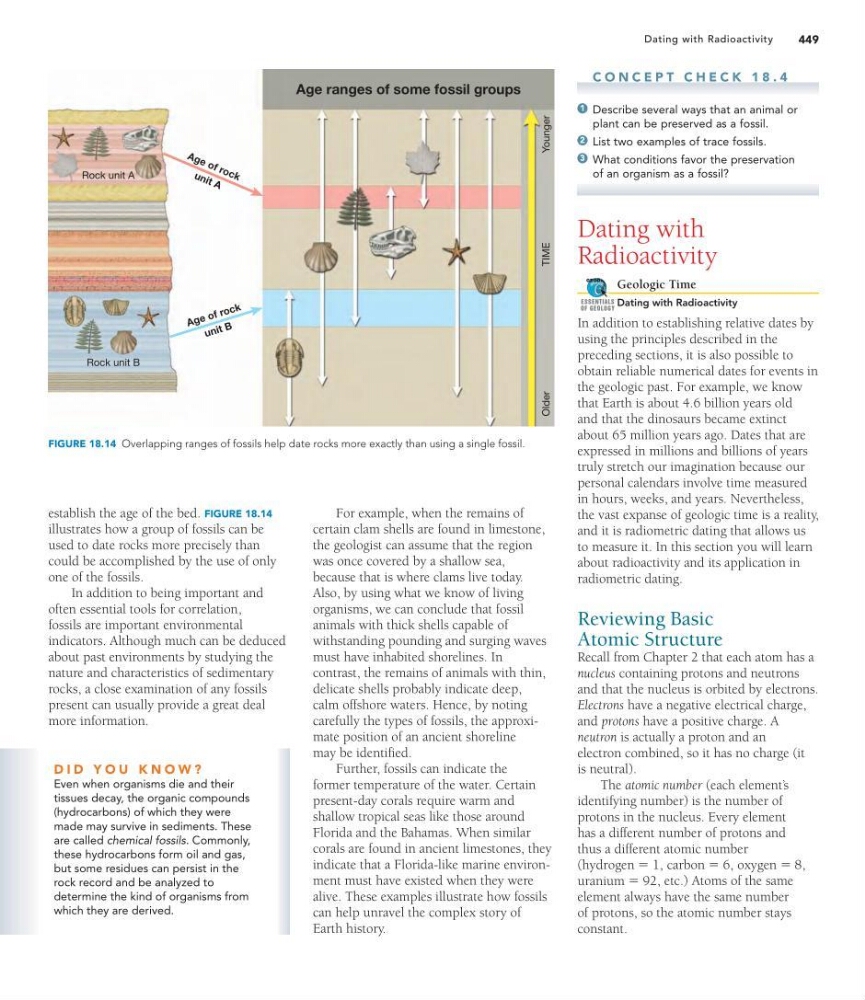
establish the age of the bed. FIGURE 18.14
illustrates how a group of fossils can be
used to date rocks more precisely than
could be accomplished by the use of only
one of the fossils.
In addition to being important and
often essential tools for correlation,
fossils are important environmental
indicators. Although much can be deduced
about past environments by studying the
nature and characteristics of sedimentary
rocks, a close examination of any fossils
present can usually provide a great deal
more information.
C O N C E P T C H E C K 1 8 . 4
Describe several ways that an animal or
plant can be preserved as a fossil.
List two examples of trace fossils.
What conditions favor the preservation
of an organism as a fossil?
Dating with
Radioactivity
Geologic Time
Dating with Radioactivity
In addition to establishing relative dates by
using the principles described in the
preceding sections, it is also possible to
obtain reliable numerical dates for events in
the geologic past. For example, we know
that Earth is about 4.6 billion years old
and that the dinosaurs became extinct
about 65 million years ago. Dates that are
expressed in millions and billions of years
truly stretch our imagination because our
personal calendars involve time measured
in hours, weeks, and years. Nevertheless,
the vast expanse of geologic time is a reality,
and it is radiometric dating that allows us
to measure it. In this section you will learn
about radioactivity and its application in
radiometric dating.
Reviewing Basic
Atomic Structure
Recall from Chapter 2 that each atom has a
nucleus containing protons and neutrons
and that the nucleus is orbited by electrons.
Electrons have a negative electrical charge,
and protons have a positive charge. A
neutron is actually a proton and an
electron combined, so it has no charge (it
is neutral).
The atomic number (each element’ s
identifying number) is the number of
protons in the nucleus. Every element
has a different number of protons and
thus a different atomic number
(
,
,
,
, etc.) Atoms of the same
element always have the same number
of protons, so the atomic number stays
constant.
uranium = 92
oxygen = 8
carbon = 6
hydrogen = 1
GEODe
ESSENTIALS
OF GEOLOGY
3
2
1
A g e o f r o c k
u n it A
A g e o f ro c k
u n it B
Rock unit A
Rock unit B
TIME
Older
Younger
Age ranges of some fossil groups
FIGURE 18.14 Overlapping ranges of fossils help date rocks more exactly than using a single fossil.
For example, when the remains of
certain clam shells are found in limestone,
the geologist can assume that the region
was once covered by a shallow sea,
because that is where clams live today.
Also, by using what we know of living
organisms, we can conclude that fossil
animals with thick shells capable of
withstanding pounding and surging waves
must have inhabited shorelines. In
contrast, the remains of animals with thin,
delicate shells probably indicate deep,
calm offshore waters. Hence, by noting
carefully the types of fossils, the approximate position of an ancient shoreline
may be identified.
Further, fossils can indicate the
former temperature of the water. Certain
present-day corals require warm and
shallow tropical seas like those around
Florida and the Bahamas. When similar
corals are found in ancient limestones, they
indicate that a Florida-like marine environment must have existed when they were
alive. These examples illustrate how fossils
can help unravel the complex story of
Earth history.
D I D Y O U K N O W ?
Even when organisms die and their
tissues decay, the organic compounds
(hydrocarbons) of which they were
made may survive in sediments. These
are called chemical fossils. Commonly,
these hydrocarbons form oil and gas,
but some residues can persist in the
rock record and be analyzed to
determine the kind of organisms from
which they are derived.
Dating with Radioactivity
establish the age of the bed. FIGURE 18.14
illustrates how a group of fossils can be
used to date rocks more precisely than
could be accomplished by the use of only
one of the fossils.
In addition to being important and
often essential tools for correlation,
fossils are important environmental
indicators. Although much can be deduced
about past environments by studying the
nature and characteristics of sedimentary
rocks, a close examination of any fossils
present can usually provide a great deal
more information.
C O N C E P T C H E C K 1 8 . 4
Describe several ways that an animal or
plant can be preserved as a fossil.
List two examples of trace fossils.
What conditions favor the preservation
of an organism as a fossil?
Dating with
Radioactivity
Geologic Time
Dating with Radioactivity
In addition to establishing relative dates by
using the principles described in the
preceding sections, it is also possible to
obtain reliable numerical dates for events in
the geologic past. For example, we know
that Earth is about 4.6 billion years old
and that the dinosaurs became extinct
about 65 million years ago. Dates that are
expressed in millions and billions of years
truly stretch our imagination because our
personal calendars involve time measured
in hours, weeks, and years. Nevertheless,
the vast expanse of geologic time is a reality,
and it is radiometric dating that allows us
to measure it. In this section you will learn
about radioactivity and its application in
radiometric dating.
Reviewing Basic
Atomic Structure
Recall from Chapter 2 that each atom has a
nucleus containing protons and neutrons
and that the nucleus is orbited by electrons.
Electrons have a negative electrical charge,
and protons have a positive charge. A
neutron is actually a proton and an
electron combined, so it has no charge (it
is neutral).
The atomic number (each element’ s
identifying number) is the number of
protons in the nucleus. Every element
has a different number of protons and
thus a different atomic number
(
,
,
,
, etc.) Atoms of the same
element always have the same number
of protons, so the atomic number stays
constant.
uranium = 92
oxygen = 8
carbon = 6
hydrogen = 1
GEODe
ESSENTIALS
OF GEOLOGY
3
2
1
A g e o f r o c k
u n it A
A g e o f ro c k
u n it B
Rock unit A
Rock unit B
TIME
Older
Younger
Age ranges of some fossil groups
FIGURE 18.14 Overlapping ranges of fossils help date rocks more exactly than using a single fossil.
For example, when the remains of
certain clam shells are found in limestone,
the geologist can assume that the region
was once covered by a shallow sea,
because that is where clams live today.
Also, by using what we know of living
organisms, we can conclude that fossil
animals with thick shells capable of
withstanding pounding and surging waves
must have inhabited shorelines. In
contrast, the remains of animals with thin,
delicate shells probably indicate deep,
calm offshore waters. Hence, by noting
carefully the types of fossils, the approximate position of an ancient shoreline
may be identified.
Further, fossils can indicate the
former temperature of the water. Certain
present-day corals require warm and
shallow tropical seas like those around
Florida and the Bahamas. When similar
corals are found in ancient limestones, they
indicate that a Florida-like marine environment must have existed when they were
alive. These examples illustrate how fossils
can help unravel the complex story of
Earth history.
D I D Y O U K N O W ?
Even when organisms die and their
tissues decay, the organic compounds
(hydrocarbons) of which they were
made may survive in sediments. These
are called chemical fossils. Commonly,
these hydrocarbons form oil and gas,
but some residues can persist in the
rock record and be analyzed to
determine the kind of organisms from
which they are derived.