

CHAPTER 18 Geologic Time
448
paleontology
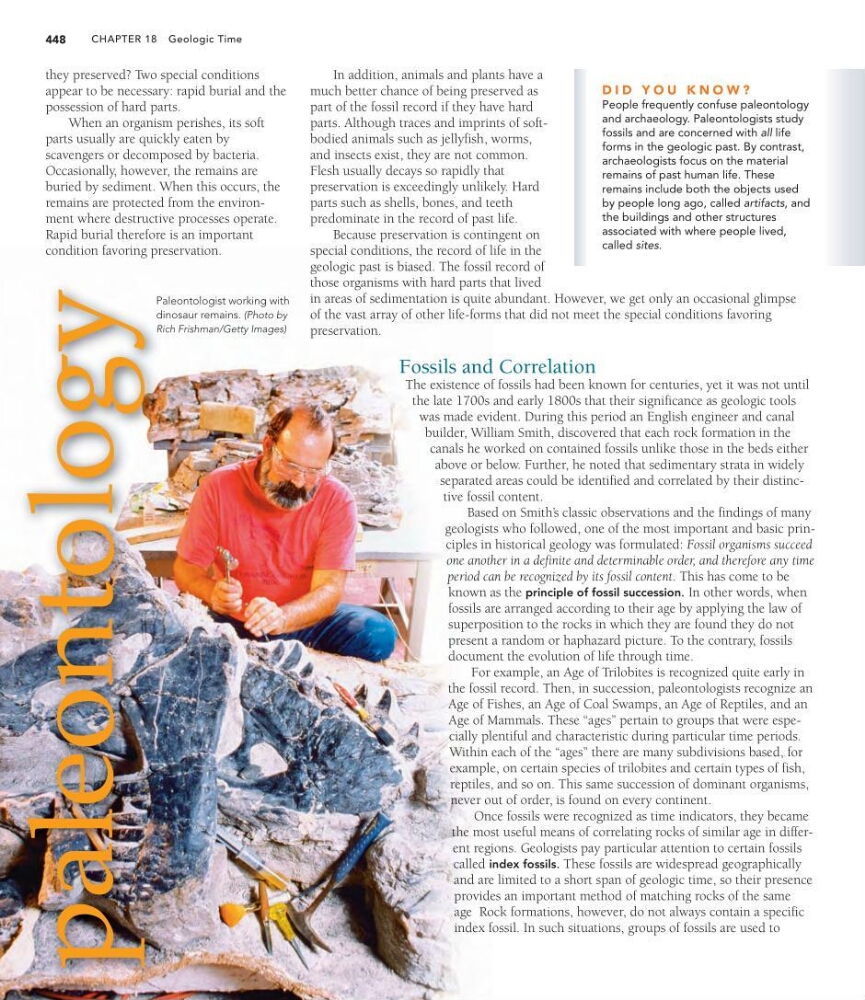
Paleontologist working with
dinosaur remains. (Photo by
Rich Frishman/Getty Images)
In addition, animals and plants have a
much better chance of being preserved as
part of the fossil record if they have hard
parts. Although traces and imprints of softbodied animals such as jellyfish, worms,
and insects exist, they are not common.
Flesh usually decays so rapidly that
preservation is exceedingly unlikely. Hard
parts such as shells, bones, and teeth
predominate in the record of past life.
Because preservation is contingent on
special conditions, the record of life in the
geologic past is biased. The fossil record of
those organisms with hard parts that lived
in areas of sedimentation is quite abundant. However, we get only an occasional glimpse
of the vast array of other life-forms that did not meet the special conditions favoring
preservation.
Fossils and Correlation
The existence of fossils had been known for centuries, yet it was not until
the late 1700s and early 1800s that their significance as geologic tools
was made evident. During this period an English engineer and canal
builder, William Smith, discovered that each rock formation in the
canals he worked on contained fossils unlike those in the beds either
above or below. Further, he noted that sedimentary strata in widely
separated areas could be identified and correlated by their distinctive fossil content.
Based on Smith’ s classic observations and the findings of many
geologists who followed, one of the most important and basic principles in historical geology was formulated: Fossil organisms succeed
one another in a definite and determinable order, and therefore any time
period can be recognized by its fossil content. This has come to be
known as the principle of fossil succession. In other words, when
fossils are arranged according to their age by applying the law of
superposition to the rocks in which they are found they do not
present a random or haphazard picture. To the contrary, fossils
document the evolution of life through time.
For example, an Age of Trilobites is recognized quite early in
the fossil record. Then, in succession, paleontologists recognize an
Age of Fishes, an Age of Coal Swamps, an Age of Reptiles, and an
Age of Mammals. These “ages” pertain to groups that were especially plentiful and characteristic during particular time periods.
Within each of the “ages” there are many subdivisions based, for
example, on certain species of trilobites and certain types of fish,
reptiles, and so on. This same succession of dominant organisms,
never out of order, is found on every continent.
Once fossils were recognized as time indicators, they became
the most useful means of correlating rocks of similar age in different regions. Geologists pay particular attention to certain fossils
called index fossils. These fossils are widespread geographically
and are limited to a short span of geologic time, so their presence
provides an important method of matching rocks of the same
age Rock formations, however, do not always contain a specific
index fossil. In such situations, groups of fossils are used to
they preserved? Two special conditions
appear to be necessary: rapid burial and the
possession of hard parts.
When an organism perishes, its soft
parts usually are quickly eaten by
scavengers or decomposed by bacteria.
Occasionally, however, the remains are
buried by sediment. When this occurs, the
remains are protected from the environment where destructive processes operate.
Rapid burial therefore is an important
condition favoring preservation.
D I D Y O U K N O W ?
People frequently confuse paleontology
and archaeology. Paleontologists study
fossils and are concerned with all life
forms in the geologic past. By contrast,
archaeologists focus on the material
remains of past human life. These
remains include both the objects used
by people long ago, called artifacts, and
the buildings and other structures
associated with where people lived,
called sites.
448
paleontology
Paleontologist working with
dinosaur remains. (Photo by
Rich Frishman/Getty Images)
In addition, animals and plants have a
much better chance of being preserved as
part of the fossil record if they have hard
parts. Although traces and imprints of softbodied animals such as jellyfish, worms,
and insects exist, they are not common.
Flesh usually decays so rapidly that
preservation is exceedingly unlikely. Hard
parts such as shells, bones, and teeth
predominate in the record of past life.
Because preservation is contingent on
special conditions, the record of life in the
geologic past is biased. The fossil record of
those organisms with hard parts that lived
in areas of sedimentation is quite abundant. However, we get only an occasional glimpse
of the vast array of other life-forms that did not meet the special conditions favoring
preservation.
Fossils and Correlation
The existence of fossils had been known for centuries, yet it was not until
the late 1700s and early 1800s that their significance as geologic tools
was made evident. During this period an English engineer and canal
builder, William Smith, discovered that each rock formation in the
canals he worked on contained fossils unlike those in the beds either
above or below. Further, he noted that sedimentary strata in widely
separated areas could be identified and correlated by their distinctive fossil content.
Based on Smith’ s classic observations and the findings of many
geologists who followed, one of the most important and basic principles in historical geology was formulated: Fossil organisms succeed
one another in a definite and determinable order, and therefore any time
period can be recognized by its fossil content. This has come to be
known as the principle of fossil succession. In other words, when
fossils are arranged according to their age by applying the law of
superposition to the rocks in which they are found they do not
present a random or haphazard picture. To the contrary, fossils
document the evolution of life through time.
For example, an Age of Trilobites is recognized quite early in
the fossil record. Then, in succession, paleontologists recognize an
Age of Fishes, an Age of Coal Swamps, an Age of Reptiles, and an
Age of Mammals. These “ages” pertain to groups that were especially plentiful and characteristic during particular time periods.
Within each of the “ages” there are many subdivisions based, for
example, on certain species of trilobites and certain types of fish,
reptiles, and so on. This same succession of dominant organisms,
never out of order, is found on every continent.
Once fossils were recognized as time indicators, they became
the most useful means of correlating rocks of similar age in different regions. Geologists pay particular attention to certain fossils
called index fossils. These fossils are widespread geographically
and are limited to a short span of geologic time, so their presence
provides an important method of matching rocks of the same
age Rock formations, however, do not always contain a specific
index fossil. In such situations, groups of fossils are used to
they preserved? Two special conditions
appear to be necessary: rapid burial and the
possession of hard parts.
When an organism perishes, its soft
parts usually are quickly eaten by
scavengers or decomposed by bacteria.
Occasionally, however, the remains are
buried by sediment. When this occurs, the
remains are protected from the environment where destructive processes operate.
Rapid burial therefore is an important
condition favoring preservation.
D I D Y O U K N O W ?
People frequently confuse paleontology
and archaeology. Paleontologists study
fossils and are concerned with all life
forms in the geologic past. By contrast,
archaeologists focus on the material
remains of past human life. These
remains include both the objects used
by people long ago, called artifacts, and
the buildings and other structures
associated with where people lived,
called sites.