

445
Fossils: Evidence of Past Life
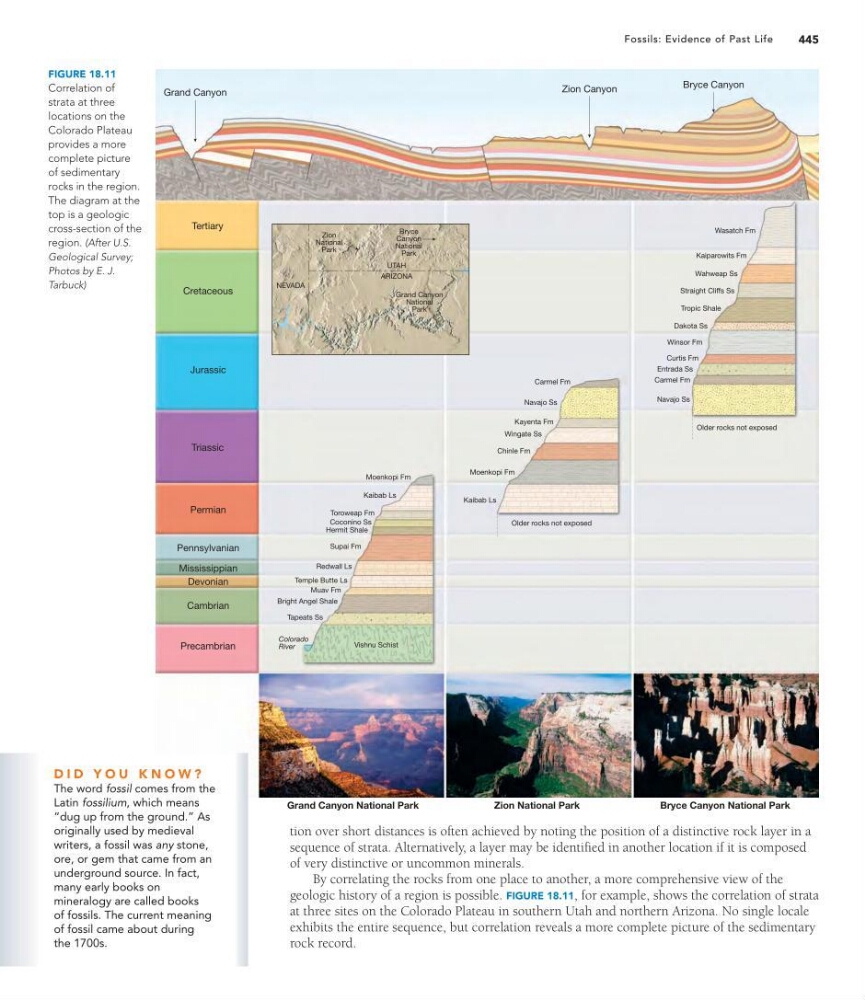
tion over short distances is often achieved by noting the position of a distinctive rock layer in a
sequence of strata. Alternatively, a layer may be identified in another location if it is composed
of very distinctive or uncommon minerals.
By correlating the rocks from one place to another, a more comprehensive view of the
geologic history of a region is possible. FIGURE 18.11, for example, shows the correlation of strata
at three sites on the Colorado Plateau in southern Utah and northern Arizona. No single locale
exhibits the entire sequence, but correlation reveals a more complete picture of the sedimentary
rock record.
Grand Canyon National Park
Zion National Park
Bryce Canyon National Park
Tertiary
Cretaceous
Jurassic
Triassic
Permian
Devonian
Pennsylvanian
Mississippian
Cambrian
Precambrian
Colorado
River
Moenkopi Fm
Kaibab Ls
Coconino Ss
Hermit Shale
Supai Fm
Redwall Ls
Temple Butte Ls
Bright Angel Shale
Tapeats Ss
Vishnu Schist
Carmel Fm
Navajo Ss
Kayenta Fm
Wingate Ss
Chinle Fm
Moenkopi Fm
Kaibab Ls
Older rocks not exposed
Wasatch Fm
Kaiparowits Fm
Wahweap Ss
Straight Cliffs Ss
Tropic Shale
Dakota Ss
Winsor Fm
Curtis Fm
Entrada Ss
Carmel Fm
Navajo Ss
Older rocks not exposed
Muav Fm
Toroweap Fm
NEVADA
UTAH
ARIZONA
Grand Canyon
National
Park
Zion
National
Park
Bryce
Canyon
National
Park
Bryce Canyon
Zion Canyon
Grand Canyon
FIGURE 18.11
Correlation of
strata at three
locations on the
Colorado Plateau
provides a more
complete picture
of sedimentary
rocks in the region.
The diagram at the
top is a geologic
cross-section of the
region. (After U.S.
Geological Survey;
Photos by E. J.
Tarbuck)
D I D Y O U K N O W ?
The word fossil comes from the
Latin fossilium, which means
“dug up from the ground.” As
originally used by medieval
writers, a fossil was any stone,
ore, or gem that came from an
underground source. In fact,
many early books on
mineralogy are called books
of fossils. The current meaning
of fossil came about during
the 1700s.
Fossils: Evidence of Past Life
tion over short distances is often achieved by noting the position of a distinctive rock layer in a
sequence of strata. Alternatively, a layer may be identified in another location if it is composed
of very distinctive or uncommon minerals.
By correlating the rocks from one place to another, a more comprehensive view of the
geologic history of a region is possible. FIGURE 18.11, for example, shows the correlation of strata
at three sites on the Colorado Plateau in southern Utah and northern Arizona. No single locale
exhibits the entire sequence, but correlation reveals a more complete picture of the sedimentary
rock record.
Grand Canyon National Park
Zion National Park
Bryce Canyon National Park
Tertiary
Cretaceous
Jurassic
Triassic
Permian
Devonian
Pennsylvanian
Mississippian
Cambrian
Precambrian
Colorado
River
Moenkopi Fm
Kaibab Ls
Coconino Ss
Hermit Shale
Supai Fm
Redwall Ls
Temple Butte Ls
Bright Angel Shale
Tapeats Ss
Vishnu Schist
Carmel Fm
Navajo Ss
Kayenta Fm
Wingate Ss
Chinle Fm
Moenkopi Fm
Kaibab Ls
Older rocks not exposed
Wasatch Fm
Kaiparowits Fm
Wahweap Ss
Straight Cliffs Ss
Tropic Shale
Dakota Ss
Winsor Fm
Curtis Fm
Entrada Ss
Carmel Fm
Navajo Ss
Older rocks not exposed
Muav Fm
Toroweap Fm
NEVADA
UTAH
ARIZONA
Grand Canyon
National
Park
Zion
National
Park
Bryce
Canyon
National
Park
Bryce Canyon
Zion Canyon
Grand Canyon
FIGURE 18.11
Correlation of
strata at three
locations on the
Colorado Plateau
provides a more
complete picture
of sedimentary
rocks in the region.
The diagram at the
top is a geologic
cross-section of the
region. (After U.S.
Geological Survey;
Photos by E. J.
Tarbuck)
D I D Y O U K N O W ?
The word fossil comes from the
Latin fossilium, which means
“dug up from the ground.” As
originally used by medieval
writers, a fossil was any stone,
ore, or gem that came from an
underground source. In fact,
many early books on
mineralogy are called books
of fossils. The current meaning
of fossil came about during
the 1700s.