

CHAPTER 18 Geologic Time
444
Correlation
of Rock Layers
To develop a geologic time scale that is
applicable to the entire Earth, rocks of
similar age in different regions must be
matched up. Such a task is referred to
as correlation.
Within a limited area, correlating the
rocks of one locality with those of another
may be done simply by walking along the
outcropping edges. However, this may not
be possible when the rocks are mostly
concealed by soil and vegetation. CorrelaK
J
I H G
F
E
D
C
B
A
Sill
F
B
A
E
D
C
E
C
B
A
F
Ocean
Uplift
Subsidence
Ocean
E
D
C
B
A
Angular
unconformity
Rock
eroded
away
Sill
Sill
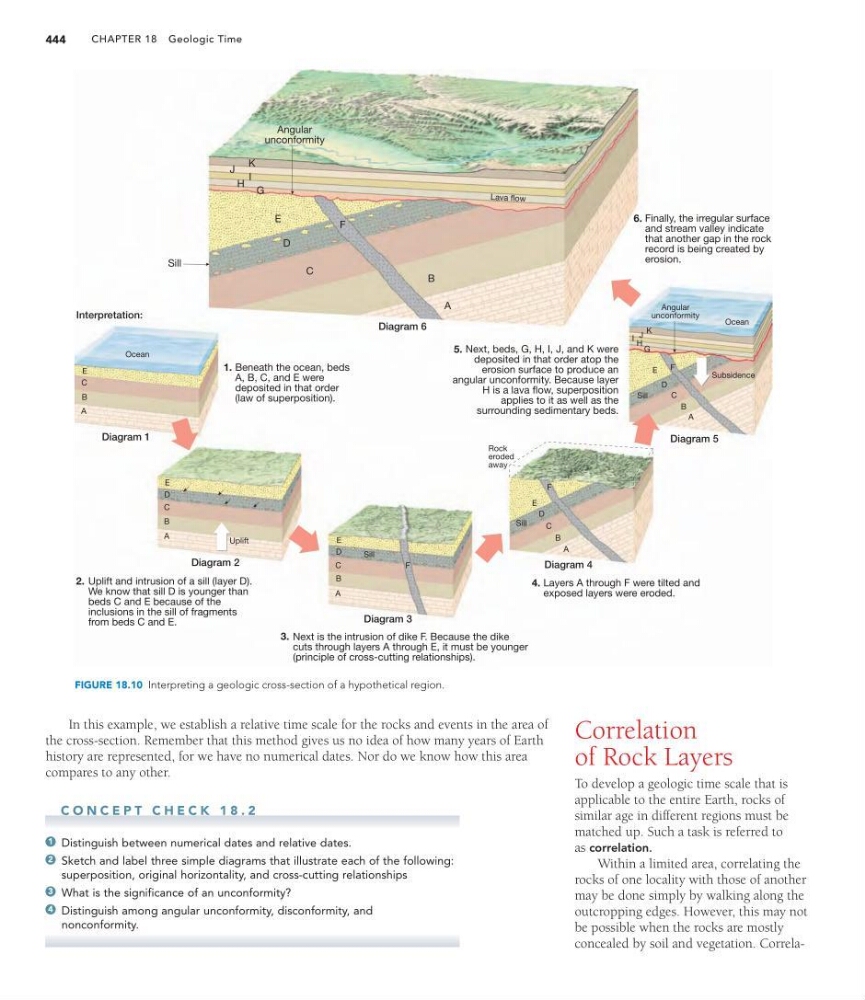
Next is the intrusion of dike F. Because the dike
cuts through layers A through E, it must be younger
(principle of cross-cutting relationships).
Uplift and intrusion of a sill (layer D).
We know that sill D is younger than
beds C and E because of the
inclusions in the sill of fragments
from beds C and E.
Beneath the ocean, beds
A, B, C, and E were
deposited in that order
(law of superposition).
1.
2.
3.
4.
5.
6.
Layers A through F were tilted and
exposed layers were eroded.
Next, beds, G, H, I, J, and K were
deposited in that order atop the
erosion surface to produce an
angular unconformity. Because layer
H is a lava flow, superposition
applies to it as well as the
surrounding sedimentary beds.
Finally, the irregular surface
and stream valley indicate
that another gap in the rock
record is being created by
erosion.
D
C
B
A
E
Interpretation:
Diagram 1
Diagram 2
Diagram 3
Diagram 4
Diagram 5
Diagram 6
K
J
I
H G
F
B
A
E
D
C
Angular
unconformity
Sill
Lava flow
FIGURE 18.10 Interpreting a geologic cross-section of a hypothetical region.
In this example, we establish a relative time scale for the rocks and events in the area of
the cross-section. Remember that this method gives us no idea of how many years of Earth
history are represented, for we have no numerical dates. Nor do we know how this area
compares to any other.
C O N C E P T C H E C K 1 8 . 2
Distinguish between numerical dates and relative dates.
Sketch and label three simple diagrams that illustrate each of the following:
superposition, original horizontality, and cross-cutting relationships
What is the significance of an unconformity?
Distinguish among angular unconformity, disconformity, and
nonconformity.
4
3
2
1
444
Correlation
of Rock Layers
To develop a geologic time scale that is
applicable to the entire Earth, rocks of
similar age in different regions must be
matched up. Such a task is referred to
as correlation.
Within a limited area, correlating the
rocks of one locality with those of another
may be done simply by walking along the
outcropping edges. However, this may not
be possible when the rocks are mostly
concealed by soil and vegetation. CorrelaK
J
I H G
F
E
D
C
B
A
Sill
F
B
A
E
D
C
E
C
B
A
F
Ocean
Uplift
Subsidence
Ocean
E
D
C
B
A
Angular
unconformity
Rock
eroded
away
Sill
Sill
Next is the intrusion of dike F. Because the dike
cuts through layers A through E, it must be younger
(principle of cross-cutting relationships).
Uplift and intrusion of a sill (layer D).
We know that sill D is younger than
beds C and E because of the
inclusions in the sill of fragments
from beds C and E.
Beneath the ocean, beds
A, B, C, and E were
deposited in that order
(law of superposition).
1.
2.
3.
4.
5.
6.
Layers A through F were tilted and
exposed layers were eroded.
Next, beds, G, H, I, J, and K were
deposited in that order atop the
erosion surface to produce an
angular unconformity. Because layer
H is a lava flow, superposition
applies to it as well as the
surrounding sedimentary beds.
Finally, the irregular surface
and stream valley indicate
that another gap in the rock
record is being created by
erosion.
D
C
B
A
E
Interpretation:
Diagram 1
Diagram 2
Diagram 3
Diagram 4
Diagram 5
Diagram 6
K
J
I
H G
F
B
A
E
D
C
Angular
unconformity
Sill
Lava flow
FIGURE 18.10 Interpreting a geologic cross-section of a hypothetical region.
In this example, we establish a relative time scale for the rocks and events in the area of
the cross-section. Remember that this method gives us no idea of how many years of Earth
history are represented, for we have no numerical dates. Nor do we know how this area
compares to any other.
C O N C E P T C H E C K 1 8 . 2
Distinguish between numerical dates and relative dates.
Sketch and label three simple diagrams that illustrate each of the following:
superposition, original horizontality, and cross-cutting relationships
What is the significance of an unconformity?
Distinguish among angular unconformity, disconformity, and
nonconformity.
4
3
2
1