

CHAPTER 18 Geologic Time
442
was deposited on top of a weathered
igneous mass rather than being intruded
from below by magma that later
crystallized.
Unconformities
When we observe layers of rock that
have been deposited essentially without
interruption, we call them conformable.
Particular sites exhibit conformable beds
representing certain spans of geologic time.
However, no place on Earth has a complete
set of conformable strata.
Throughout Earth history, the
deposition of sediment has been interrupted again and again. All such breaks
in the rock record are termed
unconformities. An unconformity
represents a long period during which
deposition ceased, erosion removed
previously formed rocks, and then deposition resumed. In each case, uplift and erosion are followed by subsidence and
renewed sedimentation. Unconformities are
important features because they represent
significant geologic events in Earth
history. Moreover, their recognition helps
us identify what intervals of time are not
represented by strata and thus are
missing from the geologic record.
The rocks exposed in the Grand
Canyon of the Colorado River represent
a tremendous span of geologic history. It
is a wonderful place to take a trip
through time. The canyon’ s colorful strata
record a long history of sedimentation in
a variety of environments—advancing seas,
rivers and deltas, tidal flats, and sand
dunes. The record is not continuous,
however. Unconformities represent vast
amounts of time that have not been
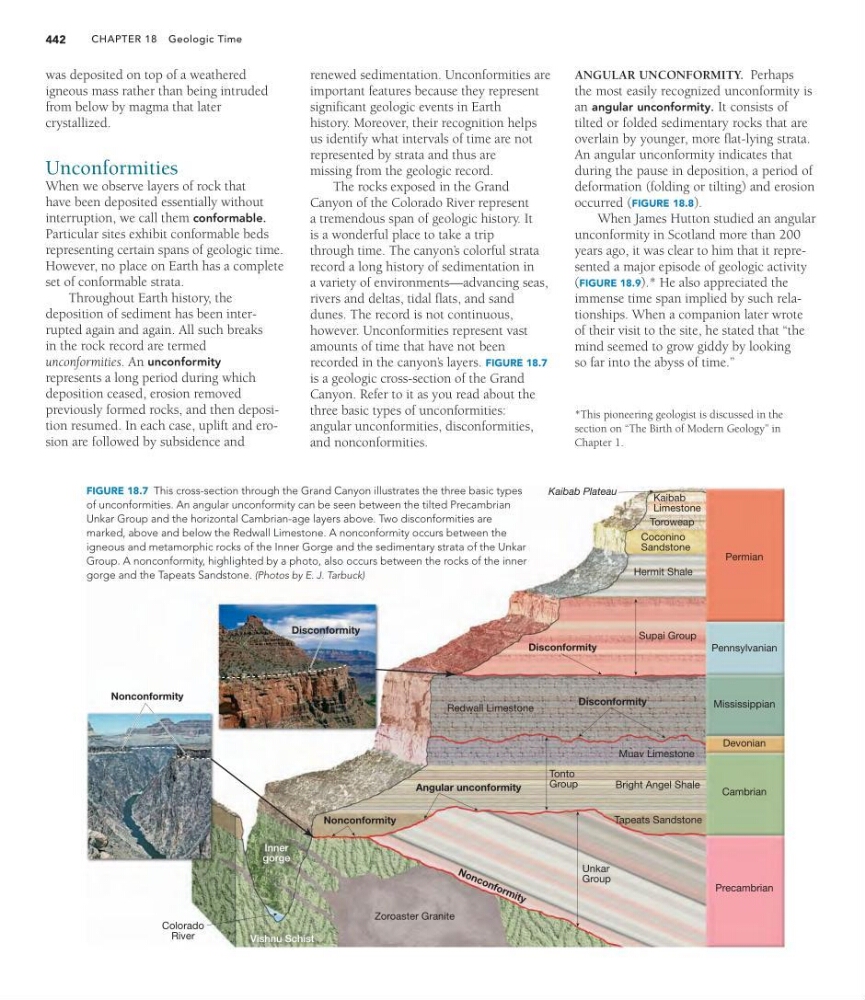
recorded in the canyon’ s layers. FIGURE 18.7
is a geologic cross-section of the Grand
Canyon. Refer to it as you read about the
three basic types of unconformities:
angular unconformities, disconformities,
and nonconformities.
ANGULAR UNCONFORMITY. Perhaps
the most easily recognized unconformity is
an angular unconformity. It consists of
tilted or folded sedimentary rocks that are
overlain by younger, more flat-lying strata.
An angular unconformity indicates that
during the pause in deposition, a period of
deformation (folding or tilting) and erosion
occurred (FIGURE 18.8).
When James Hutton studied an angular
unconformity in Scotland more than 200
years ago, it was clear to him that it represented a major episode of geologic activity
(FIGURE 18.9).* He also appreciated the
immense time span implied by such relationships. When a companion later wrote
of their visit to the site, he stated that “the
mind seemed to grow giddy by looking
so far into the abyss of time.”
Kaibab
Limestone
Toroweap
Coconino
Sandstone
Hermit Shale
Supai Group
Redwall Limestone
Muav Limestone
Bright Angel Shale
Tonto
Group
Tapeats Sandstone
Permian
Pennsylvanian
Mississippian
Devonian
Cambrian
Precambrian
Disconformity
Disconformity
Disconformity
Angular unconformity
N o n c o n f o r m it y
Vishnu Schist
Unkar
Group
Zoroaster Granite
Inner
gorge
Colorado
River
Kaibab Plateau
Nonconformity
Nonconformity
FIGURE 18.7 This cross-section through the Grand Canyon illustrates the three basic types
of unconformities. An angular unconformity can be seen between the tilted Precambrian
Unkar Group and the horizontal Cambrian-age layers above. Two disconformities are
marked, above and below the Redwall Limestone. A nonconformity occurs between the
igneous and metamorphic rocks of the Inner Gorge and the sedimentary strata of the Unkar
Group. A nonconformity, highlighted by a photo, also occurs between the rocks of the inner
gorge and the Tapeats Sandstone. (Photos by E. J. Tarbuck)
*This pioneering geologist is discussed in the
section on “The Birth of Modern Geology” in
Chapter 1.
442
was deposited on top of a weathered
igneous mass rather than being intruded
from below by magma that later
crystallized.
Unconformities
When we observe layers of rock that
have been deposited essentially without
interruption, we call them conformable.
Particular sites exhibit conformable beds
representing certain spans of geologic time.
However, no place on Earth has a complete
set of conformable strata.
Throughout Earth history, the
deposition of sediment has been interrupted again and again. All such breaks
in the rock record are termed
unconformities. An unconformity
represents a long period during which
deposition ceased, erosion removed
previously formed rocks, and then deposition resumed. In each case, uplift and erosion are followed by subsidence and
renewed sedimentation. Unconformities are
important features because they represent
significant geologic events in Earth
history. Moreover, their recognition helps
us identify what intervals of time are not
represented by strata and thus are
missing from the geologic record.
The rocks exposed in the Grand
Canyon of the Colorado River represent
a tremendous span of geologic history. It
is a wonderful place to take a trip
through time. The canyon’ s colorful strata
record a long history of sedimentation in
a variety of environments—advancing seas,
rivers and deltas, tidal flats, and sand
dunes. The record is not continuous,
however. Unconformities represent vast
amounts of time that have not been
recorded in the canyon’ s layers. FIGURE 18.7
is a geologic cross-section of the Grand
Canyon. Refer to it as you read about the
three basic types of unconformities:
angular unconformities, disconformities,
and nonconformities.
ANGULAR UNCONFORMITY. Perhaps
the most easily recognized unconformity is
an angular unconformity. It consists of
tilted or folded sedimentary rocks that are
overlain by younger, more flat-lying strata.
An angular unconformity indicates that
during the pause in deposition, a period of
deformation (folding or tilting) and erosion
occurred (FIGURE 18.8).
When James Hutton studied an angular
unconformity in Scotland more than 200
years ago, it was clear to him that it represented a major episode of geologic activity
(FIGURE 18.9).* He also appreciated the
immense time span implied by such relationships. When a companion later wrote
of their visit to the site, he stated that “the
mind seemed to grow giddy by looking
so far into the abyss of time.”
Kaibab
Limestone
Toroweap
Coconino
Sandstone
Hermit Shale
Supai Group
Redwall Limestone
Muav Limestone
Bright Angel Shale
Tonto
Group
Tapeats Sandstone
Permian
Pennsylvanian
Mississippian
Devonian
Cambrian
Precambrian
Disconformity
Disconformity
Disconformity
Angular unconformity
N o n c o n f o r m it y
Vishnu Schist
Unkar
Group
Zoroaster Granite
Inner
gorge
Colorado
River
Kaibab Plateau
Nonconformity
Nonconformity
FIGURE 18.7 This cross-section through the Grand Canyon illustrates the three basic types
of unconformities. An angular unconformity can be seen between the tilted Precambrian
Unkar Group and the horizontal Cambrian-age layers above. Two disconformities are
marked, above and below the Redwall Limestone. A nonconformity occurs between the
igneous and metamorphic rocks of the Inner Gorge and the sedimentary strata of the Unkar
Group. A nonconformity, highlighted by a photo, also occurs between the rocks of the inner
gorge and the Tapeats Sandstone. (Photos by E. J. Tarbuck)
*This pioneering geologist is discussed in the
section on “The Birth of Modern Geology” in
Chapter 1.