

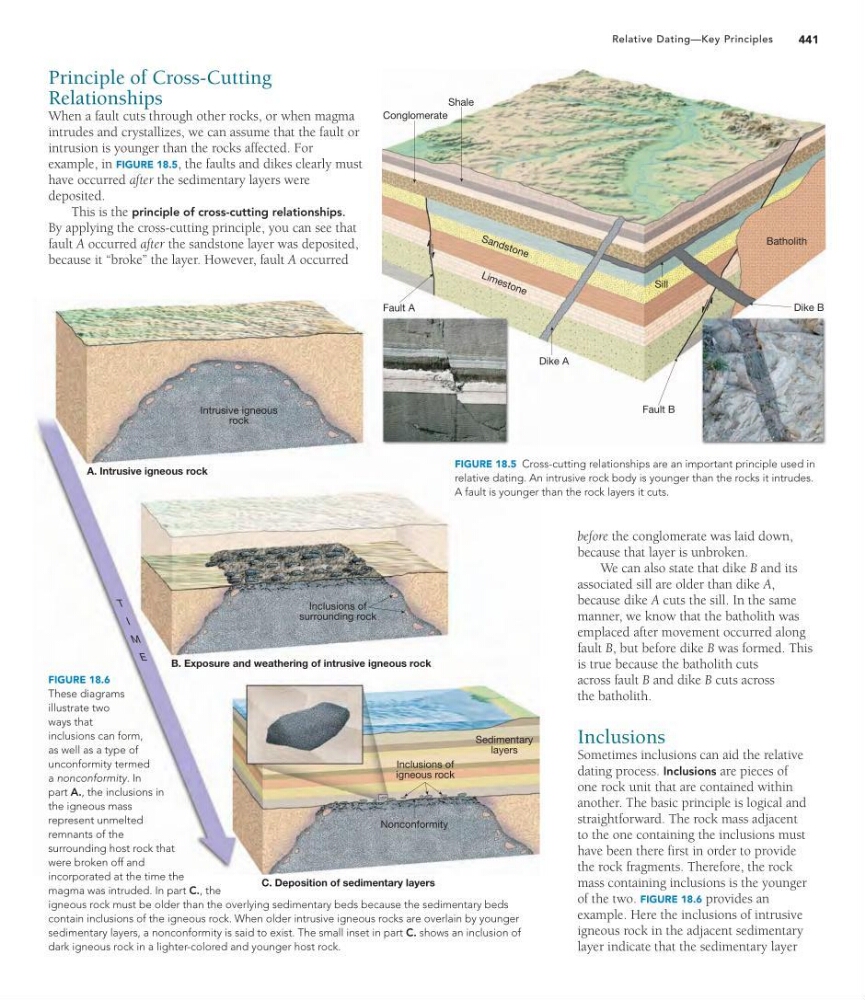
A. Intrusive igneous rock
B. Exposure and weathering of intrusive igneous rock
C. Deposition of sedimentary layers
Sedimentary
layers
Inclusions of
surrounding rock
Intrusive igneous
rock
Nonconformity
T
I
M
E
Inclusions of
igneous rock
441
Relative Dating—Key Principles
before the conglomerate was laid down,
because that layer is unbroken.
We can also state that dike B and its
associated sill are older than dike A,
because dike A cuts the sill. In the same
manner, we know that the batholith was
emplaced after movement occurred along
fault B, but before dike B was formed. This
is true because the batholith cuts
across fault B and dike B cuts across
the batholith.
Inclusions
Sometimes inclusions can aid the relative
dating process. Inclusions are pieces of
one rock unit that are contained within
another. The basic principle is logical and
straightforward. The rock mass adjacent
to the one containing the inclusions must
have been there first in order to provide
the rock fragments. Therefore, the rock
mass containing inclusions is the younger
of the two. FIGURE 18.6 provides an
example. Here the inclusions of intrusive
igneous rock in the adjacent sedimentary
layer indicate that the sedimentary layer
Principle of Cross-Cutting
Relationships
When a fault cuts through other rocks, or when magma
intrudes and crystallizes, we can assume that the fault or
intrusion is younger than the rocks affected. For
example, in FIGURE 18.5, the faults and dikes clearly must
have occurred after the sedimentary layers were
deposited.
This is the principle of cross-cutting relationships.
By applying the cross-cutting principle, you can see that
fault A occurred after the sandstone layer was deposited,
because it “broke” the layer. However, fault A occurred
FIGURE 18.6
These diagrams
illustrate two
ways that
inclusions can form,
as well as a type of
unconformity termed
a nonconformity. In
part A., the inclusions in
the igneous mass
represent unmelted
remnants of the
surrounding host rock that
were broken off and
incorporated at the time the
magma was intruded. In part C., the
igneous rock must be older than the overlying sedimentary beds because the sedimentary beds
contain inclusions of the igneous rock. When older intrusive igneous rocks are overlain by younger
sedimentary layers, a nonconformity is said to exist. The small inset in part C. shows an inclusion of
dark igneous rock in a lighter-colored and younger host rock.
Conglomerate
Shale
S a n d s to n e
L im e s to n e
Sill
Batholith
Fault A
Dike A
Fault B
Dike B
FIGURE 18.5 Cross-cutting relationships are an important principle used in
relative dating. An intrusive rock body is younger than the rocks it intrudes.
A fault is younger than the rock layers it cuts.
B. Exposure and weathering of intrusive igneous rock
C. Deposition of sedimentary layers
Sedimentary
layers
Inclusions of
surrounding rock
Intrusive igneous
rock
Nonconformity
T
I
M
E
Inclusions of
igneous rock
441
Relative Dating—Key Principles
before the conglomerate was laid down,
because that layer is unbroken.
We can also state that dike B and its
associated sill are older than dike A,
because dike A cuts the sill. In the same
manner, we know that the batholith was
emplaced after movement occurred along
fault B, but before dike B was formed. This
is true because the batholith cuts
across fault B and dike B cuts across
the batholith.
Inclusions
Sometimes inclusions can aid the relative
dating process. Inclusions are pieces of
one rock unit that are contained within
another. The basic principle is logical and
straightforward. The rock mass adjacent
to the one containing the inclusions must
have been there first in order to provide
the rock fragments. Therefore, the rock
mass containing inclusions is the younger
of the two. FIGURE 18.6 provides an
example. Here the inclusions of intrusive
igneous rock in the adjacent sedimentary
layer indicate that the sedimentary layer
Principle of Cross-Cutting
Relationships
When a fault cuts through other rocks, or when magma
intrudes and crystallizes, we can assume that the fault or
intrusion is younger than the rocks affected. For
example, in FIGURE 18.5, the faults and dikes clearly must
have occurred after the sedimentary layers were
deposited.
This is the principle of cross-cutting relationships.
By applying the cross-cutting principle, you can see that
fault A occurred after the sandstone layer was deposited,
because it “broke” the layer. However, fault A occurred
FIGURE 18.6
These diagrams
illustrate two
ways that
inclusions can form,
as well as a type of
unconformity termed
a nonconformity. In
part A., the inclusions in
the igneous mass
represent unmelted
remnants of the
surrounding host rock that
were broken off and
incorporated at the time the
magma was intruded. In part C., the
igneous rock must be older than the overlying sedimentary beds because the sedimentary beds
contain inclusions of the igneous rock. When older intrusive igneous rocks are overlain by younger
sedimentary layers, a nonconformity is said to exist. The small inset in part C. shows an inclusion of
dark igneous rock in a lighter-colored and younger host rock.
Conglomerate
Shale
S a n d s to n e
L im e s to n e
Sill
Batholith
Fault A
Dike A
Fault B
Dike B
FIGURE 18.5 Cross-cutting relationships are an important principle used in
relative dating. An intrusive rock body is younger than the rocks it intrudes.
A fault is younger than the rock layers it cuts.