

CHAPTER 18 Geologic Time
440
Relative dating means placing
rocks in their proper sequence of formation, first, second, third, and so on.
Relative dating cannot tell us how
long ago something took place, only
that it followed one event and preceded another. The relative dating
techniques that were developed are
valuable and still widely used.
Numerical dating methods did not
replace these techniques; they simply
supplemented them. To establish a relative
time scale, a few basic principles or rules
had to be discovered and applied.
Although they may seem obvious to us
today, they were major breakthroughs in
thinking at the time, and their discovery
and acceptance was an important scientific
achievement.
Law of Superposition
Nicolaus Steno, a Danish anatomist,
geologist, and priest (1636–1686), is
credited with being the first to recognize a
sequence of historical events in an outcrop
of sedimentary rock layers. Working in the
mountains of western Italy, Steno applied a
very simple rule that has come to be the
most basic principle of relative dating—the
law of superposition. The law simply
states that in an underformed sequence of
sedimentary rocks, each bed is older than
the one above it and younger than the one
below. Although it may seem obvious that a
rock layer could not be deposited unless it
had something older beneath it for support,
it was not until 1669 that Steno clearly
stated the principle.
This rule also applies to other surfacedeposited materials, such as lava flows
and beds of ash from volcanic eruptions.
Applying the law of superposition to the
beds exposed in the upper portion of the
Grand Canyon (FIGURE 18.3), you can easily
place the layers in their proper order.
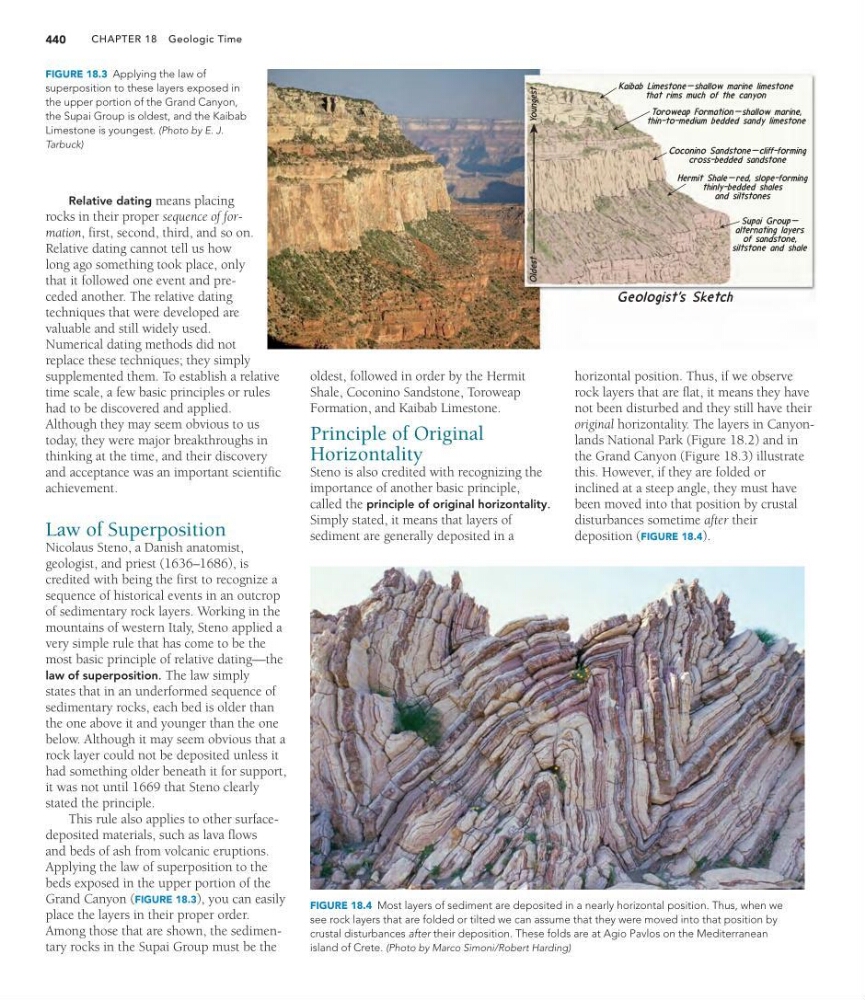
Among those that are shown, the sedimentary rocks in the Supai Group must be the
oldest, followed in order by the Hermit
Shale, Coconino Sandstone, Toroweap
Formation, and Kaibab Limestone.
Principle of Original
Horizontality
Steno is also credited with recognizing the
importance of another basic principle,
called the principle of original horizontality.
Simply stated, it means that layers of
sediment are generally deposited in a
FIGURE 18.3 Applying the law of
superposition to these layers exposed in
the upper portion of the Grand Canyon,
the Supai Group is oldest, and the Kaibab
Limestone is youngest. (Photo by E. J.
Tarbuck)
FIGURE 18.4 Most layers of sediment are deposited in a nearly horizontal position. Thus, when we
see rock layers that are folded or tilted we can assume that they were moved into that position by
crustal disturbances after their deposition. These folds are at Agio Pavlos on the Mediterranean
island of Crete. (Photo by Marco Simoni/Robert Harding)
horizontal position. Thus, if we observe
rock layers that are flat, it means they have
not been disturbed and they still have their
original horizontality. The layers in Canyonlands National Park (Figure 18.2) and in
the Grand Canyon (Figure 18.3) illustrate
this. However, if they are folded or
inclined at a steep angle, they must have
been moved into that position by crustal
disturbances sometime after their
deposition (FIGURE 18.4).
440
Relative dating means placing
rocks in their proper sequence of formation, first, second, third, and so on.
Relative dating cannot tell us how
long ago something took place, only
that it followed one event and preceded another. The relative dating
techniques that were developed are
valuable and still widely used.
Numerical dating methods did not
replace these techniques; they simply
supplemented them. To establish a relative
time scale, a few basic principles or rules
had to be discovered and applied.
Although they may seem obvious to us
today, they were major breakthroughs in
thinking at the time, and their discovery
and acceptance was an important scientific
achievement.
Law of Superposition
Nicolaus Steno, a Danish anatomist,
geologist, and priest (1636–1686), is
credited with being the first to recognize a
sequence of historical events in an outcrop
of sedimentary rock layers. Working in the
mountains of western Italy, Steno applied a
very simple rule that has come to be the
most basic principle of relative dating—the
law of superposition. The law simply
states that in an underformed sequence of
sedimentary rocks, each bed is older than
the one above it and younger than the one
below. Although it may seem obvious that a
rock layer could not be deposited unless it
had something older beneath it for support,
it was not until 1669 that Steno clearly
stated the principle.
This rule also applies to other surfacedeposited materials, such as lava flows
and beds of ash from volcanic eruptions.
Applying the law of superposition to the
beds exposed in the upper portion of the
Grand Canyon (FIGURE 18.3), you can easily
place the layers in their proper order.
Among those that are shown, the sedimentary rocks in the Supai Group must be the
oldest, followed in order by the Hermit
Shale, Coconino Sandstone, Toroweap
Formation, and Kaibab Limestone.
Principle of Original
Horizontality
Steno is also credited with recognizing the
importance of another basic principle,
called the principle of original horizontality.
Simply stated, it means that layers of
sediment are generally deposited in a
FIGURE 18.3 Applying the law of
superposition to these layers exposed in
the upper portion of the Grand Canyon,
the Supai Group is oldest, and the Kaibab
Limestone is youngest. (Photo by E. J.
Tarbuck)
FIGURE 18.4 Most layers of sediment are deposited in a nearly horizontal position. Thus, when we
see rock layers that are folded or tilted we can assume that they were moved into that position by
crustal disturbances after their deposition. These folds are at Agio Pavlos on the Mediterranean
island of Crete. (Photo by Marco Simoni/Robert Harding)
horizontal position. Thus, if we observe
rock layers that are flat, it means they have
not been disturbed and they still have their
original horizontality. The layers in Canyonlands National Park (Figure 18.2) and in
the Grand Canyon (Figure 18.3) illustrate
this. However, if they are folded or
inclined at a steep angle, they must have
been moved into that position by crustal
disturbances sometime after their
deposition (FIGURE 18.4).