

North
America
Microcontinent
Island arc
Africa
A. 600 million years ago
North
America
Blue Ridge/
Western
Piedmont
Island arc
Africa
T
I
M
E
B. 450–500 million years ago
North
America
Carolina Slate Belt/
Eastern
Piedmont
Africa
Ancestral
Atlantic
C. 400 million years ago
North
America
Valley
and Ridge
Province
Africa
D. 250–300 million years ago
CHAPTER 17 Crustal Deformation and Mountain Building
430
would account for the lofty landscape of southern Tibet, which has an
average elevation higher than Mount Whitney, the highest point in the
contiguous United States.
The collision with Asia slowed but did not stop the northward
migration of India, which has since penetrated at least 2000 kilometers (1200 miles) into the mainland of Asia. Crustal shortening
accommodated some of this motion. Much of the remaining penetration into Asia caused lateral displacement of large blocks of the
Asian crust by a mechanism described as continental escape. As
shown in FIGURE 17.22, when India continued its northward trek,
parts of Asia were “squeezed” eastward out of the collision zone.
These displaced crustal blocks include much of present-day
Indochina and sections of mainland China.
The Appalachians
The Appalachian Mountains provide great scenic beauty
near the eastern margin of North America from Alabama to
Newfoundland. In addition, mountains of similar origin that
formed during the same period are found in the British Isles,
Scandinavia, north-western Africa, and Greenland (see
Figure 15.6, p. 365). The orogeny that generated this
extensive mountain system that presently lies on both
sides of the North Atlantic lasted a few hundred million years and was one of the stages in assembling
the supercontinent of Pangaea. Detailed studies of
the Appalachians indicate that the formation of this
mountain belt was complex and resulted from three
distinct episodes of mountain building.
Our simplified overview begins roughly 750 million years ago with the break-up of a pre-Pangaea
supercontinent called Rodinia, which rifted
North America from Europe and Africa. This
episode of continental rifting and seafloor
spreading generated the ancestral North
Atlantic. Located within this developing
ocean basin was a fragment of continental
crust that had been rifted from North
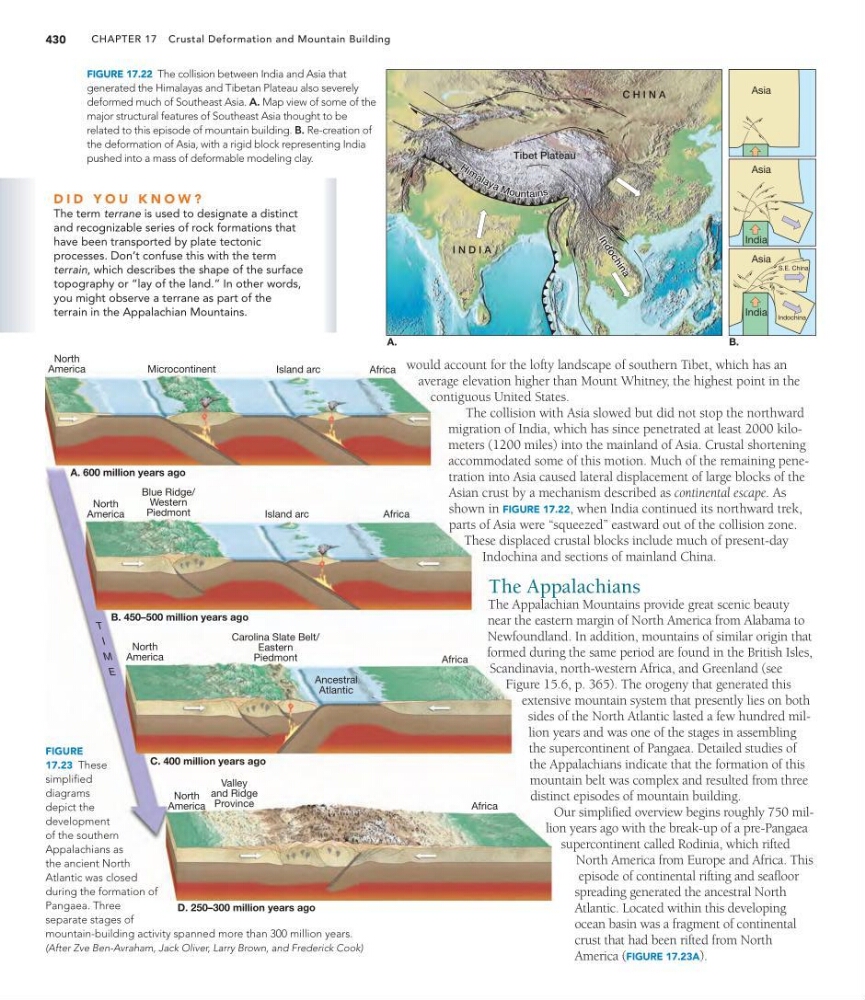
America (FIGURE 17.23A).
A.
B.
C H I N A
I N D I A
Tibet Plateau
I n d o c h i n a
H i m a la y a M o untains
Asia
Asia
India
Asia
India Indochina
S.E. China
FIGURE 17.22 The collision between India and Asia that
generated the Himalayas and Tibetan Plateau also severely
deformed much of Southeast Asia. A. Map view of some of the
major structural features of Southeast Asia thought to be
related to this episode of mountain building. B. Re-creation of
the deformation of Asia, with a rigid block representing India
pushed into a mass of deformable modeling clay.
D I D Y O U K N O W ?
The term terrane is used to designate a distinct
and recognizable series of rock formations that
have been transported by plate tectonic
processes. Don’t confuse this with the term
terrain, which describes the shape of the surface
topography or “lay of the land.” In other words,
you might observe a terrane as part of the
terrain in the Appalachian Mountains.
FIGURE
17.23 These
simplified
diagrams
depict the
development
of the southern
Appalachians as
the ancient North
Atlantic was closed
during the formation of
Pangaea. Three
separate stages of
mountain-building activity spanned more than 300 million years.
(After Zve Ben-Avraham, Jack Oliver, Larry Brown, and Frederick Cook)
America
Microcontinent
Island arc
Africa
A. 600 million years ago
North
America
Blue Ridge/
Western
Piedmont
Island arc
Africa
T
I
M
E
B. 450–500 million years ago
North
America
Carolina Slate Belt/
Eastern
Piedmont
Africa
Ancestral
Atlantic
C. 400 million years ago
North
America
Valley
and Ridge
Province
Africa
D. 250–300 million years ago
CHAPTER 17 Crustal Deformation and Mountain Building
430
would account for the lofty landscape of southern Tibet, which has an
average elevation higher than Mount Whitney, the highest point in the
contiguous United States.
The collision with Asia slowed but did not stop the northward
migration of India, which has since penetrated at least 2000 kilometers (1200 miles) into the mainland of Asia. Crustal shortening
accommodated some of this motion. Much of the remaining penetration into Asia caused lateral displacement of large blocks of the
Asian crust by a mechanism described as continental escape. As
shown in FIGURE 17.22, when India continued its northward trek,
parts of Asia were “squeezed” eastward out of the collision zone.
These displaced crustal blocks include much of present-day
Indochina and sections of mainland China.
The Appalachians
The Appalachian Mountains provide great scenic beauty
near the eastern margin of North America from Alabama to
Newfoundland. In addition, mountains of similar origin that
formed during the same period are found in the British Isles,
Scandinavia, north-western Africa, and Greenland (see
Figure 15.6, p. 365). The orogeny that generated this
extensive mountain system that presently lies on both
sides of the North Atlantic lasted a few hundred million years and was one of the stages in assembling
the supercontinent of Pangaea. Detailed studies of
the Appalachians indicate that the formation of this
mountain belt was complex and resulted from three
distinct episodes of mountain building.
Our simplified overview begins roughly 750 million years ago with the break-up of a pre-Pangaea
supercontinent called Rodinia, which rifted
North America from Europe and Africa. This
episode of continental rifting and seafloor
spreading generated the ancestral North
Atlantic. Located within this developing
ocean basin was a fragment of continental
crust that had been rifted from North
America (FIGURE 17.23A).
A.
B.
C H I N A
I N D I A
Tibet Plateau
I n d o c h i n a
H i m a la y a M o untains
Asia
Asia
India
Asia
India Indochina
S.E. China
FIGURE 17.22 The collision between India and Asia that
generated the Himalayas and Tibetan Plateau also severely
deformed much of Southeast Asia. A. Map view of some of the
major structural features of Southeast Asia thought to be
related to this episode of mountain building. B. Re-creation of
the deformation of Asia, with a rigid block representing India
pushed into a mass of deformable modeling clay.
D I D Y O U K N O W ?
The term terrane is used to designate a distinct
and recognizable series of rock formations that
have been transported by plate tectonic
processes. Don’t confuse this with the term
terrain, which describes the shape of the surface
topography or “lay of the land.” In other words,
you might observe a terrane as part of the
terrain in the Appalachian Mountains.
FIGURE
17.23 These
simplified
diagrams
depict the
development
of the southern
Appalachians as
the ancient North
Atlantic was closed
during the formation of
Pangaea. Three
separate stages of
mountain-building activity spanned more than 300 million years.
(After Zve Ben-Avraham, Jack Oliver, Larry Brown, and Frederick Cook)