

Continent
Trench
Inactive volcanic
island arc
Asthenosphere
Subdu cting o c e a n ic li t h o s p h e r e
A.
B.
Asthenosphere
C.
Asthenosphere
Subduc ting oc e a n ic li t h o s p h e r e
Inactive volcanic island
arc begins to collide
with continent
Continent
Accretion of
island arc
to continent
Continent
Former
island arc
T
I
M
E
CHAPTER 17 Crustal Deformation and Mountain Building
428
Many others were island arcs similar to Japan, the Philippines, and the Aleutian Islands.
Still others may have been submerged oceanic plateaus created by massive outpourings of
basaltic lavas associated with mantle plumes (FIGURE 17.18). More than 100 of these
relatively small crustal fragments are presently known
to exist.
ACCRETION AND OROGENESIS. As oceanic plates
move, they carry embedded oceanic plateaus,
volcanic island arcs, and microcontinents to an
Andean-type subduction zone. When an oceanic
plate contains small seamounts, these structures are
generally subducted along with the descending
oceanic slab. However, large thick units of oceanic
crust, such as the Ontong Java Plateau, which is the
size of Alaska, or an island arc composed of
abundant “light” igneous rocks, render the oceanic
lithosphere too buoyant to subduct. In these
situations, a collision between the crustal fragment
and the continental margin occurs.
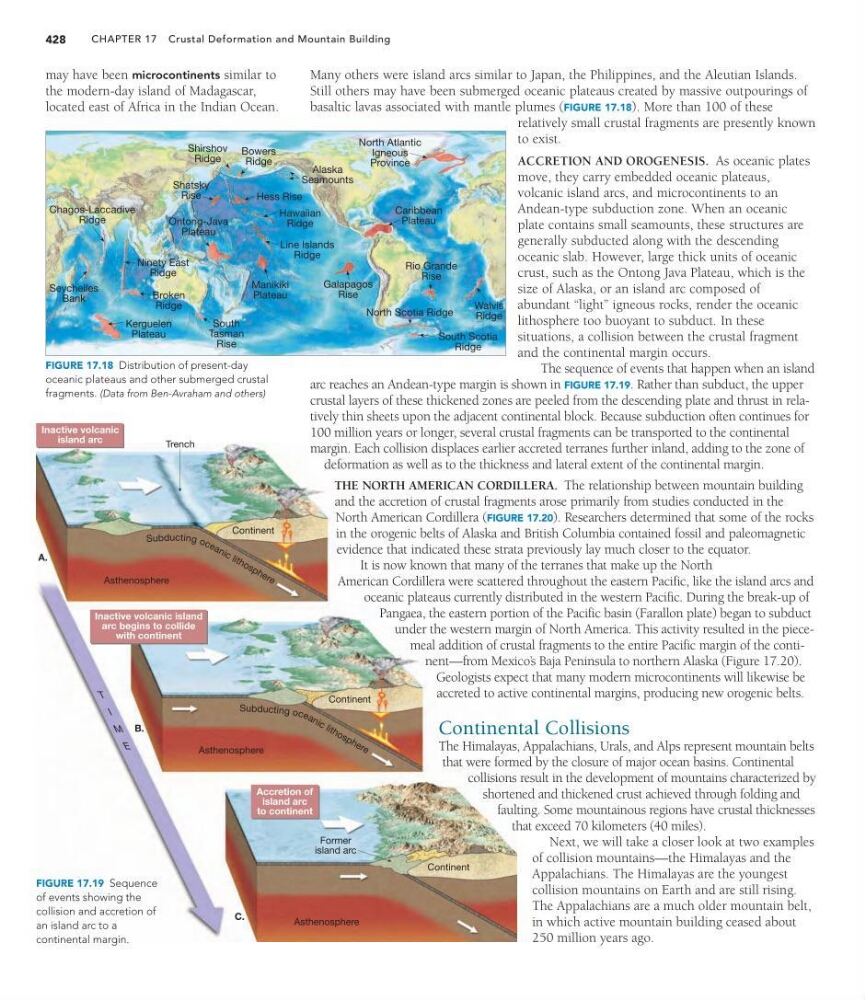
The sequence of events that happen when an island
arc reaches an Andean-type margin is shown in FIGURE 17.19. Rather than subduct, the upper
crustal layers of these thickened zones are peeled from the descending plate and thrust in relatively thin sheets upon the adjacent continental block. Because subduction often continues for
100 million years or longer, several crustal fragments can be transported to the continental
margin. Each collision displaces earlier accreted terranes further inland, adding to the zone of
deformation as well as to the thickness and lateral extent of the continental margin.
THE NORTH AMERICAN CORDILLERA. The relationship between mountain building
and the accretion of crustal fragments arose primarily from studies conducted in the
North American Cordillera (FIGURE 17.20). Researchers determined that some of the rocks
in the orogenic belts of Alaska and British Columbia contained fossil and paleomagnetic
evidence that indicated these strata previously lay much closer to the equator.
It is now known that many of the terranes that make up the North
American Cordillera were scattered throughout the eastern Pacific, like the island arcs and
oceanic plateaus currently distributed in the western Pacific. During the break-up of
Pangaea, the eastern portion of the Pacific basin (Farallon plate) began to subduct
under the western margin of North America. This activity resulted in the piecemeal addition of crustal fragments to the entire Pacific margin of the continent—from Mexico’ s Baja Peninsula to northern Alaska (Figure 17.20).
Geologists expect that many modern microcontinents will likewise be
accreted to active continental margins, producing new orogenic belts.
Continental Collisions
The Himalayas, Appalachians, Urals, and Alps represent mountain belts
that were formed by the closure of major ocean basins. Continental
collisions result in the development of mountains characterized by
shortened and thickened crust achieved through folding and
faulting. Some mountainous regions have crustal thicknesses
that exceed 70 kilometers (40 miles).
Next, we will take a closer look at two examples
of collision mountains—the Himalayas and the
Appalachians. The Himalayas are the youngest
collision mountains on Earth and are still rising.
The Appalachians are a much older mountain belt,
in which active mountain building ceased about
250 million years ago.
Seychelles
Bank
Chagos-Laccadive
Ridge
North Scotia Ridge
Kerguelen
Plateau
Broken
Ridge
Ninety East
Ridge
South
Tasman
Rise
Ontong-Java
Plateau
Manikiki
Plateau
Line Islands
Ridge
Hawaiian
Ridge
Hess Rise
Shatsky
Rise
Shirshov
Ridge
Bowers
Ridge
Alaska
Seamounts
Galapagos
Rise
Walvis
Ridge
Rio Grande
Rise
South Scotia
Ridge
Caribbean
Plateau
North Atlantic
Igneous
Province
FIGURE 17.18 Distribution of present-day
oceanic plateaus and other submerged crustal
fragments. (Data from Ben-Avraham and others)
FIGURE 17.19 Sequence
of events showing the
collision and accretion of
an island arc to a
continental margin.
may have been microcontinents similar to
the modern-day island of Madagascar,
located east of Africa in the Indian Ocean.
Trench
Inactive volcanic
island arc
Asthenosphere
Subdu cting o c e a n ic li t h o s p h e r e
A.
B.
Asthenosphere
C.
Asthenosphere
Subduc ting oc e a n ic li t h o s p h e r e
Inactive volcanic island
arc begins to collide
with continent
Continent
Accretion of
island arc
to continent
Continent
Former
island arc
T
I
M
E
CHAPTER 17 Crustal Deformation and Mountain Building
428
Many others were island arcs similar to Japan, the Philippines, and the Aleutian Islands.
Still others may have been submerged oceanic plateaus created by massive outpourings of
basaltic lavas associated with mantle plumes (FIGURE 17.18). More than 100 of these
relatively small crustal fragments are presently known
to exist.
ACCRETION AND OROGENESIS. As oceanic plates
move, they carry embedded oceanic plateaus,
volcanic island arcs, and microcontinents to an
Andean-type subduction zone. When an oceanic
plate contains small seamounts, these structures are
generally subducted along with the descending
oceanic slab. However, large thick units of oceanic
crust, such as the Ontong Java Plateau, which is the
size of Alaska, or an island arc composed of
abundant “light” igneous rocks, render the oceanic
lithosphere too buoyant to subduct. In these
situations, a collision between the crustal fragment
and the continental margin occurs.
The sequence of events that happen when an island
arc reaches an Andean-type margin is shown in FIGURE 17.19. Rather than subduct, the upper
crustal layers of these thickened zones are peeled from the descending plate and thrust in relatively thin sheets upon the adjacent continental block. Because subduction often continues for
100 million years or longer, several crustal fragments can be transported to the continental
margin. Each collision displaces earlier accreted terranes further inland, adding to the zone of
deformation as well as to the thickness and lateral extent of the continental margin.
THE NORTH AMERICAN CORDILLERA. The relationship between mountain building
and the accretion of crustal fragments arose primarily from studies conducted in the
North American Cordillera (FIGURE 17.20). Researchers determined that some of the rocks
in the orogenic belts of Alaska and British Columbia contained fossil and paleomagnetic
evidence that indicated these strata previously lay much closer to the equator.
It is now known that many of the terranes that make up the North
American Cordillera were scattered throughout the eastern Pacific, like the island arcs and
oceanic plateaus currently distributed in the western Pacific. During the break-up of
Pangaea, the eastern portion of the Pacific basin (Farallon plate) began to subduct
under the western margin of North America. This activity resulted in the piecemeal addition of crustal fragments to the entire Pacific margin of the continent—from Mexico’ s Baja Peninsula to northern Alaska (Figure 17.20).
Geologists expect that many modern microcontinents will likewise be
accreted to active continental margins, producing new orogenic belts.
Continental Collisions
The Himalayas, Appalachians, Urals, and Alps represent mountain belts
that were formed by the closure of major ocean basins. Continental
collisions result in the development of mountains characterized by
shortened and thickened crust achieved through folding and
faulting. Some mountainous regions have crustal thicknesses
that exceed 70 kilometers (40 miles).
Next, we will take a closer look at two examples
of collision mountains—the Himalayas and the
Appalachians. The Himalayas are the youngest
collision mountains on Earth and are still rising.
The Appalachians are a much older mountain belt,
in which active mountain building ceased about
250 million years ago.
Seychelles
Bank
Chagos-Laccadive
Ridge
North Scotia Ridge
Kerguelen
Plateau
Broken
Ridge
Ninety East
Ridge
South
Tasman
Rise
Ontong-Java
Plateau
Manikiki
Plateau
Line Islands
Ridge
Hawaiian
Ridge
Hess Rise
Shatsky
Rise
Shirshov
Ridge
Bowers
Ridge
Alaska
Seamounts
Galapagos
Rise
Walvis
Ridge
Rio Grande
Rise
South Scotia
Ridge
Caribbean
Plateau
North Atlantic
Igneous
Province
FIGURE 17.18 Distribution of present-day
oceanic plateaus and other submerged crustal
fragments. (Data from Ben-Avraham and others)
FIGURE 17.19 Sequence
of events showing the
collision and accretion of
an island arc to a
continental margin.
may have been microcontinents similar to
the modern-day island of Madagascar,
located east of Africa in the Indian Ocean.