

427
Collisional Mountain Belts
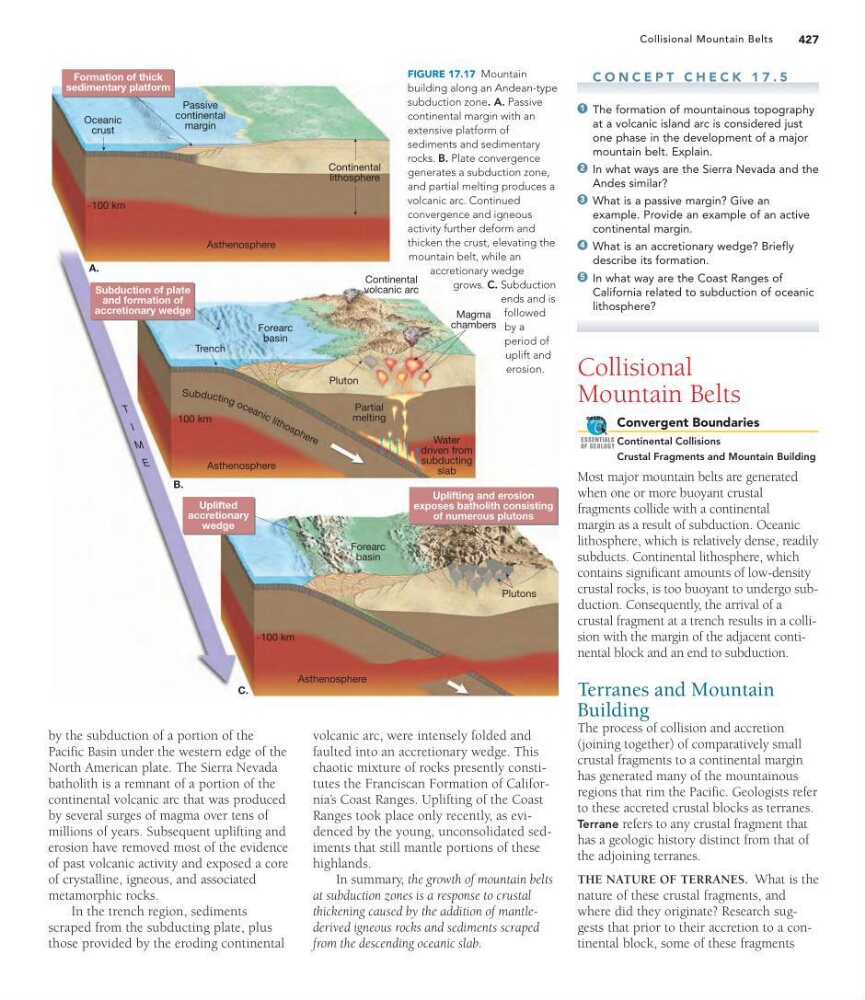
by the subduction of a portion of the
Pacific Basin under the western edge of the
North American plate. The Sierra Nevada
batholith is a remnant of a portion of the
continental volcanic arc that was produced
by several surges of magma over tens of
millions of years. Subsequent uplifting and
erosion have removed most of the evidence
of past volcanic activity and exposed a core
of crystalline, igneous, and associated
metamorphic rocks.
In the trench region, sediments
scraped from the subducting plate, plus
those provided by the eroding continental
volcanic arc, were intensely folded and
faulted into an accretionary wedge. This
chaotic mixture of rocks presently constitutes the Franciscan Formation of California’ s Coast Ranges. Uplifting of the Coast
Ranges took place only recently, as evidenced by the young, unconsolidated sediments that still mantle portions of these
highlands.
In summary, the growth of mountain belts
at subduction zones is a response to crustal
thickening caused by the addition of mantlederived igneous rocks and sediments scraped
from the descending oceanic slab.
C O N C E P T C H E C K 1 7 . 5
The formation of mountainous topography
at a volcanic island arc is considered just
one phase in the development of a major
mountain belt. Explain.
In what ways are the Sierra Nevada and the
Andes similar?
What is a passive margin? Give an
example. Provide an example of an active
continental margin.
What is an accretionary wedge? Briefly
describe its formation.
In what way are the Coast Ranges of
California related to subduction of oceanic
lithosphere?
Collisional
Mountain Belts
Convergent Boundaries
Continental Collisions
Crustal Fragments and Mountain Building
Most major mountain belts are generated
when one or more buoyant crustal
fragments collide with a continental
margin as a result of subduction. Oceanic
lithosphere, which is relatively dense, readily
subducts. Continental lithosphere, which
contains significant amounts of low-density
crustal rocks, is too buoyant to undergo subduction. Consequently, the arrival of a
crustal fragment at a trench results in a collision with the margin of the adjacent continental block and an end to subduction.
Terranes and Mountain
Building
The process of collision and accretion
(joining together) of comparatively small
crustal fragments to a continental margin
has generated many of the mountainous
regions that rim the Pacific. Geologists refer
to these accreted crustal blocks as terranes.
Terrane refers to any crustal fragment that
has a geologic history distinct from that of
the adjoining terranes.
THE NATURE OF TERRANES. What is the
nature of these crustal fragments, and
where did they originate? Research suggests that prior to their accretion to a continental block, some of these fragments
GEODe
ESSENTIALS
OF GEOLOGY
5
4
3
2
1
A.
Oceanic
crust
Asthenosphere
Passive
continental
margin
Continental
lithosphere
B.
100 km
T
I
M
E
Trench
Subduction of plate
and formation of
accretionary wedge
Forearc
basin
Continental
volcanic arc
Partial
melting
Asthenosphere
C.
Uplifted
accretionary
wedge
Asthenosphere
Formation of thick
sedimentary platform
100 km
Uplifting and erosion
exposes batholith consisting
of numerous plutons
Water
driven from
subducting
slab
Magma
chambers
100 km
Forearc
basin
Plutons
Pluton
Sub du ct in g o c e a n ic li t h o s p h e r e
FIGURE 17.17 Mountain
building along an Andean-type
subduction zone. A. Passive
continental margin with an
extensive platform of
sediments and sedimentary
rocks. B. Plate convergence
generates a subduction zone,
and partial melting produces a
volcanic arc. Continued
convergence and igneous
activity further deform and
thicken the crust, elevating the
mountain belt, while an
accretionary wedge
grows. C. Subduction
ends and is
followed
by a
period of
uplift and
erosion.
Collisional Mountain Belts
by the subduction of a portion of the
Pacific Basin under the western edge of the
North American plate. The Sierra Nevada
batholith is a remnant of a portion of the
continental volcanic arc that was produced
by several surges of magma over tens of
millions of years. Subsequent uplifting and
erosion have removed most of the evidence
of past volcanic activity and exposed a core
of crystalline, igneous, and associated
metamorphic rocks.
In the trench region, sediments
scraped from the subducting plate, plus
those provided by the eroding continental
volcanic arc, were intensely folded and
faulted into an accretionary wedge. This
chaotic mixture of rocks presently constitutes the Franciscan Formation of California’ s Coast Ranges. Uplifting of the Coast
Ranges took place only recently, as evidenced by the young, unconsolidated sediments that still mantle portions of these
highlands.
In summary, the growth of mountain belts
at subduction zones is a response to crustal
thickening caused by the addition of mantlederived igneous rocks and sediments scraped
from the descending oceanic slab.
C O N C E P T C H E C K 1 7 . 5
The formation of mountainous topography
at a volcanic island arc is considered just
one phase in the development of a major
mountain belt. Explain.
In what ways are the Sierra Nevada and the
Andes similar?
What is a passive margin? Give an
example. Provide an example of an active
continental margin.
What is an accretionary wedge? Briefly
describe its formation.
In what way are the Coast Ranges of
California related to subduction of oceanic
lithosphere?
Collisional
Mountain Belts
Convergent Boundaries
Continental Collisions
Crustal Fragments and Mountain Building
Most major mountain belts are generated
when one or more buoyant crustal
fragments collide with a continental
margin as a result of subduction. Oceanic
lithosphere, which is relatively dense, readily
subducts. Continental lithosphere, which
contains significant amounts of low-density
crustal rocks, is too buoyant to undergo subduction. Consequently, the arrival of a
crustal fragment at a trench results in a collision with the margin of the adjacent continental block and an end to subduction.
Terranes and Mountain
Building
The process of collision and accretion
(joining together) of comparatively small
crustal fragments to a continental margin
has generated many of the mountainous
regions that rim the Pacific. Geologists refer
to these accreted crustal blocks as terranes.
Terrane refers to any crustal fragment that
has a geologic history distinct from that of
the adjoining terranes.
THE NATURE OF TERRANES. What is the
nature of these crustal fragments, and
where did they originate? Research suggests that prior to their accretion to a continental block, some of these fragments
GEODe
ESSENTIALS
OF GEOLOGY
5
4
3
2
1
A.
Oceanic
crust
Asthenosphere
Passive
continental
margin
Continental
lithosphere
B.
100 km
T
I
M
E
Trench
Subduction of plate
and formation of
accretionary wedge
Forearc
basin
Continental
volcanic arc
Partial
melting
Asthenosphere
C.
Uplifted
accretionary
wedge
Asthenosphere
Formation of thick
sedimentary platform
100 km
Uplifting and erosion
exposes batholith consisting
of numerous plutons
Water
driven from
subducting
slab
Magma
chambers
100 km
Forearc
basin
Plutons
Pluton
Sub du ct in g o c e a n ic li t h o s p h e r e
FIGURE 17.17 Mountain
building along an Andean-type
subduction zone. A. Passive
continental margin with an
extensive platform of
sediments and sedimentary
rocks. B. Plate convergence
generates a subduction zone,
and partial melting produces a
volcanic arc. Continued
convergence and igneous
activity further deform and
thicken the crust, elevating the
mountain belt, while an
accretionary wedge
grows. C. Subduction
ends and is
followed
by a
period of
uplift and
erosion.