

CHAPTER 17 Crustal Deformation and Mountain Building
426
thick accumulations of sediments that have
been deposited along the flanks of landmasses. Together, these processes thicken
and shorten the continental crust, thereby
elevating rocks that may have formed near
the ocean floor to lofty heights.
To unravel the events that produce
mountains, researchers examine ancient
mountain structures as well as sites where
orogenesis is currently active. Of particular
interest are active subduction zones, where
lithospheric plates are converging. Here the
subduction of oceanic lithosphere generates
Earth’ s strongest earthquakes and most
explosive volcanic eruptions, as well as
playing a pivotal role in generating many
of Earth’ s mountain belts.
The subduction of oceanic lithosphere
gives rise to two different types of tectonic
structures. Where oceanic lithosphere
subducts beneath an oceanic plate, a
volcanic island arc and related tectonic
features develop. Subduction beneath a continental block, on the other hand, results in
the formation of a volcanic arc along the
margin of a continent. Plate boundaries that
generate continental volcanic arcs are
referred to as Andean-type plate margins.
Volcanic Island Arcs
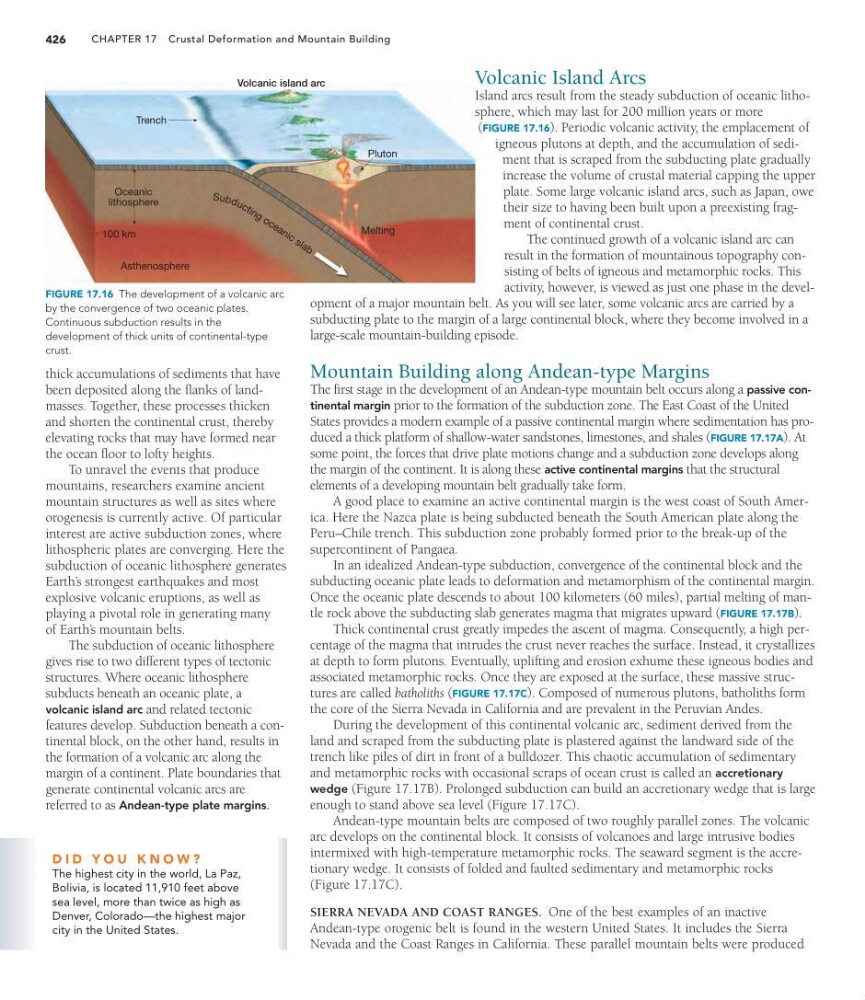
Island arcs result from the steady subduction of oceanic lithosphere, which may last for 200 million years or more
(FIGURE 17.16). Periodic volcanic activity, the emplacement of
igneous plutons at depth, and the accumulation of sediment that is scraped from the subducting plate gradually
increase the volume of crustal material capping the upper
plate. Some large volcanic island arcs, such as Japan, owe
their size to having been built upon a preexisting fragment of continental crust.
The continued growth of a volcanic island arc can
result in the formation of mountainous topography consisting of belts of igneous and metamorphic rocks. This
activity, however, is viewed as just one phase in the development of a major mountain belt. As you will see later, some volcanic arcs are carried by a
subducting plate to the margin of a large continental block, where they become involved in a
large-scale mountain-building episode.
Mountain Building along Andean-type Margins
The first stage in the development of an Andean-type mountain belt occurs along a passive continental margin prior to the formation of the subduction zone. The East Coast of the United
States provides a modern example of a passive continental margin where sedimentation has produced a thick platform of shallow-water sandstones, limestones, and shales (FIGURE 17.17A). At
some point, the forces that drive plate motions change and a subduction zone develops along
the margin of the continent. It is along these active continental margins that the structural
elements of a developing mountain belt gradually take form.
A good place to examine an active continental margin is the west coast of South America. Here the Nazca plate is being subducted beneath the South American plate along the
Peru–Chile trench. This subduction zone probably formed prior to the break-up of the
supercontinent of Pangaea.
In an idealized Andean-type subduction, convergence of the continental block and the
subducting oceanic plate leads to deformation and metamorphism of the continental margin.
Once the oceanic plate descends to about 100 kilometers (60 miles), partial melting of mantle rock above the subducting slab generates magma that migrates upward (FIGURE 17.17B).
Thick continental crust greatly impedes the ascent of magma. Consequently, a high percentage of the magma that intrudes the crust never reaches the surface. Instead, it crystallizes
at depth to form plutons. Eventually, uplifting and erosion exhume these igneous bodies and
associated metamorphic rocks. Once they are exposed at the surface, these massive structures are called batholiths (FIGURE 17.17C). Composed of numerous plutons, batholiths form
the core of the Sierra Nevada in California and are prevalent in the Peruvian Andes.
During the development of this continental volcanic arc, sediment derived from the
land and scraped from the subducting plate is plastered against the landward side of the
trench like piles of dirt in front of a bulldozer. This chaotic accumulation of sedimentary
and metamorphic rocks with occasional scraps of ocean crust is called an accretionary
wedge (Figure 17.17B). Prolonged subduction can build an accretionary wedge that is large
enough to stand above sea level (Figure 17.17C).
Andean-type mountain belts are composed of two roughly parallel zones. The volcanic
arc develops on the continental block. It consists of volcanoes and large intrusive bodies
intermixed with high-temperature metamorphic rocks. The seaward segment is the accretionary wedge. It consists of folded and faulted sedimentary and metamorphic rocks
(Figure 17.17C).
SIERRA NEVADA AND COAST RANGES. One of the best examples of an inactive
Andean-type orogenic belt is found in the western United States. It includes the Sierra
Nevada and the Coast Ranges in California. These parallel mountain belts were produced
Asthenosphere
Oceanic
lithosphere
Trench
Volcanic island arc
Pluton
Su b d u c t in g o c e a n i c s l a b
100 km
Melting
D I D Y O U K N O W ?
The highest city in the world, La Paz,
Bolivia, is located 11,910 feet above
sea level, more than twice as high as
Denver, Colorado—the highest major
city in the United States.
FIGURE 17.16 The development of a volcanic arc
by the convergence of two oceanic plates.
Continuous subduction results in the
development of thick units of continental-type
crust.
426
thick accumulations of sediments that have
been deposited along the flanks of landmasses. Together, these processes thicken
and shorten the continental crust, thereby
elevating rocks that may have formed near
the ocean floor to lofty heights.
To unravel the events that produce
mountains, researchers examine ancient
mountain structures as well as sites where
orogenesis is currently active. Of particular
interest are active subduction zones, where
lithospheric plates are converging. Here the
subduction of oceanic lithosphere generates
Earth’ s strongest earthquakes and most
explosive volcanic eruptions, as well as
playing a pivotal role in generating many
of Earth’ s mountain belts.
The subduction of oceanic lithosphere
gives rise to two different types of tectonic
structures. Where oceanic lithosphere
subducts beneath an oceanic plate, a
volcanic island arc and related tectonic
features develop. Subduction beneath a continental block, on the other hand, results in
the formation of a volcanic arc along the
margin of a continent. Plate boundaries that
generate continental volcanic arcs are
referred to as Andean-type plate margins.
Volcanic Island Arcs
Island arcs result from the steady subduction of oceanic lithosphere, which may last for 200 million years or more
(FIGURE 17.16). Periodic volcanic activity, the emplacement of
igneous plutons at depth, and the accumulation of sediment that is scraped from the subducting plate gradually
increase the volume of crustal material capping the upper
plate. Some large volcanic island arcs, such as Japan, owe
their size to having been built upon a preexisting fragment of continental crust.
The continued growth of a volcanic island arc can
result in the formation of mountainous topography consisting of belts of igneous and metamorphic rocks. This
activity, however, is viewed as just one phase in the development of a major mountain belt. As you will see later, some volcanic arcs are carried by a
subducting plate to the margin of a large continental block, where they become involved in a
large-scale mountain-building episode.
Mountain Building along Andean-type Margins
The first stage in the development of an Andean-type mountain belt occurs along a passive continental margin prior to the formation of the subduction zone. The East Coast of the United
States provides a modern example of a passive continental margin where sedimentation has produced a thick platform of shallow-water sandstones, limestones, and shales (FIGURE 17.17A). At
some point, the forces that drive plate motions change and a subduction zone develops along
the margin of the continent. It is along these active continental margins that the structural
elements of a developing mountain belt gradually take form.
A good place to examine an active continental margin is the west coast of South America. Here the Nazca plate is being subducted beneath the South American plate along the
Peru–Chile trench. This subduction zone probably formed prior to the break-up of the
supercontinent of Pangaea.
In an idealized Andean-type subduction, convergence of the continental block and the
subducting oceanic plate leads to deformation and metamorphism of the continental margin.
Once the oceanic plate descends to about 100 kilometers (60 miles), partial melting of mantle rock above the subducting slab generates magma that migrates upward (FIGURE 17.17B).
Thick continental crust greatly impedes the ascent of magma. Consequently, a high percentage of the magma that intrudes the crust never reaches the surface. Instead, it crystallizes
at depth to form plutons. Eventually, uplifting and erosion exhume these igneous bodies and
associated metamorphic rocks. Once they are exposed at the surface, these massive structures are called batholiths (FIGURE 17.17C). Composed of numerous plutons, batholiths form
the core of the Sierra Nevada in California and are prevalent in the Peruvian Andes.
During the development of this continental volcanic arc, sediment derived from the
land and scraped from the subducting plate is plastered against the landward side of the
trench like piles of dirt in front of a bulldozer. This chaotic accumulation of sedimentary
and metamorphic rocks with occasional scraps of ocean crust is called an accretionary
wedge (Figure 17.17B). Prolonged subduction can build an accretionary wedge that is large
enough to stand above sea level (Figure 17.17C).
Andean-type mountain belts are composed of two roughly parallel zones. The volcanic
arc develops on the continental block. It consists of volcanoes and large intrusive bodies
intermixed with high-temperature metamorphic rocks. The seaward segment is the accretionary wedge. It consists of folded and faulted sedimentary and metamorphic rocks
(Figure 17.17C).
SIERRA NEVADA AND COAST RANGES. One of the best examples of an inactive
Andean-type orogenic belt is found in the western United States. It includes the Sierra
Nevada and the Coast Ranges in California. These parallel mountain belts were produced
Asthenosphere
Oceanic
lithosphere
Trench
Volcanic island arc
Pluton
Su b d u c t in g o c e a n i c s l a b
100 km
Melting
D I D Y O U K N O W ?
The highest city in the world, La Paz,
Bolivia, is located 11,910 feet above
sea level, more than twice as high as
Denver, Colorado—the highest major
city in the United States.
FIGURE 17.16 The development of a volcanic arc
by the convergence of two oceanic plates.
Continuous subduction results in the
development of thick units of continental-type
crust.