

425
Mountain Building at Subduction Zones
Mountain Building
Mountain building has occurred in the recent geologic past at several locations around the
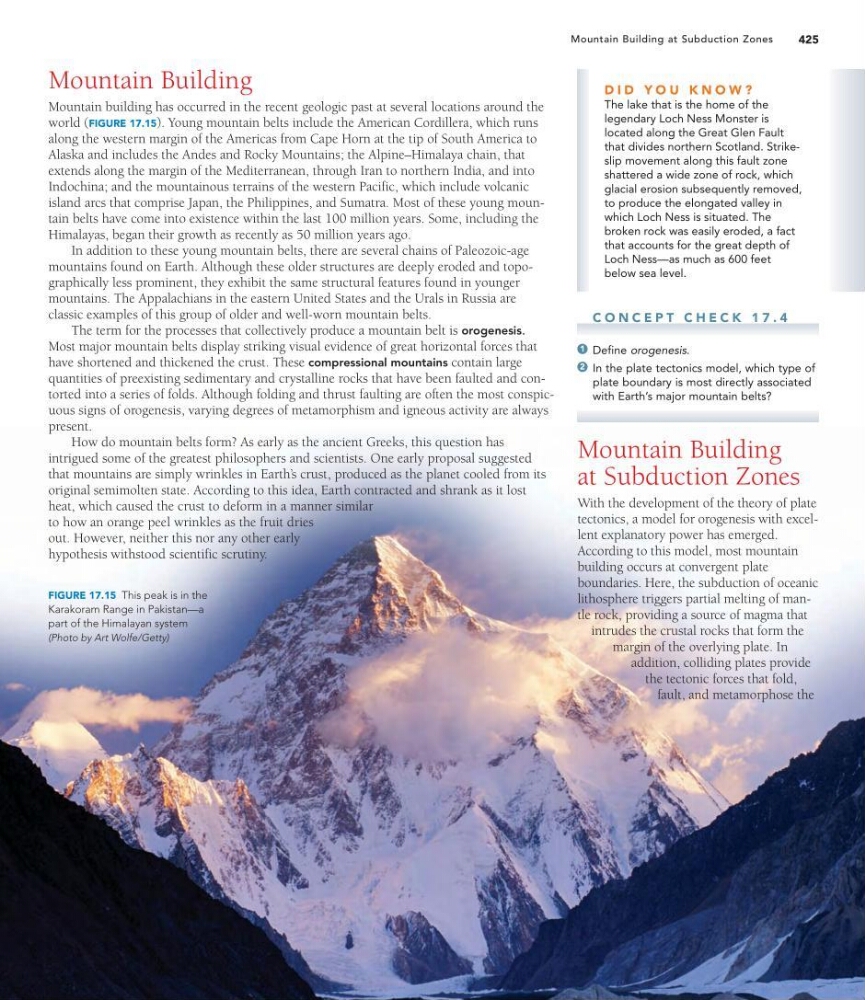
world (FIGURE 17.15). Young mountain belts include the American Cordillera, which runs
along the western margin of the Americas from Cape Horn at the tip of South America to
Alaska and includes the Andes and Rocky Mountains; the Alpine–Himalaya chain, that
extends along the margin of the Mediterranean, through Iran to northern India, and into
Indochina; and the mountainous terrains of the western Pacific, which include volcanic
island arcs that comprise Japan, the Philippines, and Sumatra. Most of these young mountain belts have come into existence within the last 100 million years. Some, including the
Himalayas, began their growth as recently as 50 million years ago.
In addition to these young mountain belts, there are several chains of Paleozoic-age
mountains found on Earth. Although these older structures are deeply eroded and topographically less prominent, they exhibit the same structural features found in younger
mountains. The Appalachians in the eastern United States and the Urals in Russia are
classic examples of this group of older and well-worn mountain belts.
The term for the processes that collectively produce a mountain belt is orogenesis.
Most major mountain belts display striking visual evidence of great horizontal forces that
have shortened and thickened the crust. These compressional mountains contain large
quantities of preexisting sedimentary and crystalline rocks that have been faulted and contorted into a series of folds. Although folding and thrust faulting are often the most conspicuous signs of orogenesis, varying degrees of metamorphism and igneous activity are always
present.
How do mountain belts form? As early as the ancient Greeks, this question has
intrigued some of the greatest philosophers and scientists. One early proposal suggested
that mountains are simply wrinkles in Earth’ s crust, produced as the planet cooled from its
original semimolten state. According to this idea, Earth contracted and shrank as it lost
heat, which caused the crust to deform in a manner similar
to how an orange peel wrinkles as the fruit dries
out. However, neither this nor any other early
hypothesis withstood scientific scrutiny.
C O N C E P T C H E C K 1 7 . 4
Define orogenesis.
In the plate tectonics model, which type of
plate boundary is most directly associated
with Earth’s major mountain belts?
Mountain Building
at Subduction Zones
With the development of the theory of plate
tectonics, a model for orogenesis with excellent explanatory power has emerged.
According to this model, most mountain
building occurs at convergent plate
boundaries. Here, the subduction of oceanic
lithosphere triggers partial melting of mantle rock, providing a source of magma that
intrudes the crustal rocks that form the
margin of the overlying plate. In
addition, colliding plates provide
the tectonic forces that fold,
fault, and metamorphose the
2
1
D I D Y O U K N O W ?
The lake that is the home of the
legendary Loch Ness Monster is
located along the Great Glen Fault
that divides northern Scotland. Strikeslip movement along this fault zone
shattered a wide zone of rock, which
glacial erosion subsequently removed,
to produce the elongated valley in
which Loch Ness is situated. The
broken rock was easily eroded, a fact
that accounts for the great depth of
Loch Ness—as much as 600 feet
below sea level.
FIGURE 17.15 This peak is in the
Karakoram Range in Pakistan—a
part of the Himalayan system
(Photo by Art Wolfe/Getty)
Mountain Building at Subduction Zones
Mountain Building
Mountain building has occurred in the recent geologic past at several locations around the
world (FIGURE 17.15). Young mountain belts include the American Cordillera, which runs
along the western margin of the Americas from Cape Horn at the tip of South America to
Alaska and includes the Andes and Rocky Mountains; the Alpine–Himalaya chain, that
extends along the margin of the Mediterranean, through Iran to northern India, and into
Indochina; and the mountainous terrains of the western Pacific, which include volcanic
island arcs that comprise Japan, the Philippines, and Sumatra. Most of these young mountain belts have come into existence within the last 100 million years. Some, including the
Himalayas, began their growth as recently as 50 million years ago.
In addition to these young mountain belts, there are several chains of Paleozoic-age
mountains found on Earth. Although these older structures are deeply eroded and topographically less prominent, they exhibit the same structural features found in younger
mountains. The Appalachians in the eastern United States and the Urals in Russia are
classic examples of this group of older and well-worn mountain belts.
The term for the processes that collectively produce a mountain belt is orogenesis.
Most major mountain belts display striking visual evidence of great horizontal forces that
have shortened and thickened the crust. These compressional mountains contain large
quantities of preexisting sedimentary and crystalline rocks that have been faulted and contorted into a series of folds. Although folding and thrust faulting are often the most conspicuous signs of orogenesis, varying degrees of metamorphism and igneous activity are always
present.
How do mountain belts form? As early as the ancient Greeks, this question has
intrigued some of the greatest philosophers and scientists. One early proposal suggested
that mountains are simply wrinkles in Earth’ s crust, produced as the planet cooled from its
original semimolten state. According to this idea, Earth contracted and shrank as it lost
heat, which caused the crust to deform in a manner similar
to how an orange peel wrinkles as the fruit dries
out. However, neither this nor any other early
hypothesis withstood scientific scrutiny.
C O N C E P T C H E C K 1 7 . 4
Define orogenesis.
In the plate tectonics model, which type of
plate boundary is most directly associated
with Earth’s major mountain belts?
Mountain Building
at Subduction Zones
With the development of the theory of plate
tectonics, a model for orogenesis with excellent explanatory power has emerged.
According to this model, most mountain
building occurs at convergent plate
boundaries. Here, the subduction of oceanic
lithosphere triggers partial melting of mantle rock, providing a source of magma that
intrudes the crustal rocks that form the
margin of the overlying plate. In
addition, colliding plates provide
the tectonic forces that fold,
fault, and metamorphose the
2
1
D I D Y O U K N O W ?
The lake that is the home of the
legendary Loch Ness Monster is
located along the Great Glen Fault
that divides northern Scotland. Strikeslip movement along this fault zone
shattered a wide zone of rock, which
glacial erosion subsequently removed,
to produce the elongated valley in
which Loch Ness is situated. The
broken rock was easily eroded, a fact
that accounts for the great depth of
Loch Ness—as much as 600 feet
below sea level.
FIGURE 17.15 This peak is in the
Karakoram Range in Pakistan—a
part of the Himalayan system
(Photo by Art Wolfe/Getty)