

D I D Y O U K N O W ?
New Zealander Edmund Hillary and Tenzing Norgay of Nepal were the first
to reach the summit of Mount Everest on May 29, 1953. Not one to rest on
his laurels, Hillary later went on to lead the first crossing of Antarctica.
CHAPTER 17 Crustal Deformation and Mountain Building
424
ing oceanic ridges. Others accommodate displacement between continental plates that move
horizontally with respect to each other. One of the best-known transform faults is California’ s
San Andreas Fault. This plate-bounding fault can be traced for about 950 kilometers (600
miles) from the Gulf of California to a point along the Pacific Coast north of San Francisco,
where it heads out to sea. Since its formation about 30 million years ago, displacement along
the San Andreas Fault has exceeded 560 kilometers. This movement has accommodated the
northward displacement of southwestern California and the Baja Peninsula of Mexico in relation to the remainder of North America.
Joints
Among the most common rock structures are fractures called joints. Unlike faults, joints are
fractures along which no appreciable displacement has occurred. Although some joints have
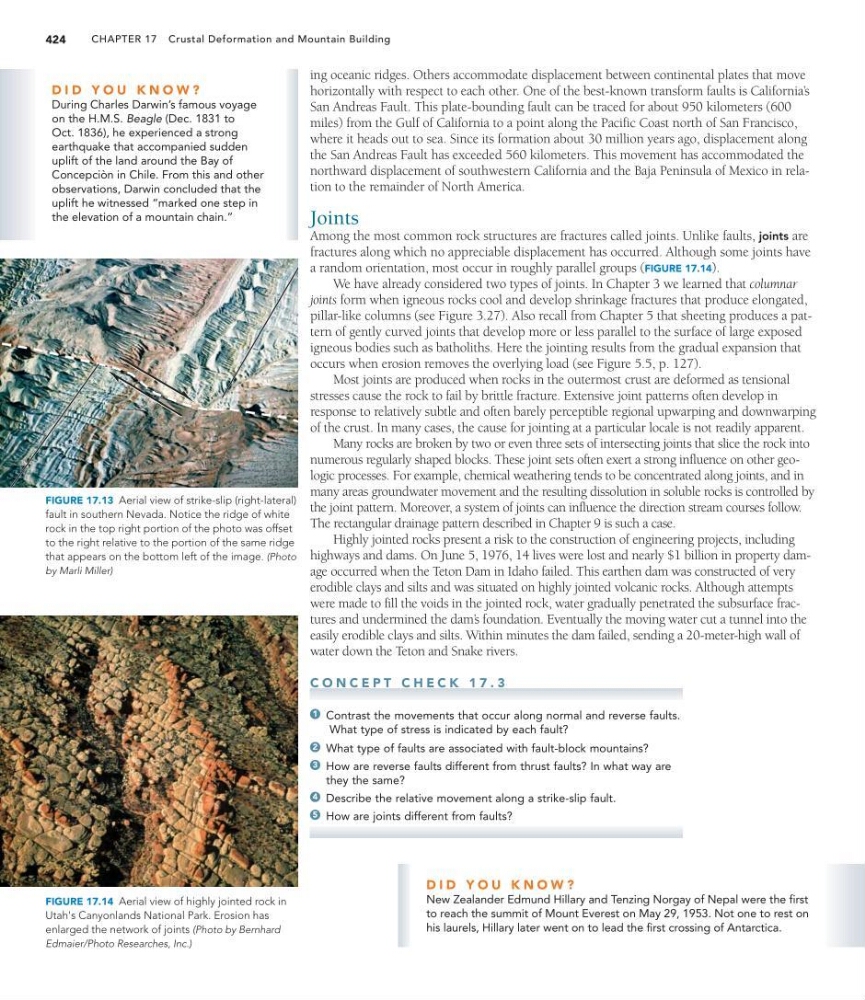
a random orientation, most occur in roughly parallel groups (FIGURE 17.14).
We have already considered two types of joints. In Chapter 3 we learned that columnar
joints form when igneous rocks cool and develop shrinkage fractures that produce elongated,
pillar-like columns (see Figure 3.27). Also recall from Chapter 5 that sheeting produces a pattern of gently curved joints that develop more or less parallel to the surface of large exposed
igneous bodies such as batholiths. Here the jointing results from the gradual expansion that
occurs when erosion removes the overlying load (see Figure 5.5, p. 127).
Most joints are produced when rocks in the outermost crust are deformed as tensional
stresses cause the rock to fail by brittle fracture. Extensive joint patterns often develop in
response to relatively subtle and often barely perceptible regional upwarping and downwarping
of the crust. In many cases, the cause for jointing at a particular locale is not readily apparent.
Many rocks are broken by two or even three sets of intersecting joints that slice the rock into
numerous regularly shaped blocks. These joint sets often exert a strong influence on other geologic processes. For example, chemical weathering tends to be concentrated along joints, and in
many areas groundwater movement and the resulting dissolution in soluble rocks is controlled by
the joint pattern. Moreover, a system of joints can influence the direction stream courses follow.
The rectangular drainage pattern described in Chapter 9 is such a case.
Highly jointed rocks present a risk to the construction of engineering projects, including
highways and dams. On June 5, 1976, 14 lives were lost and nearly $1 billion in property damage occurred when the Teton Dam in Idaho failed. This earthen dam was constructed of very
erodible clays and silts and was situated on highly jointed volcanic rocks. Although attempts
were made to fill the voids in the jointed rock, water gradually penetrated the subsurface fractures and undermined the dam’ s foundation. Eventually the moving water cut a tunnel into the
easily erodible clays and silts. Within minutes the dam failed, sending a 20-meter-high wall of
water down the Teton and Snake rivers.
C O N C E P T C H E C K 1 7 . 3
Contrast the movements that occur along normal and reverse faults.
What type of stress is indicated by each fault?
What type of faults are associated with fault-block mountains?
How are reverse faults different from thrust faults? In what way are
they the same?
Describe the relative movement along a strike-slip fault.
How are joints different from faults?
5
4
3
2
1
D I D Y O U K N O W ?
During Charles Darwin’s famous voyage
on the H.M.S. Beagle (Dec. 1831 to
Oct. 1836), he experienced a strong
earthquake that accompanied sudden
uplift of the land around the Bay of
Concepciòn in Chile. From this and other
observations, Darwin concluded that the
uplift he witnessed “marked one step in
the elevation of a mountain chain.”
FIGURE 17.13 Aerial view of strike-slip (right-lateral)
fault in southern Nevada. Notice the ridge of white
rock in the top right portion of the photo was offset
to the right relative to the portion of the same ridge
that appears on the bottom left of the image. (Photo
by Marli Miller)
FIGURE 17.14 Aerial view of highly jointed rock in
Utah's Canyonlands National Park. Erosion has
enlarged the network of joints (Photo by Bernhard
Edmaier/Photo Researches, Inc.)
New Zealander Edmund Hillary and Tenzing Norgay of Nepal were the first
to reach the summit of Mount Everest on May 29, 1953. Not one to rest on
his laurels, Hillary later went on to lead the first crossing of Antarctica.
CHAPTER 17 Crustal Deformation and Mountain Building
424
ing oceanic ridges. Others accommodate displacement between continental plates that move
horizontally with respect to each other. One of the best-known transform faults is California’ s
San Andreas Fault. This plate-bounding fault can be traced for about 950 kilometers (600
miles) from the Gulf of California to a point along the Pacific Coast north of San Francisco,
where it heads out to sea. Since its formation about 30 million years ago, displacement along
the San Andreas Fault has exceeded 560 kilometers. This movement has accommodated the
northward displacement of southwestern California and the Baja Peninsula of Mexico in relation to the remainder of North America.
Joints
Among the most common rock structures are fractures called joints. Unlike faults, joints are
fractures along which no appreciable displacement has occurred. Although some joints have
a random orientation, most occur in roughly parallel groups (FIGURE 17.14).
We have already considered two types of joints. In Chapter 3 we learned that columnar
joints form when igneous rocks cool and develop shrinkage fractures that produce elongated,
pillar-like columns (see Figure 3.27). Also recall from Chapter 5 that sheeting produces a pattern of gently curved joints that develop more or less parallel to the surface of large exposed
igneous bodies such as batholiths. Here the jointing results from the gradual expansion that
occurs when erosion removes the overlying load (see Figure 5.5, p. 127).
Most joints are produced when rocks in the outermost crust are deformed as tensional
stresses cause the rock to fail by brittle fracture. Extensive joint patterns often develop in
response to relatively subtle and often barely perceptible regional upwarping and downwarping
of the crust. In many cases, the cause for jointing at a particular locale is not readily apparent.
Many rocks are broken by two or even three sets of intersecting joints that slice the rock into
numerous regularly shaped blocks. These joint sets often exert a strong influence on other geologic processes. For example, chemical weathering tends to be concentrated along joints, and in
many areas groundwater movement and the resulting dissolution in soluble rocks is controlled by
the joint pattern. Moreover, a system of joints can influence the direction stream courses follow.
The rectangular drainage pattern described in Chapter 9 is such a case.
Highly jointed rocks present a risk to the construction of engineering projects, including
highways and dams. On June 5, 1976, 14 lives were lost and nearly $1 billion in property damage occurred when the Teton Dam in Idaho failed. This earthen dam was constructed of very
erodible clays and silts and was situated on highly jointed volcanic rocks. Although attempts
were made to fill the voids in the jointed rock, water gradually penetrated the subsurface fractures and undermined the dam’ s foundation. Eventually the moving water cut a tunnel into the
easily erodible clays and silts. Within minutes the dam failed, sending a 20-meter-high wall of
water down the Teton and Snake rivers.
C O N C E P T C H E C K 1 7 . 3
Contrast the movements that occur along normal and reverse faults.
What type of stress is indicated by each fault?
What type of faults are associated with fault-block mountains?
How are reverse faults different from thrust faults? In what way are
they the same?
Describe the relative movement along a strike-slip fault.
How are joints different from faults?
5
4
3
2
1
D I D Y O U K N O W ?
During Charles Darwin’s famous voyage
on the H.M.S. Beagle (Dec. 1831 to
Oct. 1836), he experienced a strong
earthquake that accompanied sudden
uplift of the land around the Bay of
Concepciòn in Chile. From this and other
observations, Darwin concluded that the
uplift he witnessed “marked one step in
the elevation of a mountain chain.”
FIGURE 17.13 Aerial view of strike-slip (right-lateral)
fault in southern Nevada. Notice the ridge of white
rock in the top right portion of the photo was offset
to the right relative to the portion of the same ridge
that appears on the bottom left of the image. (Photo
by Marli Miller)
FIGURE 17.14 Aerial view of highly jointed rock in
Utah's Canyonlands National Park. Erosion has
enlarged the network of joints (Photo by Bernhard
Edmaier/Photo Researches, Inc.)