

421
Structures Formed by Brittle Deformation
San Andreas Fault
Aerial view of
the surface
expression of
the San Andreas
Fault. (Photo by
D. Parker/Photo
Researchers)
Cross section
Fault in
basement
rock
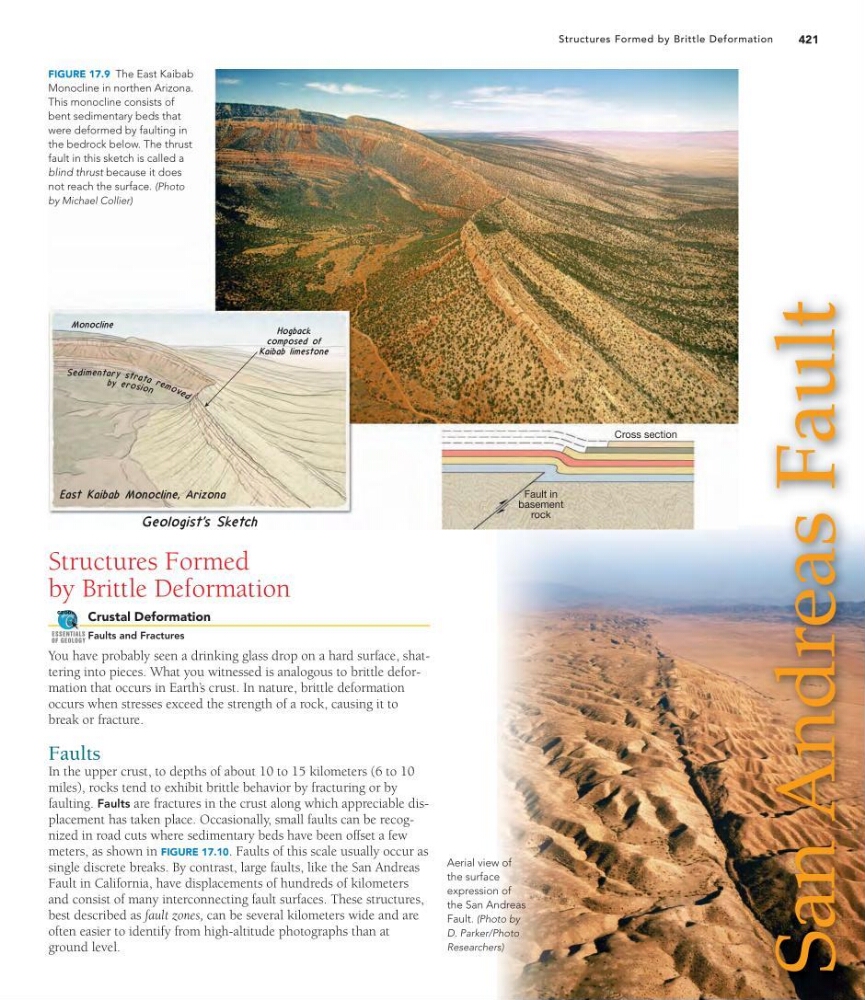
FIGURE 17.9 The East Kaibab
Monocline in northen Arizona.
This monocline consists of
bent sedimentary beds that
were deformed by faulting in
the bedrock below. The thrust
fault in this sketch is called a
blind thrust because it does
not reach the surface. (Photo
by Michael Collier)
Structures Formed
by Brittle Deformation
Crustal Deformation
Faults and Fractures
You have probably seen a drinking glass drop on a hard surface, shattering into pieces. What you witnessed is analogous to brittle deformation that occurs in Earth’ s crust. In nature, brittle deformation
occurs when stresses exceed the strength of a rock, causing it to
break or fracture.
Faults
In the upper crust, to depths of about 10 to 15 kilometers (6 to 10
miles), rocks tend to exhibit brittle behavior by fracturing or by
faulting. Faults are fractures in the crust along which appreciable displacement has taken place. Occasionally, small faults can be recognized in road cuts where sedimentary beds have been offset a few
meters, as shown in FIGURE 17.10. Faults of this scale usually occur as
single discrete breaks. By contrast, large faults, like the San Andreas
Fault in California, have displacements of hundreds of kilometers
and consist of many interconnecting fault surfaces. These structures,
best described as fault zones, can be several kilometers wide and are
often easier to identify from high-altitude photographs than at
ground level.
GEODe
ESSENTIALS
OF GEOLOGY
Structures Formed by Brittle Deformation
San Andreas Fault
Aerial view of
the surface
expression of
the San Andreas
Fault. (Photo by
D. Parker/Photo
Researchers)
Cross section
Fault in
basement
rock
FIGURE 17.9 The East Kaibab
Monocline in northen Arizona.
This monocline consists of
bent sedimentary beds that
were deformed by faulting in
the bedrock below. The thrust
fault in this sketch is called a
blind thrust because it does
not reach the surface. (Photo
by Michael Collier)
Structures Formed
by Brittle Deformation
Crustal Deformation
Faults and Fractures
You have probably seen a drinking glass drop on a hard surface, shattering into pieces. What you witnessed is analogous to brittle deformation that occurs in Earth’ s crust. In nature, brittle deformation
occurs when stresses exceed the strength of a rock, causing it to
break or fracture.
Faults
In the upper crust, to depths of about 10 to 15 kilometers (6 to 10
miles), rocks tend to exhibit brittle behavior by fracturing or by
faulting. Faults are fractures in the crust along which appreciable displacement has taken place. Occasionally, small faults can be recognized in road cuts where sedimentary beds have been offset a few
meters, as shown in FIGURE 17.10. Faults of this scale usually occur as
single discrete breaks. By contrast, large faults, like the San Andreas
Fault in California, have displacements of hundreds of kilometers
and consist of many interconnecting fault surfaces. These structures,
best described as fault zones, can be several kilometers wide and are
often easier to identify from high-altitude photographs than at
ground level.
GEODe
ESSENTIALS
OF GEOLOGY