

Limestone Limestone
plateau plateau
Central Central
crystalline crystalline
area ea
Ha Harney ney
Peak Peak
Limestone
plateau
Bear Butte
Red Valley
Dakota
sandstone
hogback
Central
crystalline
area
Schist
Granite
X
Y
Harney
Peak
Red Valley
Black Hills,
South Dakota
Chey enne River
0
10 20
30 km
0
10
20 mi
5
1 5
X
Y
B el le Fo u rc h e R iv e r
CHAPTER 17 Crustal Deformation and Mountain Building
420
plateau. As large blocks of basement rock
were displaced upward, the comparatively
ductile sedimentary strata above responded
by folding. Displacement along these
reactivated faults often exceeds 1 kilometer
(FIGURE 17.9).
Examples of monoclines found on the
Colorado Plateau include the East Kaibab
Monocline, Raplee Anticline, Waterpocket
Fold, and the San Rafael Swell. The inclined
strata shown in Figure 17.9 once extended
over the sedimentary layers that are now
exposed at the surface—evidence that a
tremendous volume of rock has been eroded
from this area. Differential erosion has left
the more resistant beds outcropping as
prominent angular ridges called hogbacks.
Because hogbacks can form whenever resistant strata are steeply inclined, they are associated with most types of folds.
C O N C E P T C H E C K 1 7 . 2
Distinguish between anticlines and
synclines, domes and basins, anticlines
and domes.
The Black Hills of South Dakota is a
good example of what type of structural
feature?
Describe the formation of a monocline.
3
2
1
DOMES AND BASINS. Broad upwarps in basement rock may deform the overlying cover of
sedimentary strata and generate large folds. When this upwarping produces a circular or slightly
elongated structure, the feature is called a dome. Downwarped structures having a similar shape
are termed basins.
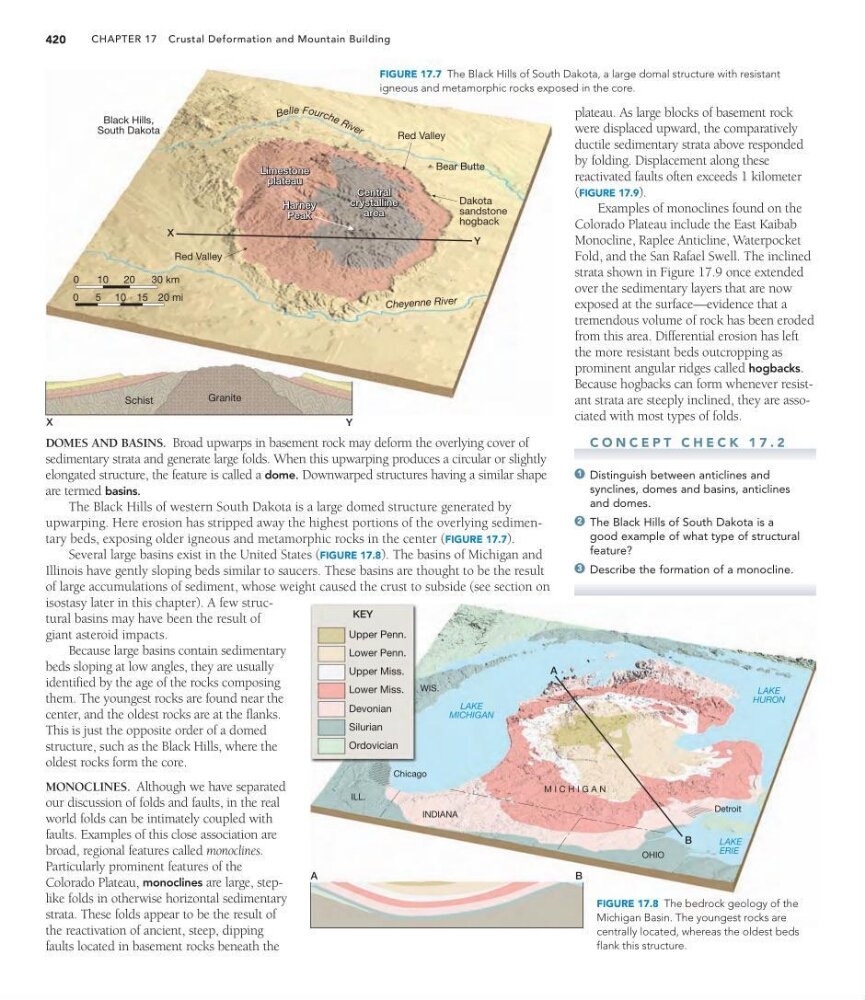
The Black Hills of western South Dakota is a large domed structure generated by
upwarping. Here erosion has stripped away the highest portions of the overlying sedimentary beds, exposing older igneous and metamorphic rocks in the center (FIGURE 17.7).
Several large basins exist in the United States (FIGURE 17.8). The basins of Michigan and
Illinois have gently sloping beds similar to saucers. These basins are thought to be the result
of large accumulations of sediment, whose weight caused the crust to subside (see section on
isostasy later in this chapter). A few structural basins may have been the result of
giant asteroid impacts.
Because large basins contain sedimentary
beds sloping at low angles, they are usually
identified by the age of the rocks composing
them. The youngest rocks are found near the
center, and the oldest rocks are at the flanks.
This is just the opposite order of a domed
structure, such as the Black Hills, where the
oldest rocks form the core.
MONOCLINES. Although we have separated
our discussion of folds and faults, in the real
world folds can be intimately coupled with
faults. Examples of this close association are
broad, regional features called monoclines.
Particularly prominent features of the
Colorado Plateau, monoclines are large, steplike folds in otherwise horizontal sedimentary
strata. These folds appear to be the result of
the reactivation of ancient, steep, dipping
faults located in basement rocks beneath the
FIGURE 17.7 The Black Hills of South Dakota, a large domal structure with resistant
igneous and metamorphic rocks exposed in the core.
M I C H I G A N
WIS.
LAKE
MICHIGAN
LAKE
HURON
ILL.
Chicago
INDIANA
OHIO
LAKE
ERIE
KEY
Lower Penn.
Upper Miss.
Lower Miss.
Devonian
Silurian
Ordovician
A
B
A
B
Detroit
Upper Penn.
FIGURE 17.8 The bedrock geology of the
Michigan Basin. The youngest rocks are
centrally located, whereas the oldest beds
flank this structure.
plateau plateau
Central Central
crystalline crystalline
area ea
Ha Harney ney
Peak Peak
Limestone
plateau
Bear Butte
Red Valley
Dakota
sandstone
hogback
Central
crystalline
area
Schist
Granite
X
Y
Harney
Peak
Red Valley
Black Hills,
South Dakota
Chey enne River
0
10 20
30 km
0
10
20 mi
5
1 5
X
Y
B el le Fo u rc h e R iv e r
CHAPTER 17 Crustal Deformation and Mountain Building
420
plateau. As large blocks of basement rock
were displaced upward, the comparatively
ductile sedimentary strata above responded
by folding. Displacement along these
reactivated faults often exceeds 1 kilometer
(FIGURE 17.9).
Examples of monoclines found on the
Colorado Plateau include the East Kaibab
Monocline, Raplee Anticline, Waterpocket
Fold, and the San Rafael Swell. The inclined
strata shown in Figure 17.9 once extended
over the sedimentary layers that are now
exposed at the surface—evidence that a
tremendous volume of rock has been eroded
from this area. Differential erosion has left
the more resistant beds outcropping as
prominent angular ridges called hogbacks.
Because hogbacks can form whenever resistant strata are steeply inclined, they are associated with most types of folds.
C O N C E P T C H E C K 1 7 . 2
Distinguish between anticlines and
synclines, domes and basins, anticlines
and domes.
The Black Hills of South Dakota is a
good example of what type of structural
feature?
Describe the formation of a monocline.
3
2
1
DOMES AND BASINS. Broad upwarps in basement rock may deform the overlying cover of
sedimentary strata and generate large folds. When this upwarping produces a circular or slightly
elongated structure, the feature is called a dome. Downwarped structures having a similar shape
are termed basins.
The Black Hills of western South Dakota is a large domed structure generated by
upwarping. Here erosion has stripped away the highest portions of the overlying sedimentary beds, exposing older igneous and metamorphic rocks in the center (FIGURE 17.7).
Several large basins exist in the United States (FIGURE 17.8). The basins of Michigan and
Illinois have gently sloping beds similar to saucers. These basins are thought to be the result
of large accumulations of sediment, whose weight caused the crust to subside (see section on
isostasy later in this chapter). A few structural basins may have been the result of
giant asteroid impacts.
Because large basins contain sedimentary
beds sloping at low angles, they are usually
identified by the age of the rocks composing
them. The youngest rocks are found near the
center, and the oldest rocks are at the flanks.
This is just the opposite order of a domed
structure, such as the Black Hills, where the
oldest rocks form the core.
MONOCLINES. Although we have separated
our discussion of folds and faults, in the real
world folds can be intimately coupled with
faults. Examples of this close association are
broad, regional features called monoclines.
Particularly prominent features of the
Colorado Plateau, monoclines are large, steplike folds in otherwise horizontal sedimentary
strata. These folds appear to be the result of
the reactivation of ancient, steep, dipping
faults located in basement rocks beneath the
FIGURE 17.7 The Black Hills of South Dakota, a large domal structure with resistant
igneous and metamorphic rocks exposed in the core.
M I C H I G A N
WIS.
LAKE
MICHIGAN
LAKE
HURON
ILL.
Chicago
INDIANA
OHIO
LAKE
ERIE
KEY
Lower Penn.
Upper Miss.
Lower Miss.
Devonian
Silurian
Ordovician
A
B
A
B
Detroit
Upper Penn.
FIGURE 17.8 The bedrock geology of the
Michigan Basin. The youngest rocks are
centrally located, whereas the oldest beds
flank this structure.