

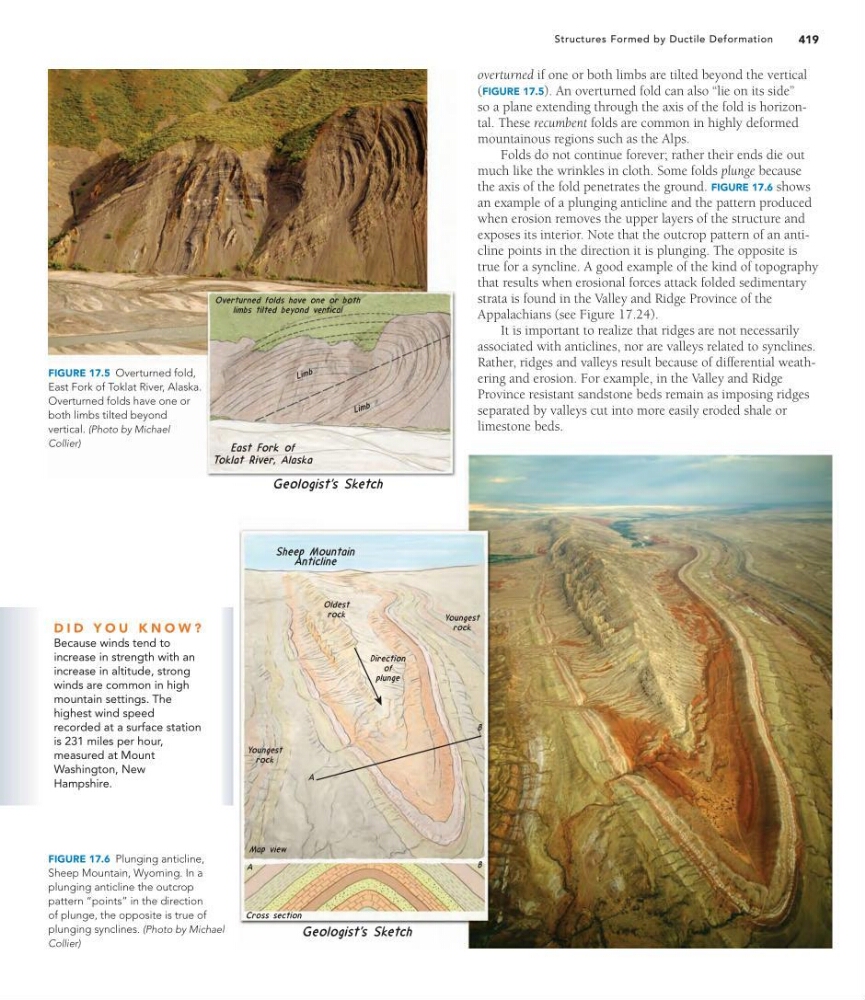
FIGURE 17.5 Overturned fold,
East Fork of Toklat River, Alaska.
Overturned folds have one or
both limbs tilted beyond
vertical. (Photo by Michael
Collier)
419
Structures Formed by Ductile Deformation
FIGURE 17.6 Plunging anticline,
Sheep Mountain, Wyoming. In a
plunging anticline the outcrop
pattern “points” in the direction
of plunge, the opposite is true of
plunging synclines. (Photo by Michael
Collier)
D I D Y O U K N O W ?
Because winds tend to
increase in strength with an
increase in altitude, strong
winds are common in high
mountain settings. The
highest wind speed
recorded at a surface station
is 231 miles per hour,
measured at Mount
Washington, New
Hampshire.
overturned if one or both limbs are tilted beyond the vertical
(FIGURE 17.5). An overturned fold can also “lie on its side”
so a plane extending through the axis of the fold is horizontal. These recumbent folds are common in highly deformed
mountainous regions such as the Alps.
Folds do not continue forever; rather their ends die out
much like the wrinkles in cloth. Some folds plunge because
the axis of the fold penetrates the ground. FIGURE 17.6 shows
an example of a plunging anticline and the pattern produced
when erosion removes the upper layers of the structure and
exposes its interior. Note that the outcrop pattern of an anticline points in the direction it is plunging. The opposite is
true for a syncline. A good example of the kind of topography
that results when erosional forces attack folded sedimentary
strata is found in the Valley and Ridge Province of the
Appalachians (see Figure 17.24).
It is important to realize that ridges are not necessarily
associated with anticlines, nor are valleys related to synclines.
Rather, ridges and valleys result because of differential weathering and erosion. For example, in the Valley and Ridge
Province resistant sandstone beds remain as imposing ridges
separated by valleys cut into more easily eroded shale or
limestone beds.
East Fork of Toklat River, Alaska.
Overturned folds have one or
both limbs tilted beyond
vertical. (Photo by Michael
Collier)
419
Structures Formed by Ductile Deformation
FIGURE 17.6 Plunging anticline,
Sheep Mountain, Wyoming. In a
plunging anticline the outcrop
pattern “points” in the direction
of plunge, the opposite is true of
plunging synclines. (Photo by Michael
Collier)
D I D Y O U K N O W ?
Because winds tend to
increase in strength with an
increase in altitude, strong
winds are common in high
mountain settings. The
highest wind speed
recorded at a surface station
is 231 miles per hour,
measured at Mount
Washington, New
Hampshire.
overturned if one or both limbs are tilted beyond the vertical
(FIGURE 17.5). An overturned fold can also “lie on its side”
so a plane extending through the axis of the fold is horizontal. These recumbent folds are common in highly deformed
mountainous regions such as the Alps.
Folds do not continue forever; rather their ends die out
much like the wrinkles in cloth. Some folds plunge because
the axis of the fold penetrates the ground. FIGURE 17.6 shows
an example of a plunging anticline and the pattern produced
when erosion removes the upper layers of the structure and
exposes its interior. Note that the outcrop pattern of an anticline points in the direction it is plunging. The opposite is
true for a syncline. A good example of the kind of topography
that results when erosional forces attack folded sedimentary
strata is found in the Valley and Ridge Province of the
Appalachians (see Figure 17.24).
It is important to realize that ridges are not necessarily
associated with anticlines, nor are valleys related to synclines.
Rather, ridges and valleys result because of differential weathering and erosion. For example, in the Valley and Ridge
Province resistant sandstone beds remain as imposing ridges
separated by valleys cut into more easily eroded shale or
limestone beds.