

CHAPTER 17 Crustal Deformation and Mountain Building
418
Normal limb
Overturned
limb
Symmetrical fold
Asymmetrical fold
Overturned fold
A n ti cli n e
A n ti cl in
e
Sy ncline
Syncline
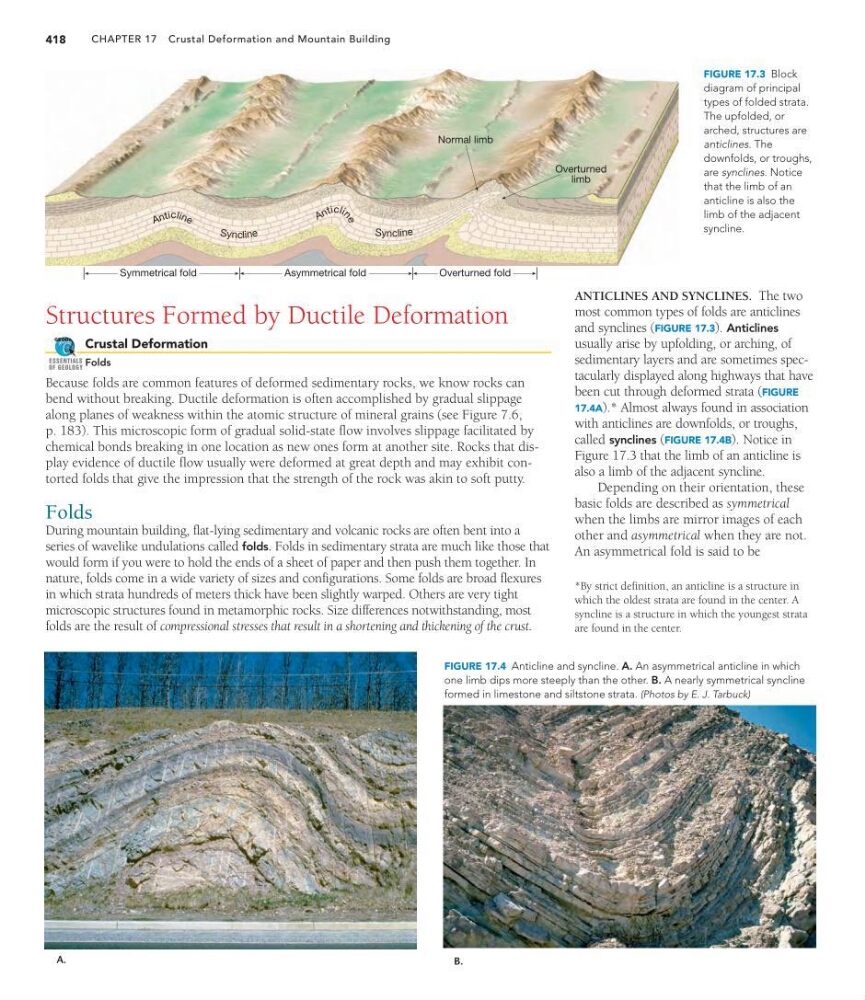
FIGURE 17.3 Block
diagram of principal
types of folded strata.
The upfolded, or
arched, structures are
anticlines. The
downfolds, or troughs,
are synclines. Notice
that the limb of an
anticline is also the
limb of the adjacent
syncline.
Structures Formed by Ductile Deformation
Crustal Deformation
Folds
Because folds are common features of deformed sedimentary rocks, we know rocks can
bend without breaking. Ductile deformation is often accomplished by gradual slippage
along planes of weakness within the atomic structure of mineral grains (see Figure 7.6,
p. 183). This microscopic form of gradual solid-state flow involves slippage facilitated by
chemical bonds breaking in one location as new ones form at another site. Rocks that display evidence of ductile flow usually were deformed at great depth and may exhibit contorted folds that give the impression that the strength of the rock was akin to soft putty.
Folds
During mountain building, flat-lying sedimentary and volcanic rocks are often bent into a
series of wavelike undulations called folds. Folds in sedimentary strata are much like those that
would form if you were to hold the ends of a sheet of paper and then push them together. In
nature, folds come in a wide variety of sizes and configurations. Some folds are broad flexures
in which strata hundreds of meters thick have been slightly warped. Others are very tight
microscopic structures found in metamorphic rocks. Size differences notwithstanding, most
folds are the result of compressional stresses that result in a shortening and thickening of the crust.
GEODe
ESSENTIALS
OF GEOLOGY
ANTICLINES AND SYNCLINES. The two
most common types of folds are anticlines
and synclines (FIGURE 17.3). Anticlines
usually arise by upfolding, or arching, of
sedimentary layers and are sometimes spectacularly displayed along highways that have
been cut through deformed strata (FIGURE
17.4A).* Almost always found in association
with anticlines are downfolds, or troughs,
called synclines (FIGURE 17.4B). Notice in
Figure 17.3 that the limb of an anticline is
also a limb of the adjacent syncline.
Depending on their orientation, these
basic folds are described as symmetrical
when the limbs are mirror images of each
other and asymmetrical when they are not.
An asymmetrical fold is said to be
B.
A.
FIGURE 17.4 Anticline and syncline. A. An asymmetrical anticline in which
one limb dips more steeply than the other. B. A nearly symmetrical syncline
formed in limestone and siltstone strata. (Photos by E. J. Tarbuck)
*By strict definition, an anticline is a structure in
which the oldest strata are found in the center. A
syncline is a structure in which the youngest strata
are found in the center.
418
Normal limb
Overturned
limb
Symmetrical fold
Asymmetrical fold
Overturned fold
A n ti cli n e
A n ti cl in
e
Sy ncline
Syncline
FIGURE 17.3 Block
diagram of principal
types of folded strata.
The upfolded, or
arched, structures are
anticlines. The
downfolds, or troughs,
are synclines. Notice
that the limb of an
anticline is also the
limb of the adjacent
syncline.
Structures Formed by Ductile Deformation
Crustal Deformation
Folds
Because folds are common features of deformed sedimentary rocks, we know rocks can
bend without breaking. Ductile deformation is often accomplished by gradual slippage
along planes of weakness within the atomic structure of mineral grains (see Figure 7.6,
p. 183). This microscopic form of gradual solid-state flow involves slippage facilitated by
chemical bonds breaking in one location as new ones form at another site. Rocks that display evidence of ductile flow usually were deformed at great depth and may exhibit contorted folds that give the impression that the strength of the rock was akin to soft putty.
Folds
During mountain building, flat-lying sedimentary and volcanic rocks are often bent into a
series of wavelike undulations called folds. Folds in sedimentary strata are much like those that
would form if you were to hold the ends of a sheet of paper and then push them together. In
nature, folds come in a wide variety of sizes and configurations. Some folds are broad flexures
in which strata hundreds of meters thick have been slightly warped. Others are very tight
microscopic structures found in metamorphic rocks. Size differences notwithstanding, most
folds are the result of compressional stresses that result in a shortening and thickening of the crust.
GEODe
ESSENTIALS
OF GEOLOGY
ANTICLINES AND SYNCLINES. The two
most common types of folds are anticlines
and synclines (FIGURE 17.3). Anticlines
usually arise by upfolding, or arching, of
sedimentary layers and are sometimes spectacularly displayed along highways that have
been cut through deformed strata (FIGURE
17.4A).* Almost always found in association
with anticlines are downfolds, or troughs,
called synclines (FIGURE 17.4B). Notice in
Figure 17.3 that the limb of an anticline is
also a limb of the adjacent syncline.
Depending on their orientation, these
basic folds are described as symmetrical
when the limbs are mirror images of each
other and asymmetrical when they are not.
An asymmetrical fold is said to be
B.
A.
FIGURE 17.4 Anticline and syncline. A. An asymmetrical anticline in which
one limb dips more steeply than the other. B. A nearly symmetrical syncline
formed in limestone and siltstone strata. (Photos by E. J. Tarbuck)
*By strict definition, an anticline is a structure in
which the oldest strata are found in the center. A
syncline is a structure in which the youngest strata
are found in the center.