

417
Crustal Deformation
D I D Y O U K N O W ?
The tallest mountain in North America is
the 20,321-foot-high Mount McKinley.
The area surrounding the mountain was
established as Mount McKinley National
Park in 1917. In 1980 the park was
enlarged and renamed Denali National
Park and Preserve. Denali, the “High
One” is the name used by native
Athabascan people for this massive
peak that crowns the 600-mile-long
Alaska Range.
TEMPERATURE. The effect of temperature
on the strength of a material can be easily
demonstrated with a piece of glass tubing
commonly found in a chemistry lab. If the
tubing is dropped on a hard surface, it will
shatter. However, if the tubing is heated over
a Bunsen burner, it can be easily bent into a
variety of shapes. Rocks respond similarly to
heat. Where temperatures are high (deep in
Earth’ s crust), rocks tend to deform ductilely
and flow. Likewise, where temperatures are
low (at or near the surface), rocks tend to
behave like brittle solids and fracture.
CONFINING PRESSURE. Recall from
Chapter 7 that pressure, like temperature,
increases with depth as the thickness of the
overlying rock increases. Buried rocks are
subjected to confining pressure, which is
much like water pressure, where the forces
are applied equally in all directions. The
deeper you go in the ocean, the greater the
confining pressure. The same is true for
rock that is buried. Confining pressure
“squeezes” the materials in Earth’ s crust.
Therefore, rocks that are deeply buried are
“held together” by the immense pressure
and tend to flow, rather than fracture.
ROCK TYPE. In addition to the physical
environment, the mineral composition
and texture of rock greatly influence how
it will deform. For example, crystalline
rocks composed of minerals that have
strong internal molecular bonds tend to
fail by brittle fracture. By contrast,
sedimentary rocks that are weakly
cemented, or metamorphic rocks that
contain zones of weakness such as foliation,
are more susceptible to ductile deformation.
Weak rocks that are most likely to
behave in a ductile manner (flow or fold)
when subjected to differential stress,
include rock salt, shale, limestone, and
schist. Igneous and some metamorphic
rocks tend to be strong and brittle. In a
near-surface environment, strong, brittle
rocks will fail by fracturing when subjected
to stresses that exceed their strength. At
increasing depths, however, the strength of
all rock types decreases significantly.
TIME. One key factor that researchers are
unable to duplicate in the laboratory is how
rocks respond to small stresses applied
gradually over long spans of geologic time.
However, insights into the effects of time on
deformation are provided in everyday settings. For example, marble benches have
been known to sag under their own weight
over a span of 100 years or so, and wooden
bookshelves may bend after being loaded
with books for a relatively short period.
In general, when tectonic forces are
applied slowly over long time spans, rocks
tend to display ductile behavior and
deform by flowing and folding. An analogous situation occurs when you take a taffy
bar and slowly move the two ends together.
The taffy will deform by folding. However,
if you swiftly hit the taffy against the edge
of a table, it will break into two or more
pieces, exhibiting brittle failure.
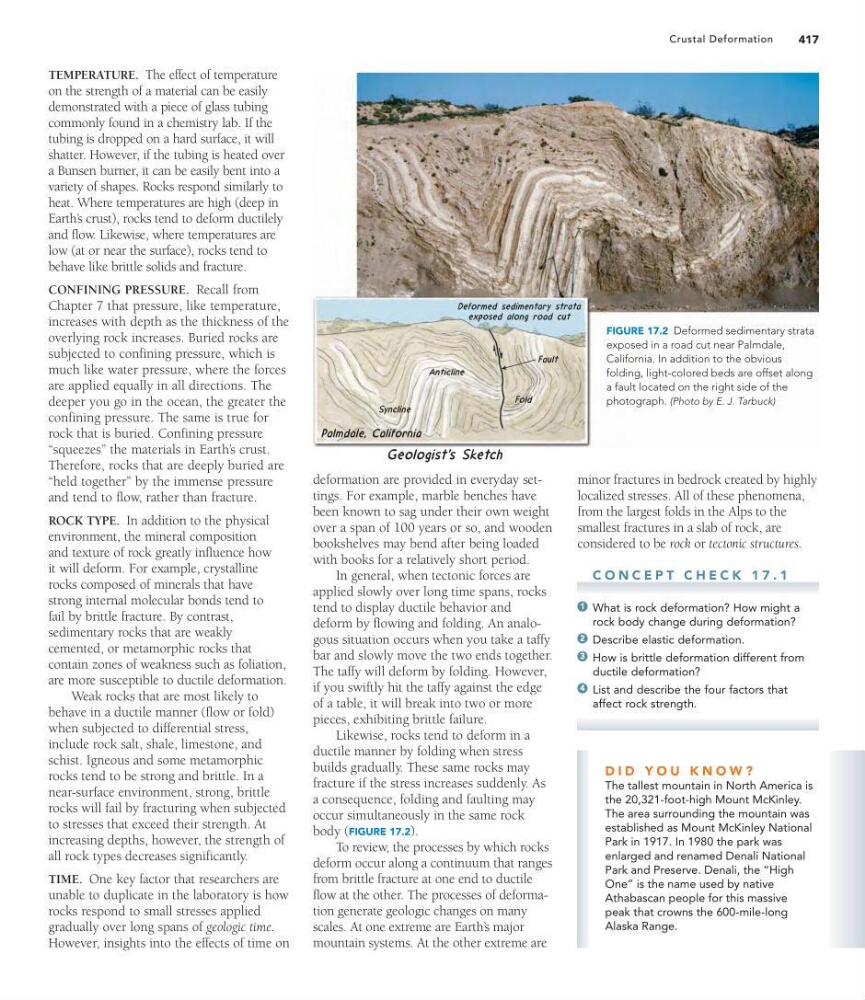
Likewise, rocks tend to deform in a
ductile manner by folding when stress
builds gradually. These same rocks may
fracture if the stress increases suddenly. As
a consequence, folding and faulting may
occur simultaneously in the same rock
body (FIGURE 17.2).
To review, the processes by which rocks
deform occur along a continuum that ranges
from brittle fracture at one end to ductile
flow at the other. The processes of deformation generate geologic changes on many
scales. At one extreme are Earth’ s major
mountain systems. At the other extreme are
FIGURE 17.2 Deformed sedimentary strata
exposed in a road cut near Palmdale,
California. In addition to the obvious
folding, light-colored beds are offset along
a fault located on the right side of the
photograph. (Photo by E. J. Tarbuck)
minor fractures in bedrock created by highly
localized stresses. All of these phenomena,
from the largest folds in the Alps to the
smallest fractures in a slab of rock, are
considered to be rock or tectonic structures.
C O N C E P T C H E C K 1 7 . 1
What is rock deformation? How might a
rock body change during deformation?
Describe elastic deformation.
How is brittle deformation different from
ductile deformation?
List and describe the four factors that
affect rock strength.
4
3
2
1
Crustal Deformation
D I D Y O U K N O W ?
The tallest mountain in North America is
the 20,321-foot-high Mount McKinley.
The area surrounding the mountain was
established as Mount McKinley National
Park in 1917. In 1980 the park was
enlarged and renamed Denali National
Park and Preserve. Denali, the “High
One” is the name used by native
Athabascan people for this massive
peak that crowns the 600-mile-long
Alaska Range.
TEMPERATURE. The effect of temperature
on the strength of a material can be easily
demonstrated with a piece of glass tubing
commonly found in a chemistry lab. If the
tubing is dropped on a hard surface, it will
shatter. However, if the tubing is heated over
a Bunsen burner, it can be easily bent into a
variety of shapes. Rocks respond similarly to
heat. Where temperatures are high (deep in
Earth’ s crust), rocks tend to deform ductilely
and flow. Likewise, where temperatures are
low (at or near the surface), rocks tend to
behave like brittle solids and fracture.
CONFINING PRESSURE. Recall from
Chapter 7 that pressure, like temperature,
increases with depth as the thickness of the
overlying rock increases. Buried rocks are
subjected to confining pressure, which is
much like water pressure, where the forces
are applied equally in all directions. The
deeper you go in the ocean, the greater the
confining pressure. The same is true for
rock that is buried. Confining pressure
“squeezes” the materials in Earth’ s crust.
Therefore, rocks that are deeply buried are
“held together” by the immense pressure
and tend to flow, rather than fracture.
ROCK TYPE. In addition to the physical
environment, the mineral composition
and texture of rock greatly influence how
it will deform. For example, crystalline
rocks composed of minerals that have
strong internal molecular bonds tend to
fail by brittle fracture. By contrast,
sedimentary rocks that are weakly
cemented, or metamorphic rocks that
contain zones of weakness such as foliation,
are more susceptible to ductile deformation.
Weak rocks that are most likely to
behave in a ductile manner (flow or fold)
when subjected to differential stress,
include rock salt, shale, limestone, and
schist. Igneous and some metamorphic
rocks tend to be strong and brittle. In a
near-surface environment, strong, brittle
rocks will fail by fracturing when subjected
to stresses that exceed their strength. At
increasing depths, however, the strength of
all rock types decreases significantly.
TIME. One key factor that researchers are
unable to duplicate in the laboratory is how
rocks respond to small stresses applied
gradually over long spans of geologic time.
However, insights into the effects of time on
deformation are provided in everyday settings. For example, marble benches have
been known to sag under their own weight
over a span of 100 years or so, and wooden
bookshelves may bend after being loaded
with books for a relatively short period.
In general, when tectonic forces are
applied slowly over long time spans, rocks
tend to display ductile behavior and
deform by flowing and folding. An analogous situation occurs when you take a taffy
bar and slowly move the two ends together.
The taffy will deform by folding. However,
if you swiftly hit the taffy against the edge
of a table, it will break into two or more
pieces, exhibiting brittle failure.
Likewise, rocks tend to deform in a
ductile manner by folding when stress
builds gradually. These same rocks may
fracture if the stress increases suddenly. As
a consequence, folding and faulting may
occur simultaneously in the same rock
body (FIGURE 17.2).
To review, the processes by which rocks
deform occur along a continuum that ranges
from brittle fracture at one end to ductile
flow at the other. The processes of deformation generate geologic changes on many
scales. At one extreme are Earth’ s major
mountain systems. At the other extreme are
FIGURE 17.2 Deformed sedimentary strata
exposed in a road cut near Palmdale,
California. In addition to the obvious
folding, light-colored beds are offset along
a fault located on the right side of the
photograph. (Photo by E. J. Tarbuck)
minor fractures in bedrock created by highly
localized stresses. All of these phenomena,
from the largest folds in the Alps to the
smallest fractures in a slab of rock, are
considered to be rock or tectonic structures.
C O N C E P T C H E C K 1 7 . 1
What is rock deformation? How might a
rock body change during deformation?
Describe elastic deformation.
How is brittle deformation different from
ductile deformation?
List and describe the four factors that
affect rock strength.
4
3
2
1