

CHAPTER 17 Crustal Deformation and Mountain Building
416
Crustal Deformation
Crustal Deformation
Deformation
Earth is a dynamic planet. Shifting lithospheric plates continually change the face of our
planet by moving continents across the globe. The results of this tectonic activity are
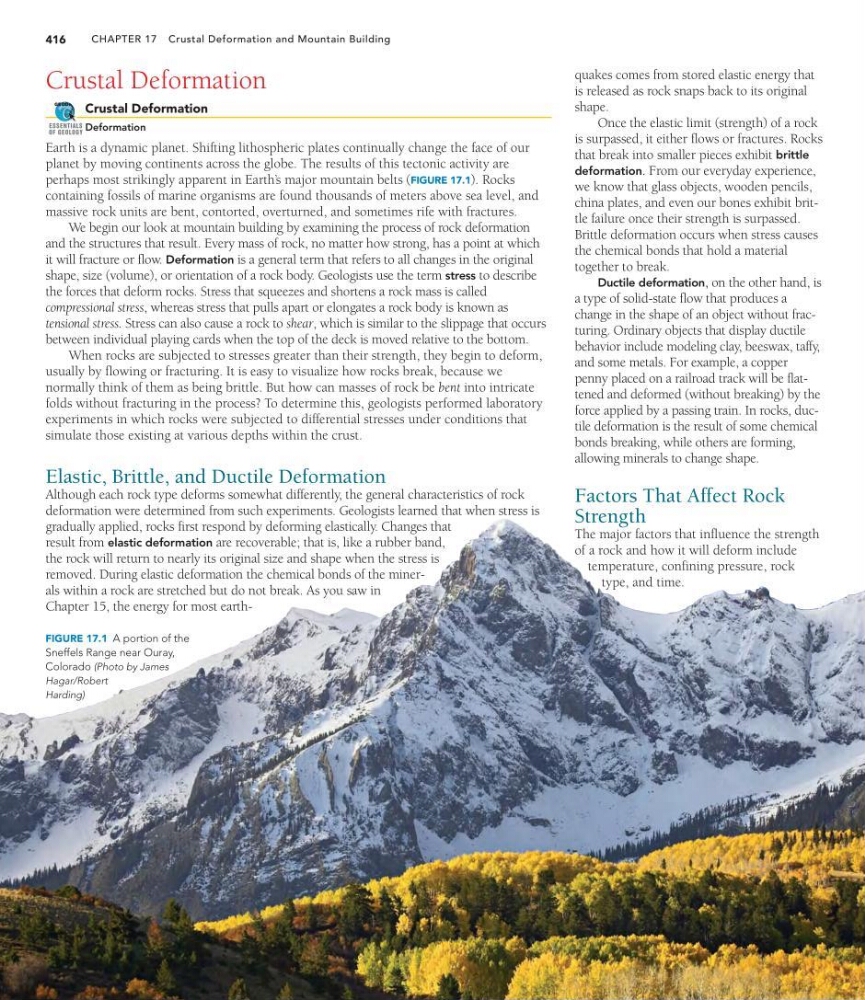
perhaps most strikingly apparent in Earth’ s major mountain belts (FIGURE 17.1). Rocks
containing fossils of marine organisms are found thousands of meters above sea level, and
massive rock units are bent, contorted, overturned, and sometimes rife with fractures.
We begin our look at mountain building by examining the process of rock deformation
and the structures that result. Every mass of rock, no matter how strong, has a point at which
it will fracture or flow. Deformation is a general term that refers to all changes in the original
shape, size (volume), or orientation of a rock body. Geologists use the term stress to describe
the forces that deform rocks. Stress that squeezes and shortens a rock mass is called
compressional stress, whereas stress that pulls apart or elongates a rock body is known as
tensional stress. Stress can also cause a rock to shear, which is similar to the slippage that occurs
between individual playing cards when the top of the deck is moved relative to the bottom.
When rocks are subjected to stresses greater than their strength, they begin to deform,
usually by flowing or fracturing. It is easy to visualize how rocks break, because we
normally think of them as being brittle. But how can masses of rock be bent into intricate
folds without fracturing in the process? To determine this, geologists performed laboratory
experiments in which rocks were subjected to differential stresses under conditions that
simulate those existing at various depths within the crust.
Elastic, Brittle, and Ductile Deformation
Although each rock type deforms somewhat differently, the general characteristics of rock
deformation were determined from such experiments. Geologists learned that when stress is
gradually applied, rocks first respond by deforming elastically. Changes that
result from elastic deformation are recoverable; that is, like a rubber band,
the rock will return to nearly its original size and shape when the stress is
removed. During elastic deformation the chemical bonds of the minerals within a rock are stretched but do not break. As you saw in
Chapter 15, the energy for most earthGEODe
ESSENTIALS
OF GEOLOGY
quakes comes from stored elastic energy that
is released as rock snaps back to its original
shape.
Once the elastic limit (strength) of a rock
is surpassed, it either flows or fractures. Rocks
that break into smaller pieces exhibit brittle
deformation. From our everyday experience,
we know that glass objects, wooden pencils,
china plates, and even our bones exhibit brittle failure once their strength is surpassed.
Brittle deformation occurs when stress causes
the chemical bonds that hold a material
together to break.
Ductile deformation, on the other hand, is
a type of solid-state flow that produces a
change in the shape of an object without fracturing. Ordinary objects that display ductile
behavior include modeling clay, beeswax, taffy,
and some metals. For example, a copper
penny placed on a railroad track will be flattened and deformed (without breaking) by the
force applied by a passing train. In rocks, ductile deformation is the result of some chemical
bonds breaking, while others are forming,
allowing minerals to change shape.
Factors That Affect Rock
Strength
The major factors that influence the strength
of a rock and how it will deform include
temperature, confining pressure, rock
type, and time.
FIGURE 17.1 A portion of the
Sneffels Range near Ouray,
Colorado (Photo by James
Hagar/Robert
Harding)
416
Crustal Deformation
Crustal Deformation
Deformation
Earth is a dynamic planet. Shifting lithospheric plates continually change the face of our
planet by moving continents across the globe. The results of this tectonic activity are
perhaps most strikingly apparent in Earth’ s major mountain belts (FIGURE 17.1). Rocks
containing fossils of marine organisms are found thousands of meters above sea level, and
massive rock units are bent, contorted, overturned, and sometimes rife with fractures.
We begin our look at mountain building by examining the process of rock deformation
and the structures that result. Every mass of rock, no matter how strong, has a point at which
it will fracture or flow. Deformation is a general term that refers to all changes in the original
shape, size (volume), or orientation of a rock body. Geologists use the term stress to describe
the forces that deform rocks. Stress that squeezes and shortens a rock mass is called
compressional stress, whereas stress that pulls apart or elongates a rock body is known as
tensional stress. Stress can also cause a rock to shear, which is similar to the slippage that occurs
between individual playing cards when the top of the deck is moved relative to the bottom.
When rocks are subjected to stresses greater than their strength, they begin to deform,
usually by flowing or fracturing. It is easy to visualize how rocks break, because we
normally think of them as being brittle. But how can masses of rock be bent into intricate
folds without fracturing in the process? To determine this, geologists performed laboratory
experiments in which rocks were subjected to differential stresses under conditions that
simulate those existing at various depths within the crust.
Elastic, Brittle, and Ductile Deformation
Although each rock type deforms somewhat differently, the general characteristics of rock
deformation were determined from such experiments. Geologists learned that when stress is
gradually applied, rocks first respond by deforming elastically. Changes that
result from elastic deformation are recoverable; that is, like a rubber band,
the rock will return to nearly its original size and shape when the stress is
removed. During elastic deformation the chemical bonds of the minerals within a rock are stretched but do not break. As you saw in
Chapter 15, the energy for most earthGEODe
ESSENTIALS
OF GEOLOGY
quakes comes from stored elastic energy that
is released as rock snaps back to its original
shape.
Once the elastic limit (strength) of a rock
is surpassed, it either flows or fractures. Rocks
that break into smaller pieces exhibit brittle
deformation. From our everyday experience,
we know that glass objects, wooden pencils,
china plates, and even our bones exhibit brittle failure once their strength is surpassed.
Brittle deformation occurs when stress causes
the chemical bonds that hold a material
together to break.
Ductile deformation, on the other hand, is
a type of solid-state flow that produces a
change in the shape of an object without fracturing. Ordinary objects that display ductile
behavior include modeling clay, beeswax, taffy,
and some metals. For example, a copper
penny placed on a railroad track will be flattened and deformed (without breaking) by the
force applied by a passing train. In rocks, ductile deformation is the result of some chemical
bonds breaking, while others are forming,
allowing minerals to change shape.
Factors That Affect Rock
Strength
The major factors that influence the strength
of a rock and how it will deform include
temperature, confining pressure, rock
type, and time.
FIGURE 17.1 A portion of the
Sneffels Range near Ouray,
Colorado (Photo by James
Hagar/Robert
Harding)