

M
OUNTAINS PROVIDE
SOME OF THE MOST
SPECTACULAR
scenery on our planet. This
splendor has been captured by
poets, painters, and songwriters
alike. Geologists understand that at
some time all continental regions
were mountainous masses. They
have determined that continents
grow by the addition of mountains
to their flanks. Consequently, as
geologists unravel the secrets of
mountain formation, they also gain
a deeper understanding of the
evolution of Earth’ s continents.
F O C U S O N C O N C E P T S
To assist you in learning
the important concepts in this
chapter, focus on the following
questions:
What is rock deformation? What
factors influence how rock
deforms?
How are elastic, brittle, and
ductile deformation different?
What structures form as a result
of brittle deformation?
What structures form as a result
of ductile deformation?
What are the most common
types of faults? How does each
type form?
How are Aleutian- and Andeantype mountain building similar?
How are they different?
How does continental accretion
relate to mountain building?
What are the stages in the
formation of a major mountain
belt?
How is the concept of isostasy
related to mountain building?
What is meant by gravitational
collapse?
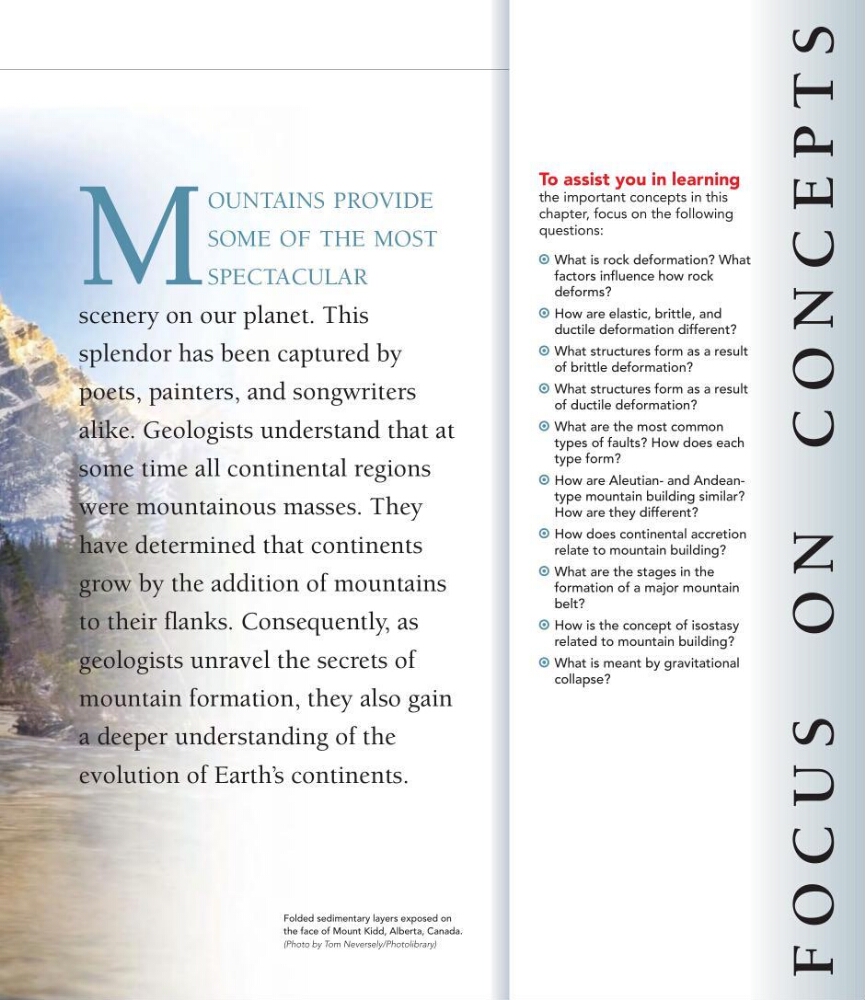
Folded sedimentary layers exposed on
the face of Mount Kidd, Alberta, Canada.
(Photo by Tom Neversely/Photolibrary)
OUNTAINS PROVIDE
SOME OF THE MOST
SPECTACULAR
scenery on our planet. This
splendor has been captured by
poets, painters, and songwriters
alike. Geologists understand that at
some time all continental regions
were mountainous masses. They
have determined that continents
grow by the addition of mountains
to their flanks. Consequently, as
geologists unravel the secrets of
mountain formation, they also gain
a deeper understanding of the
evolution of Earth’ s continents.
F O C U S O N C O N C E P T S
To assist you in learning
the important concepts in this
chapter, focus on the following
questions:
What is rock deformation? What
factors influence how rock
deforms?
How are elastic, brittle, and
ductile deformation different?
What structures form as a result
of brittle deformation?
What structures form as a result
of ductile deformation?
What are the most common
types of faults? How does each
type form?
How are Aleutian- and Andeantype mountain building similar?
How are they different?
How does continental accretion
relate to mountain building?
What are the stages in the
formation of a major mountain
belt?
How is the concept of isostasy
related to mountain building?
What is meant by gravitational
collapse?
Folded sedimentary layers exposed on
the face of Mount Kidd, Alberta, Canada.
(Photo by Tom Neversely/Photolibrary)