

Footwall
block
Footwall
block
Footwall
block
Hanging wall
block
Hanging wall
block
Compressional
stress
Compressional
stress
Tensional
stress
Shear
stress
Hanging wall
block
A. Normal fault
B. Reverse fault
C. Thrust fault
D. Strike-slip fault
CHAPTER 17 Crustal Deformation and Mountain Building
422
Dip-Slip Faults
Faults in which movement is primarily parallel to the dip (or inclination) of the fault surface are called dip-slip faults. It has become common practice to call the rock surface that
is immediately above the fault the hanging wall block and to call the rock surface below,
the footwall block (Figure 17.10). This nomenclature arose from prospectors and miners
who excavated shafts and tunnels along fault zones that were sites of ore deposits. In
these tunnels, the miners would walk on the rocks below the mineralized fault zone (the
footwall block) and hang their lanterns on the rocks above (the hanging wall block).
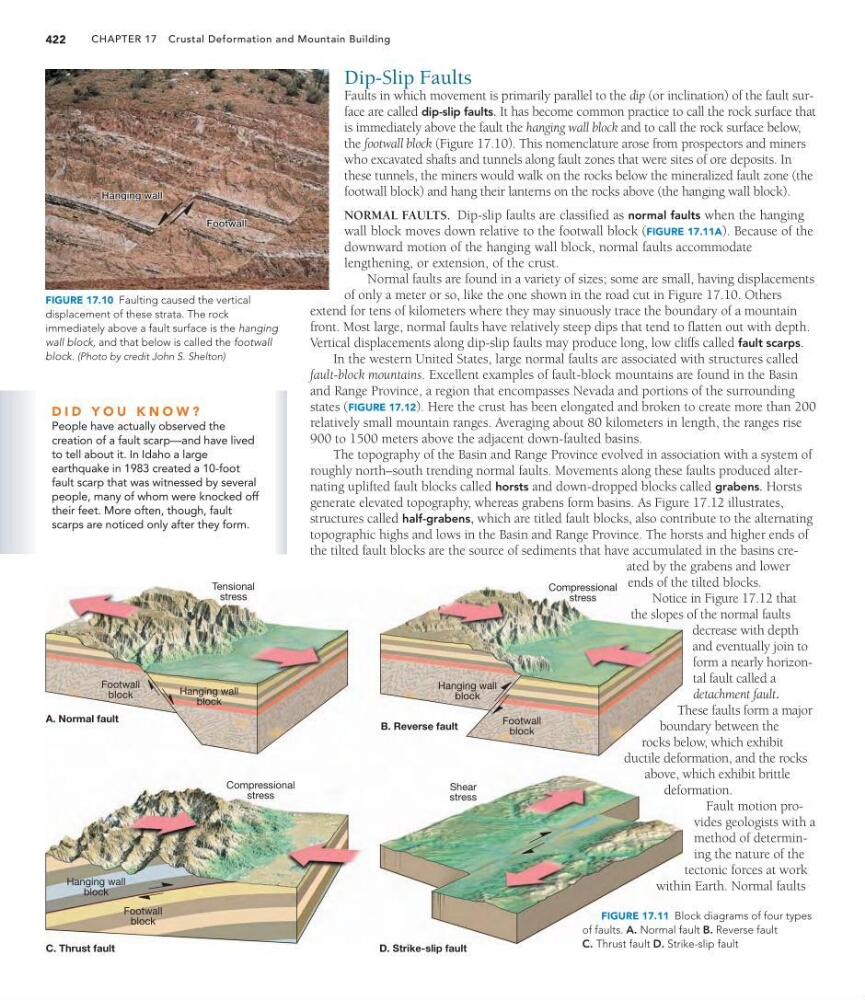
NORMAL FAULTS. Dip-slip faults are classified as normal faults when the hanging
wall block moves down relative to the footwall block (FIGURE 17.11A). Because of the
downward motion of the hanging wall block, normal faults accommodate
lengthening, or extension, of the crust.
Normal faults are found in a variety of sizes; some are small, having displacements
of only a meter or so, like the one shown in the road cut in Figure 17.10. Others
extend for tens of kilometers where they may sinuously trace the boundary of a mountain
front. Most large, normal faults have relatively steep dips that tend to flatten out with depth.
Vertical displacements along dip-slip faults may produce long, low cliffs called fault scarps.
In the western United States, large normal faults are associated with structures called
fault-block mountains. Excellent examples of fault-block mountains are found in the Basin
and Range Province, a region that encompasses Nevada and portions of the surrounding
states (FIGURE 17.12). Here the crust has been elongated and broken to create more than 200
relatively small mountain ranges. Averaging about 80 kilometers in length, the ranges rise
900 to 1500 meters above the adjacent down-faulted basins.
The topography of the Basin and Range Province evolved in association with a system of
roughly north–south trending normal faults. Movements along these faults produced alternating uplifted fault blocks called horsts and down-dropped blocks called grabens. Horsts
generate elevated topography, whereas grabens form basins. As Figure 17.12 illustrates,
structures called half-grabens, which are titled fault blocks, also contribute to the alternating
topographic highs and lows in the Basin and Range Province. The horsts and higher ends of
the tilted fault blocks are the source of sediments that have accumulated in the basins created by the grabens and lower
ends of the tilted blocks.
Notice in Figure 17.12 that
the slopes of the normal faults
decrease with depth
and eventually join to
form a nearly horizontal fault called a
detachment fault.
These faults form a major
boundary between the
rocks below, which exhibit
ductile deformation, and the rocks
above, which exhibit brittle
deformation.
Fault motion provides geologists with a
method of determining the nature of the
tectonic forces at work
within Earth. Normal faults
Hanging wall
Hanging wall
Footwall Footwall
Hanging wall
Footwall
FIGURE 17.10 Faulting caused the vertical
displacement of these strata. The rock
immediately above a fault surface is the hanging
wall block, and that below is called the footwall
block. (Photo by credit John S. Shelton)
D I D Y O U K N O W ?
People have actually observed the
creation of a fault scarp—and have lived
to tell about it. In Idaho a large
earthquake in 1983 created a 10-foot
fault scarp that was witnessed by several
people, many of whom were knocked off
their feet. More often, though, fault
scarps are noticed only after they form.
FIGURE 17.11 Block diagrams of four types
of faults. A. Normal fault B. Reverse fault
C. Thrust fault D. Strike-slip fault
block
Footwall
block
Footwall
block
Hanging wall
block
Hanging wall
block
Compressional
stress
Compressional
stress
Tensional
stress
Shear
stress
Hanging wall
block
A. Normal fault
B. Reverse fault
C. Thrust fault
D. Strike-slip fault
CHAPTER 17 Crustal Deformation and Mountain Building
422
Dip-Slip Faults
Faults in which movement is primarily parallel to the dip (or inclination) of the fault surface are called dip-slip faults. It has become common practice to call the rock surface that
is immediately above the fault the hanging wall block and to call the rock surface below,
the footwall block (Figure 17.10). This nomenclature arose from prospectors and miners
who excavated shafts and tunnels along fault zones that were sites of ore deposits. In
these tunnels, the miners would walk on the rocks below the mineralized fault zone (the
footwall block) and hang their lanterns on the rocks above (the hanging wall block).
NORMAL FAULTS. Dip-slip faults are classified as normal faults when the hanging
wall block moves down relative to the footwall block (FIGURE 17.11A). Because of the
downward motion of the hanging wall block, normal faults accommodate
lengthening, or extension, of the crust.
Normal faults are found in a variety of sizes; some are small, having displacements
of only a meter or so, like the one shown in the road cut in Figure 17.10. Others
extend for tens of kilometers where they may sinuously trace the boundary of a mountain
front. Most large, normal faults have relatively steep dips that tend to flatten out with depth.
Vertical displacements along dip-slip faults may produce long, low cliffs called fault scarps.
In the western United States, large normal faults are associated with structures called
fault-block mountains. Excellent examples of fault-block mountains are found in the Basin
and Range Province, a region that encompasses Nevada and portions of the surrounding
states (FIGURE 17.12). Here the crust has been elongated and broken to create more than 200
relatively small mountain ranges. Averaging about 80 kilometers in length, the ranges rise
900 to 1500 meters above the adjacent down-faulted basins.
The topography of the Basin and Range Province evolved in association with a system of
roughly north–south trending normal faults. Movements along these faults produced alternating uplifted fault blocks called horsts and down-dropped blocks called grabens. Horsts
generate elevated topography, whereas grabens form basins. As Figure 17.12 illustrates,
structures called half-grabens, which are titled fault blocks, also contribute to the alternating
topographic highs and lows in the Basin and Range Province. The horsts and higher ends of
the tilted fault blocks are the source of sediments that have accumulated in the basins created by the grabens and lower
ends of the tilted blocks.
Notice in Figure 17.12 that
the slopes of the normal faults
decrease with depth
and eventually join to
form a nearly horizontal fault called a
detachment fault.
These faults form a major
boundary between the
rocks below, which exhibit
ductile deformation, and the rocks
above, which exhibit brittle
deformation.
Fault motion provides geologists with a
method of determining the nature of the
tectonic forces at work
within Earth. Normal faults
Hanging wall
Hanging wall
Footwall Footwall
Hanging wall
Footwall
FIGURE 17.10 Faulting caused the vertical
displacement of these strata. The rock
immediately above a fault surface is the hanging
wall block, and that below is called the footwall
block. (Photo by credit John S. Shelton)
D I D Y O U K N O W ?
People have actually observed the
creation of a fault scarp—and have lived
to tell about it. In Idaho a large
earthquake in 1983 created a 10-foot
fault scarp that was witnessed by several
people, many of whom were knocked off
their feet. More often, though, fault
scarps are noticed only after they form.
FIGURE 17.11 Block diagrams of four types
of faults. A. Normal fault B. Reverse fault
C. Thrust fault D. Strike-slip fault