

density of the slab, which helps pull the plate
into the subduction zone.
At some locations, the oceanic crust is
unusually thick and buoyant because it is capped
by large outpourings of basaltic lava, or other thick
crustal fragments. In these settings subduction may
be modified, or even prevented. This appears to be the situation in two areas along the
Peru–Chile Trench, where the angle of descent is shallow—about 10 to 15 degrees. Low dip
angles often result in a strong interaction between the descending slab and the overriding
plate. Consequently, the regions near the Peru–Chile Trench experience frequent, great
earthquakes.
It has also been determined that unusually thick units of oceanic crust, those that are
greater than 30 kilometers in thickness, are not likely to subduct. The Ontong Java Plateau,
for example, is a thick oceanic plateau, about the size of Alaska, located in the western
Pacific. About 20 million years ago this plateau reached the trench that forms the boundary
between the subducting Pacific plate and the overriding Australian–Indian plate. Apparently too buoyant to subduct, the Ontong Java Plateau clogged the trench. We will consider
the fate of crustal fragments that are too buoyant to subduct in the next chapter.
Subducting Plates: The Demise of an Ocean Basin
In the 1970s, geologists began using magnetic stripes and fracture zones on the ocean floor
to reconstruct the last 200 million years of plate movement. This research showed that
parts of, or even entire, ocean basins have been destroyed along subduction zones. For
example, during the break-up of Pangaea shown in Figure 15.26 (p. 385), notice that the
African plate moves northward eventually colliding with Eurasia. During this event, the
floor of the intervening Tethys Ocean was almost entirely consumed into the mantle,
leaving behind a small remnant—the Mediterranean Sea.
Reconstructions of the break-up of Pangaea also helped investigators understand the
demise of the Farallon plate—a large oceanic plate that once occupied much of the eastern
Pacific basin. The Farallon plate was once situated on the eastern side of a spreading center
opposite the Pacific plate as shown in FIGURE 16.22A. The modern remnant of this spreading
center, which generated both the Farallon and Pacific plates, is the East Pacific Rise.
Beginning about 180 million years ago, the Americas were propelled westward by
seafloor spreading in the Atlantic. Therefore, the Farallon plate, which was subducting beneath the Americas faster than it
was being generated, decreased in size
(FIGURE 16.22B). As its surface area shrank,
it broke into smaller pieces, some of
which subducted entirely. The remaining
fragments of the once-extensive Farallon
plate are the Juan de Fuca, Cocos, and
Nazca plates.
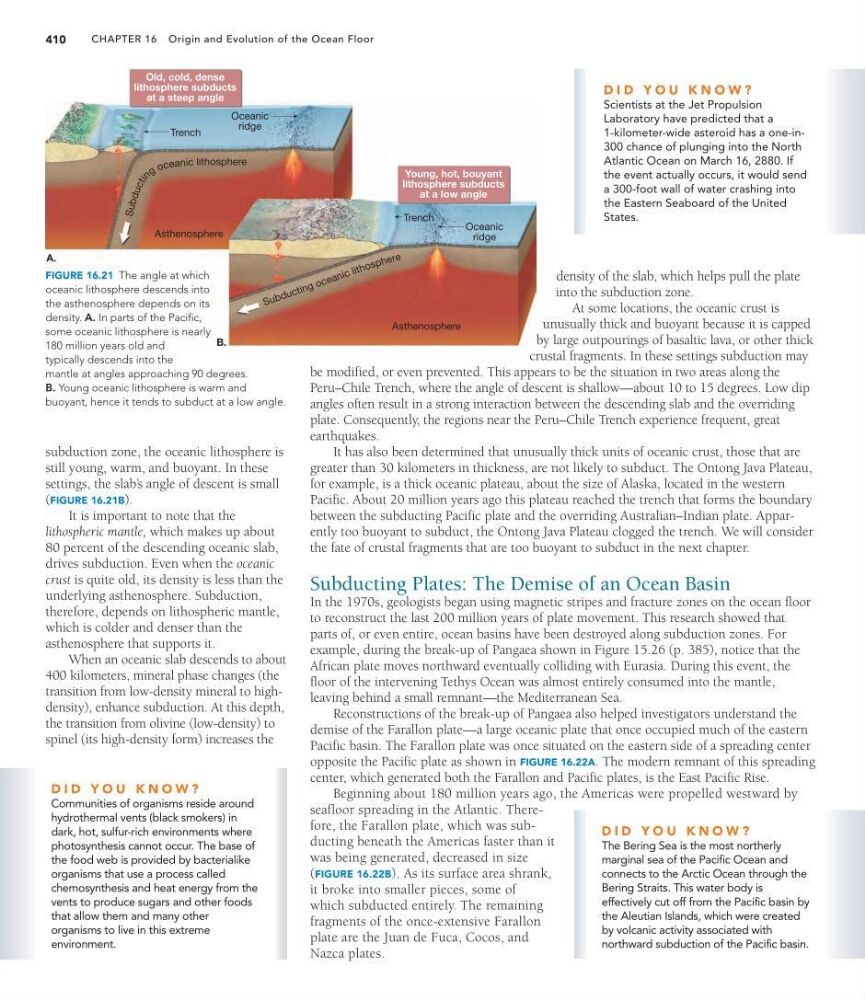
subduction zone, the oceanic lithosphere is
still young, warm, and buoyant. In these
settings, the slab’ s angle of descent is small
(FIGURE 16.21B).
It is important to note that the
lithospheric mantle, which makes up about
80 percent of the descending oceanic slab,
drives subduction. Even when the oceanic
crust is quite old, its density is less than the
underlying asthenosphere. Subduction,
therefore, depends on lithospheric mantle,
which is colder and denser than the
asthenosphere that supports it.
When an oceanic slab descends to about
400 kilometers, mineral phase changes (the
transition from low-density mineral to highdensity), enhance subduction. At this depth,
the transition from olivine (low-density) to
spinel (its high-density form) increases the
CHAPTER 16 Origin and Evolution of the Ocean Floor
410
A.
B.
Trench
Trench
Oceanic
ridge
Asthenosphere
Oceanic
ridge
Asthenosphere
S u b d u c ti n g o c e a n ic li th o s p h e re
S u b d u c t i
n g o ce anic lithosphere
Old, cold, dense
lithosphere subducts
at a steep angle
Young, hot, bouyant
lithosphere subducts
at a low angle
FIGURE 16.21 The angle at which
oceanic lithosphere descends into
the asthenosphere depends on its
density. A. In parts of the Pacific,
some oceanic lithosphere is nearly
180 million years old and
typically descends into the
mantle at angles approaching 90 degrees.
B. Young oceanic lithosphere is warm and
buoyant, hence it tends to subduct at a low angle.
D I D Y O U K N O W ?
Scientists at the Jet Propulsion
Laboratory have predicted that a
1-kilometer-wide asteroid has a one-in300 chance of plunging into the North
Atlantic Ocean on March 16, 2880. If
the event actually occurs, it would send
a 300-foot wall of water crashing into
the Eastern Seaboard of the United
States.
D I D Y O U K N O W ?
Communities of organisms reside around
hydrothermal vents (black smokers) in
dark, hot, sulfur-rich environments where
photosynthesis cannot occur. The base of
the food web is provided by bacterialike
organisms that use a process called
chemosynthesis and heat energy from the
vents to produce sugars and other foods
that allow them and many other
organisms to live in this extreme
environment.
D I D Y O U K N O W ?
The Bering Sea is the most northerly
marginal sea of the Pacific Ocean and
connects to the Arctic Ocean through the
Bering Straits. This water body is
effectively cut off from the Pacific basin by
the Aleutian Islands, which were created
by volcanic activity associated with
northward subduction of the Pacific basin.
into the subduction zone.
At some locations, the oceanic crust is
unusually thick and buoyant because it is capped
by large outpourings of basaltic lava, or other thick
crustal fragments. In these settings subduction may
be modified, or even prevented. This appears to be the situation in two areas along the
Peru–Chile Trench, where the angle of descent is shallow—about 10 to 15 degrees. Low dip
angles often result in a strong interaction between the descending slab and the overriding
plate. Consequently, the regions near the Peru–Chile Trench experience frequent, great
earthquakes.
It has also been determined that unusually thick units of oceanic crust, those that are
greater than 30 kilometers in thickness, are not likely to subduct. The Ontong Java Plateau,
for example, is a thick oceanic plateau, about the size of Alaska, located in the western
Pacific. About 20 million years ago this plateau reached the trench that forms the boundary
between the subducting Pacific plate and the overriding Australian–Indian plate. Apparently too buoyant to subduct, the Ontong Java Plateau clogged the trench. We will consider
the fate of crustal fragments that are too buoyant to subduct in the next chapter.
Subducting Plates: The Demise of an Ocean Basin
In the 1970s, geologists began using magnetic stripes and fracture zones on the ocean floor
to reconstruct the last 200 million years of plate movement. This research showed that
parts of, or even entire, ocean basins have been destroyed along subduction zones. For
example, during the break-up of Pangaea shown in Figure 15.26 (p. 385), notice that the
African plate moves northward eventually colliding with Eurasia. During this event, the
floor of the intervening Tethys Ocean was almost entirely consumed into the mantle,
leaving behind a small remnant—the Mediterranean Sea.
Reconstructions of the break-up of Pangaea also helped investigators understand the
demise of the Farallon plate—a large oceanic plate that once occupied much of the eastern
Pacific basin. The Farallon plate was once situated on the eastern side of a spreading center
opposite the Pacific plate as shown in FIGURE 16.22A. The modern remnant of this spreading
center, which generated both the Farallon and Pacific plates, is the East Pacific Rise.
Beginning about 180 million years ago, the Americas were propelled westward by
seafloor spreading in the Atlantic. Therefore, the Farallon plate, which was subducting beneath the Americas faster than it
was being generated, decreased in size
(FIGURE 16.22B). As its surface area shrank,
it broke into smaller pieces, some of
which subducted entirely. The remaining
fragments of the once-extensive Farallon
plate are the Juan de Fuca, Cocos, and
Nazca plates.
subduction zone, the oceanic lithosphere is
still young, warm, and buoyant. In these
settings, the slab’ s angle of descent is small
(FIGURE 16.21B).
It is important to note that the
lithospheric mantle, which makes up about
80 percent of the descending oceanic slab,
drives subduction. Even when the oceanic
crust is quite old, its density is less than the
underlying asthenosphere. Subduction,
therefore, depends on lithospheric mantle,
which is colder and denser than the
asthenosphere that supports it.
When an oceanic slab descends to about
400 kilometers, mineral phase changes (the
transition from low-density mineral to highdensity), enhance subduction. At this depth,
the transition from olivine (low-density) to
spinel (its high-density form) increases the
CHAPTER 16 Origin and Evolution of the Ocean Floor
410
A.
B.
Trench
Trench
Oceanic
ridge
Asthenosphere
Oceanic
ridge
Asthenosphere
S u b d u c ti n g o c e a n ic li th o s p h e re
S u b d u c t i
n g o ce anic lithosphere
Old, cold, dense
lithosphere subducts
at a steep angle
Young, hot, bouyant
lithosphere subducts
at a low angle
FIGURE 16.21 The angle at which
oceanic lithosphere descends into
the asthenosphere depends on its
density. A. In parts of the Pacific,
some oceanic lithosphere is nearly
180 million years old and
typically descends into the
mantle at angles approaching 90 degrees.
B. Young oceanic lithosphere is warm and
buoyant, hence it tends to subduct at a low angle.
D I D Y O U K N O W ?
Scientists at the Jet Propulsion
Laboratory have predicted that a
1-kilometer-wide asteroid has a one-in300 chance of plunging into the North
Atlantic Ocean on March 16, 2880. If
the event actually occurs, it would send
a 300-foot wall of water crashing into
the Eastern Seaboard of the United
States.
D I D Y O U K N O W ?
Communities of organisms reside around
hydrothermal vents (black smokers) in
dark, hot, sulfur-rich environments where
photosynthesis cannot occur. The base of
the food web is provided by bacterialike
organisms that use a process called
chemosynthesis and heat energy from the
vents to produce sugars and other foods
that allow them and many other
organisms to live in this extreme
environment.
D I D Y O U K N O W ?
The Bering Sea is the most northerly
marginal sea of the Pacific Ocean and
connects to the Arctic Ocean through the
Bering Straits. This water body is
effectively cut off from the Pacific basin by
the Aleutian Islands, which were created
by volcanic activity associated with
northward subduction of the Pacific basin.