

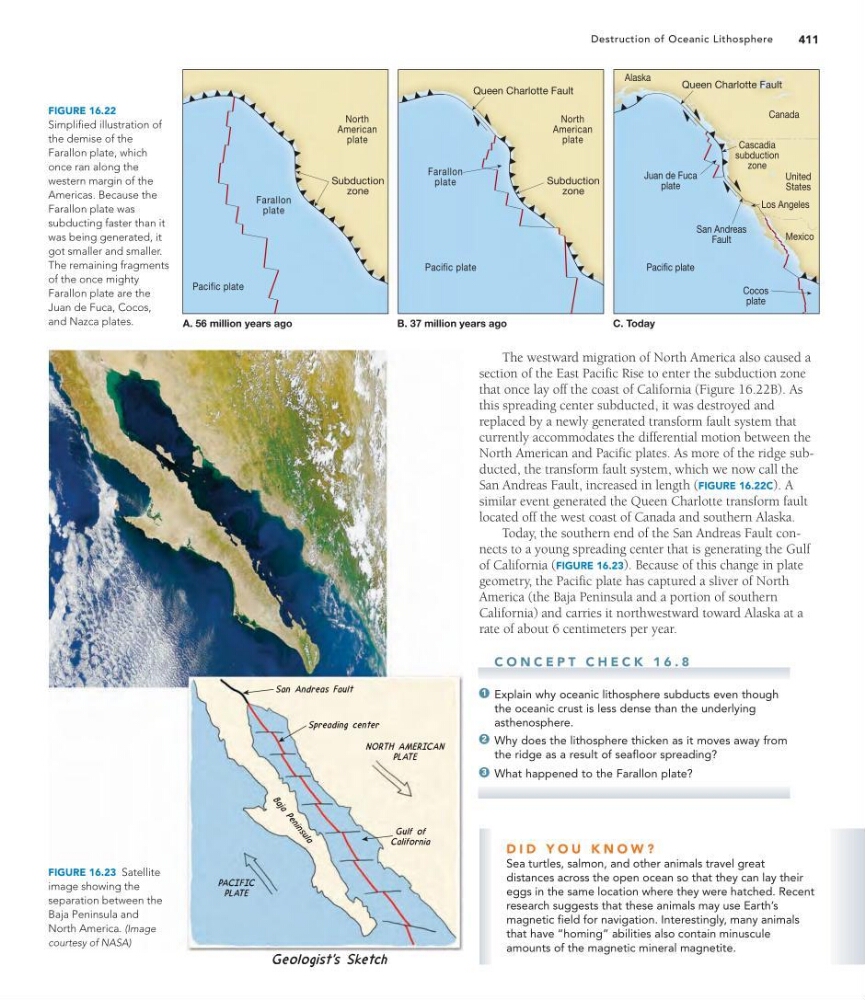
The westward migration of North America also caused a
section of the East Pacific Rise to enter the subduction zone
that once lay off the coast of California (Figure 16.22B). As
this spreading center subducted, it was destroyed and
replaced by a newly generated transform fault system that
currently accommodates the differential motion between the
North American and Pacific plates. As more of the ridge subducted, the transform fault system, which we now call the
San Andreas Fault, increased in length (FIGURE 16.22C). A
similar event generated the Queen Charlotte transform fault
located off the west coast of Canada and southern Alaska.
Today, the southern end of the San Andreas Fault connects to a young spreading center that is generating the Gulf
of California (FIGURE 16.23). Because of this change in plate
geometry, the Pacific plate has captured a sliver of North
America (the Baja Peninsula and a portion of southern
California) and carries it northwestward toward Alaska at a
rate of about 6 centimeters per year.
C O N C E P T C H E C K 1 6 . 8
Explain why oceanic lithosphere subducts even though
the oceanic crust is less dense than the underlying
asthenosphere.
Why does the lithosphere thicken as it moves away from
the ridge as a result of seafloor spreading?
What happened to the Farallon plate?
3
2
1
B. 37 million years ago
A. 56 million years ago
Juan de Fuca
plate
Cascadia
subduction
zone
Pacific plate
Cocos
plate
San Andreas
Fault
Canada
Mexico
Alaska
United
States
Los Angeles
North
American
plate
Pacific plate
Farallon
plate
Subduction
zone
North
American
plate
Pacific plate
Farallon
plate
Subduction
zone
Queen Charlotte Fault
Queen Charlotte Fault
C. Today
FIGURE 16.22
Simplified illustration of
the demise of the
Farallon plate, which
once ran along the
western margin of the
Americas. Because the
Farallon plate was
subducting faster than it
was being generated, it
got smaller and smaller.
The remaining fragments
of the once mighty
Farallon plate are the
Juan de Fuca, Cocos,
and Nazca plates.
FIGURE 16.23 Satellite
image showing the
separation between the
Baja Peninsula and
North America. (Image
courtesy of NASA)
Destruction of Oceanic Lithosphere
411
D I D Y O U K N O W ?
Sea turtles, salmon, and other animals travel great
distances across the open ocean so that they can lay their
eggs in the same location where they were hatched. Recent
research suggests that these animals may use Earth’s
magnetic field for navigation. Interestingly, many animals
that have “homing” abilities also contain minuscule
amounts of the magnetic mineral magnetite.
section of the East Pacific Rise to enter the subduction zone
that once lay off the coast of California (Figure 16.22B). As
this spreading center subducted, it was destroyed and
replaced by a newly generated transform fault system that
currently accommodates the differential motion between the
North American and Pacific plates. As more of the ridge subducted, the transform fault system, which we now call the
San Andreas Fault, increased in length (FIGURE 16.22C). A
similar event generated the Queen Charlotte transform fault
located off the west coast of Canada and southern Alaska.
Today, the southern end of the San Andreas Fault connects to a young spreading center that is generating the Gulf
of California (FIGURE 16.23). Because of this change in plate
geometry, the Pacific plate has captured a sliver of North
America (the Baja Peninsula and a portion of southern
California) and carries it northwestward toward Alaska at a
rate of about 6 centimeters per year.
C O N C E P T C H E C K 1 6 . 8
Explain why oceanic lithosphere subducts even though
the oceanic crust is less dense than the underlying
asthenosphere.
Why does the lithosphere thicken as it moves away from
the ridge as a result of seafloor spreading?
What happened to the Farallon plate?
3
2
1
B. 37 million years ago
A. 56 million years ago
Juan de Fuca
plate
Cascadia
subduction
zone
Pacific plate
Cocos
plate
San Andreas
Fault
Canada
Mexico
Alaska
United
States
Los Angeles
North
American
plate
Pacific plate
Farallon
plate
Subduction
zone
North
American
plate
Pacific plate
Farallon
plate
Subduction
zone
Queen Charlotte Fault
Queen Charlotte Fault
C. Today
FIGURE 16.22
Simplified illustration of
the demise of the
Farallon plate, which
once ran along the
western margin of the
Americas. Because the
Farallon plate was
subducting faster than it
was being generated, it
got smaller and smaller.
The remaining fragments
of the once mighty
Farallon plate are the
Juan de Fuca, Cocos,
and Nazca plates.
FIGURE 16.23 Satellite
image showing the
separation between the
Baja Peninsula and
North America. (Image
courtesy of NASA)
Destruction of Oceanic Lithosphere
411
D I D Y O U K N O W ?
Sea turtles, salmon, and other animals travel great
distances across the open ocean so that they can lay their
eggs in the same location where they were hatched. Recent
research suggests that these animals may use Earth’s
magnetic field for navigation. Interestingly, many animals
that have “homing” abilities also contain minuscule
amounts of the magnetic mineral magnetite.