

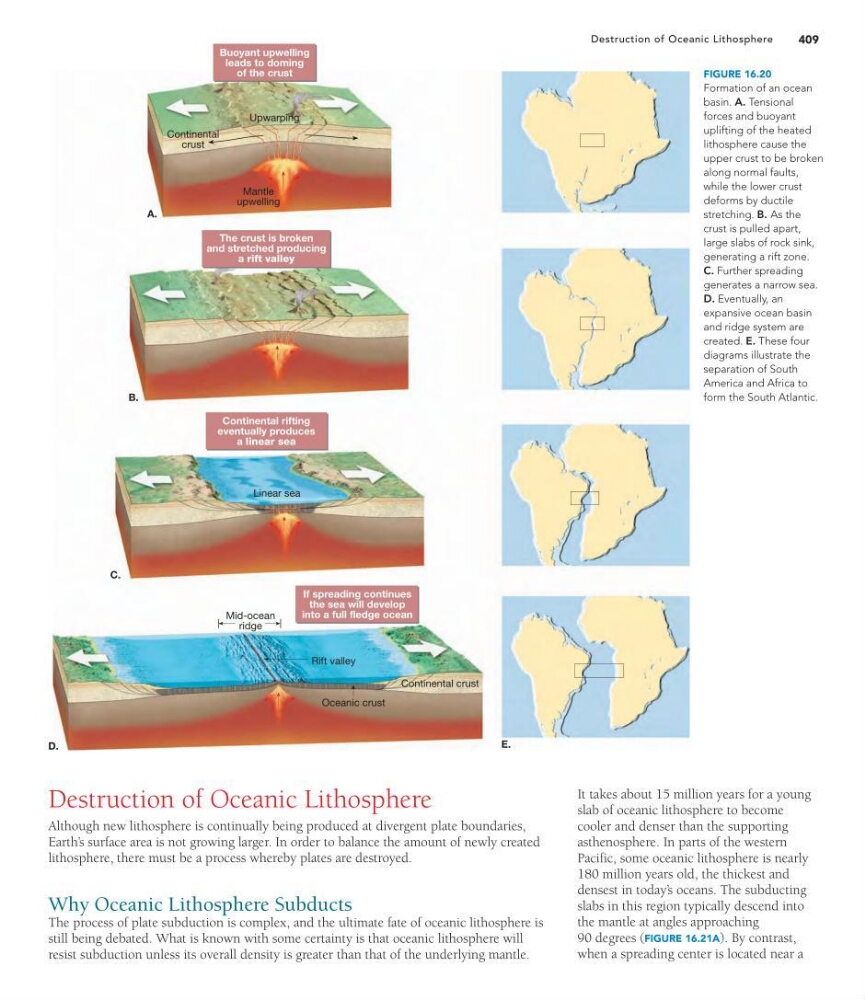
FIGURE 16.20
Formation of an ocean
basin. A. Tensional
forces and buoyant
uplifting of the heated
lithosphere cause the
upper crust to be broken
along normal faults,
while the lower crust
deforms by ductile
stretching. B. As the
crust is pulled apart,
large slabs of rock sink,
generating a rift zone.
C. Further spreading
generates a narrow sea.
D. Eventually, an
expansive ocean basin
and ridge system are
created. E. These four
diagrams illustrate the
separation of South
America and Africa to
form the South Atlantic.
A.
Upwarping
Continental
crust
B.
C.
D.
Rift valley
Mid-ocean
ridge
Oceanic crust
Continental crust
E.
Buoyant upwelling
leads to doming
of the crust
The crust is broken
and stretched producing
a rift valley
Continental rifting
eventually produces
a linear sea
If spreading continues
the sea will develop
into a full fledge ocean
Mantle
upwelling
Linear sea
409
Destruction of Oceanic Lithosphere
Destruction of Oceanic Lithosphere
Although new lithosphere is continually being produced at divergent plate boundaries,
Earth’ s surface area is not growing larger. In order to balance the amount of newly created
lithosphere, there must be a process whereby plates are destroyed.
Why Oceanic Lithosphere Subducts
The process of plate subduction is complex, and the ultimate fate of oceanic lithosphere is
still being debated. What is known with some certainty is that oceanic lithosphere will
resist subduction unless its overall density is greater than that of the underlying mantle.
It takes about 15 million years for a young
slab of oceanic lithosphere to become
cooler and denser than the supporting
asthenosphere. In parts of the western
Pacific, some oceanic lithosphere is nearly
180 million years old, the thickest and
densest in today’ s oceans. The subducting
slabs in this region typically descend into
the mantle at angles approaching
90 degrees (FIGURE 16.21A). By contrast,
when a spreading center is located near a
Formation of an ocean
basin. A. Tensional
forces and buoyant
uplifting of the heated
lithosphere cause the
upper crust to be broken
along normal faults,
while the lower crust
deforms by ductile
stretching. B. As the
crust is pulled apart,
large slabs of rock sink,
generating a rift zone.
C. Further spreading
generates a narrow sea.
D. Eventually, an
expansive ocean basin
and ridge system are
created. E. These four
diagrams illustrate the
separation of South
America and Africa to
form the South Atlantic.
A.
Upwarping
Continental
crust
B.
C.
D.
Rift valley
Mid-ocean
ridge
Oceanic crust
Continental crust
E.
Buoyant upwelling
leads to doming
of the crust
The crust is broken
and stretched producing
a rift valley
Continental rifting
eventually produces
a linear sea
If spreading continues
the sea will develop
into a full fledge ocean
Mantle
upwelling
Linear sea
409
Destruction of Oceanic Lithosphere
Destruction of Oceanic Lithosphere
Although new lithosphere is continually being produced at divergent plate boundaries,
Earth’ s surface area is not growing larger. In order to balance the amount of newly created
lithosphere, there must be a process whereby plates are destroyed.
Why Oceanic Lithosphere Subducts
The process of plate subduction is complex, and the ultimate fate of oceanic lithosphere is
still being debated. What is known with some certainty is that oceanic lithosphere will
resist subduction unless its overall density is greater than that of the underlying mantle.
It takes about 15 million years for a young
slab of oceanic lithosphere to become
cooler and denser than the supporting
asthenosphere. In parts of the western
Pacific, some oceanic lithosphere is nearly
180 million years old, the thickest and
densest in today’ s oceans. The subducting
slabs in this region typically descend into
the mantle at angles approaching
90 degrees (FIGURE 16.21A). By contrast,
when a spreading center is located near a