

CHAPTER 16 Origin and Evolution of the Ocean Floor
408
By contrast, where the crust is thin, hot, and
weak, rifts can be more than 1000 kilometers wide, as exemplified by the Basin and
Range Province in the western United States.
In those settings where rifting continues,
the rift system evolves into a young, narrow
ocean basin, such as the present-day Red
Sea. Continued seafloor spreading eventually
results in the formation of a mature ocean
basin bordered by rifted continental margins. The Atlantic Ocean is such a feature.
What follows is an overview of ocean basin
evolution using modern examples to represent the various stages of rifting.
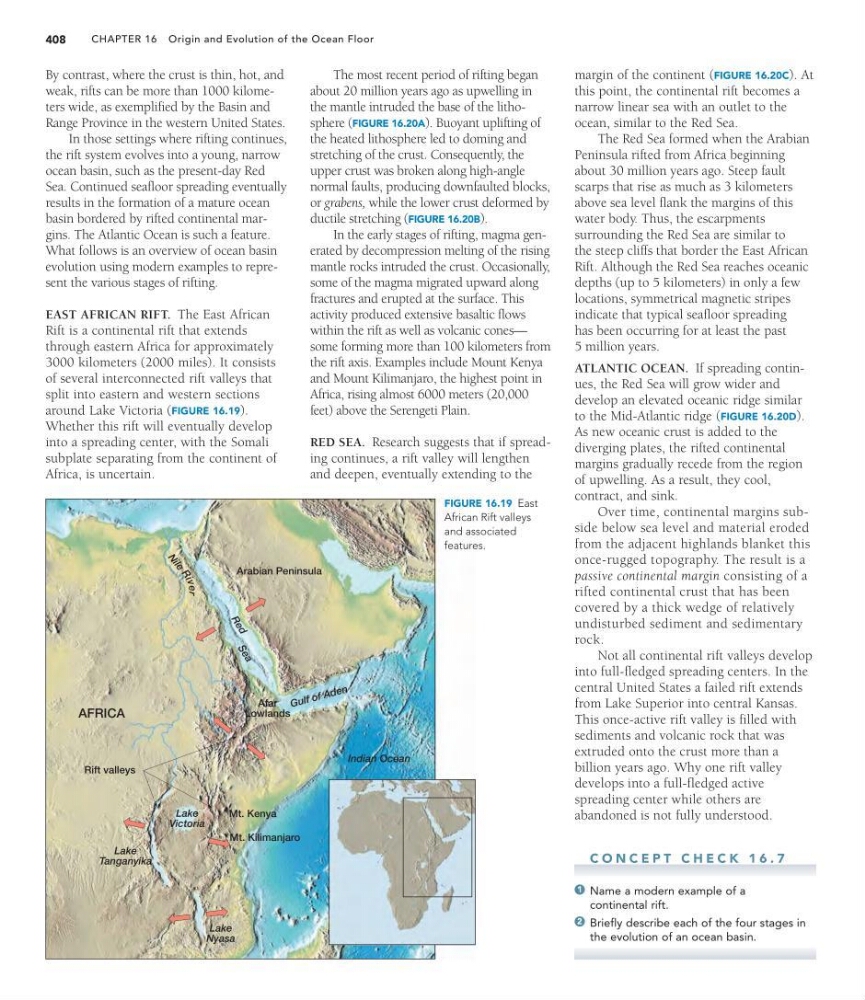
EAST AFRICAN RIFT. The East African
Rift is a continental rift that extends
through eastern Africa for approximately
3000 kilometers (2000 miles). It consists
of several interconnected rift valleys that
split into eastern and western sections
around Lake Victoria (FIGURE 16.19).
Whether this rift will eventually develop
into a spreading center, with the Somali
subplate separating from the continent of
Africa, is uncertain.
The most recent period of rifting began
about 20 million years ago as upwelling in
the mantle intruded the base of the lithosphere (FIGURE 16.20A). Buoyant uplifting of
the heated lithosphere led to doming and
stretching of the crust. Consequently, the
upper crust was broken along high-angle
normal faults, producing downfaulted blocks,
or grabens, while the lower crust deformed by
ductile stretching (FIGURE 16.20B).
In the early stages of rifting, magma generated by decompression melting of the rising
mantle rocks intruded the crust. Occasionally,
some of the magma migrated upward along
fractures and erupted at the surface. This
activity produced extensive basaltic flows
within the rift as well as volcanic cones—
some forming more than 100 kilometers from
the rift axis. Examples include Mount Kenya
and Mount Kilimanjaro, the highest point in
Africa, rising almost 6000 meters (20,000
feet) above the Serengeti Plain.
RED SEA. Research suggests that if spreading continues, a rift valley will lengthen
and deepen, eventually extending to the
margin of the continent (FIGURE 16.20C). At
this point, the continental rift becomes a
narrow linear sea with an outlet to the
ocean, similar to the Red Sea.
The Red Sea formed when the Arabian
Peninsula rifted from Africa beginning
about 30 million years ago. Steep fault
scarps that rise as much as 3 kilometers
above sea level flank the margins of this
water body. Thus, the escarpments
surrounding the Red Sea are similar to
the steep cliffs that border the East African
Rift. Although the Red Sea reaches oceanic
depths (up to 5 kilometers) in only a few
locations, symmetrical magnetic stripes
indicate that typical seafloor spreading
has been occurring for at least the past
5 million years.
ATLANTIC OCEAN. If spreading continues, the Red Sea will grow wider and
develop an elevated oceanic ridge similar
to the Mid-Atlantic ridge (FIGURE 16.20D).
As new oceanic crust is added to the
diverging plates, the rifted continental
margins gradually recede from the region
of upwelling. As a result, they cool,
contract, and sink.
Over time, continental margins subside below sea level and material eroded
from the adjacent highlands blanket this
once-rugged topography. The result is a
passive continental margin consisting of a
rifted continental crust that has been
covered by a thick wedge of relatively
undisturbed sediment and sedimentary
rock.
Not all continental rift valleys develop
into full-fledged spreading centers. In the
central United States a failed rift extends
from Lake Superior into central Kansas.
This once-active rift valley is filled with
sediments and volcanic rock that was
extruded onto the crust more than a
billion years ago. Why one rift valley
develops into a full-fledged active
spreading center while others are
abandoned is not fully understood.
C O N C E P T C H E C K 1 6 . 7
Name a modern example of a
continental rift.
Briefly describe each of the four stages in
the evolution of an ocean basin.
2
1
R
e
d
S
e
a
G u lf o f A d e n
Indian Ocean
Lake
Victoria
Lake
Tanganyika
AFRICA
Afar
Lowlands
Mt. Kenya
Mt. Kilimanjaro
Arabian Peninsula
N
i
l
e
R
i
v
er
Lake
Nyasa
Rift valleys
FIGURE 16.19 East
African Rift valleys
and associated
features.
408
By contrast, where the crust is thin, hot, and
weak, rifts can be more than 1000 kilometers wide, as exemplified by the Basin and
Range Province in the western United States.
In those settings where rifting continues,
the rift system evolves into a young, narrow
ocean basin, such as the present-day Red
Sea. Continued seafloor spreading eventually
results in the formation of a mature ocean
basin bordered by rifted continental margins. The Atlantic Ocean is such a feature.
What follows is an overview of ocean basin
evolution using modern examples to represent the various stages of rifting.
EAST AFRICAN RIFT. The East African
Rift is a continental rift that extends
through eastern Africa for approximately
3000 kilometers (2000 miles). It consists
of several interconnected rift valleys that
split into eastern and western sections
around Lake Victoria (FIGURE 16.19).
Whether this rift will eventually develop
into a spreading center, with the Somali
subplate separating from the continent of
Africa, is uncertain.
The most recent period of rifting began
about 20 million years ago as upwelling in
the mantle intruded the base of the lithosphere (FIGURE 16.20A). Buoyant uplifting of
the heated lithosphere led to doming and
stretching of the crust. Consequently, the
upper crust was broken along high-angle
normal faults, producing downfaulted blocks,
or grabens, while the lower crust deformed by
ductile stretching (FIGURE 16.20B).
In the early stages of rifting, magma generated by decompression melting of the rising
mantle rocks intruded the crust. Occasionally,
some of the magma migrated upward along
fractures and erupted at the surface. This
activity produced extensive basaltic flows
within the rift as well as volcanic cones—
some forming more than 100 kilometers from
the rift axis. Examples include Mount Kenya
and Mount Kilimanjaro, the highest point in
Africa, rising almost 6000 meters (20,000
feet) above the Serengeti Plain.
RED SEA. Research suggests that if spreading continues, a rift valley will lengthen
and deepen, eventually extending to the
margin of the continent (FIGURE 16.20C). At
this point, the continental rift becomes a
narrow linear sea with an outlet to the
ocean, similar to the Red Sea.
The Red Sea formed when the Arabian
Peninsula rifted from Africa beginning
about 30 million years ago. Steep fault
scarps that rise as much as 3 kilometers
above sea level flank the margins of this
water body. Thus, the escarpments
surrounding the Red Sea are similar to
the steep cliffs that border the East African
Rift. Although the Red Sea reaches oceanic
depths (up to 5 kilometers) in only a few
locations, symmetrical magnetic stripes
indicate that typical seafloor spreading
has been occurring for at least the past
5 million years.
ATLANTIC OCEAN. If spreading continues, the Red Sea will grow wider and
develop an elevated oceanic ridge similar
to the Mid-Atlantic ridge (FIGURE 16.20D).
As new oceanic crust is added to the
diverging plates, the rifted continental
margins gradually recede from the region
of upwelling. As a result, they cool,
contract, and sink.
Over time, continental margins subside below sea level and material eroded
from the adjacent highlands blanket this
once-rugged topography. The result is a
passive continental margin consisting of a
rifted continental crust that has been
covered by a thick wedge of relatively
undisturbed sediment and sedimentary
rock.
Not all continental rift valleys develop
into full-fledged spreading centers. In the
central United States a failed rift extends
from Lake Superior into central Kansas.
This once-active rift valley is filled with
sediments and volcanic rock that was
extruded onto the crust more than a
billion years ago. Why one rift valley
develops into a full-fledged active
spreading center while others are
abandoned is not fully understood.
C O N C E P T C H E C K 1 6 . 7
Name a modern example of a
continental rift.
Briefly describe each of the four stages in
the evolution of an ocean basin.
2
1
R
e
d
S
e
a
G u lf o f A d e n
Indian Ocean
Lake
Victoria
Lake
Tanganyika
AFRICA
Afar
Lowlands
Mt. Kenya
Mt. Kilimanjaro
Arabian Peninsula
N
i
l
e
R
i
v
er
Lake
Nyasa
Rift valleys
FIGURE 16.19 East
African Rift valleys
and associated
features.