

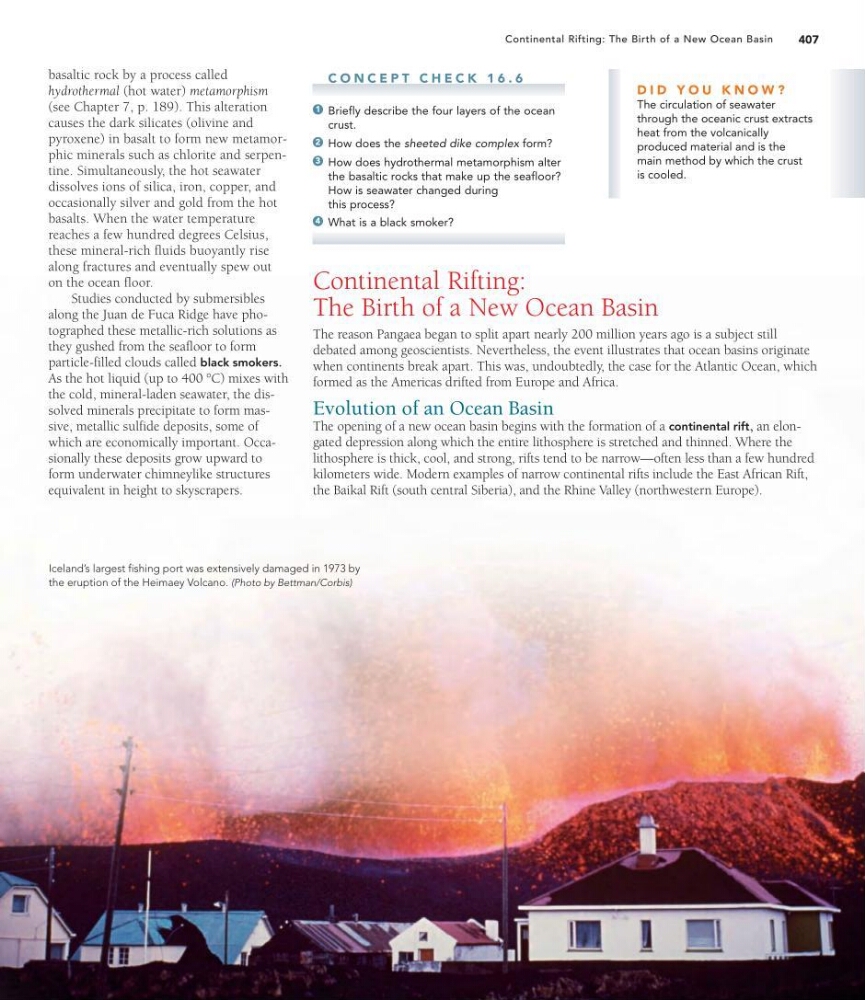
Iceland’s largest fishing port was extensively damaged in 1973 by
the eruption of the Heimaey Volcano. (Photo by Bettman/Corbis)
407
Continental Rifting: The Birth of a New Ocean Basin
basaltic rock by a process called
hydrothermal (hot water) metamorphism
(see Chapter 7, p. 189). This alteration
causes the dark silicates (olivine and
pyroxene) in basalt to form new metamorphic minerals such as chlorite and serpentine. Simultaneously, the hot seawater
dissolves ions of silica, iron, copper, and
occasionally silver and gold from the hot
basalts. When the water temperature
reaches a few hundred degrees Celsius,
these mineral-rich fluids buoyantly rise
along fractures and eventually spew out
on the ocean floor.
Studies conducted by submersibles
along the Juan de Fuca Ridge have photographed these metallic-rich solutions as
they gushed from the seafloor to form
particle-filled clouds called black smokers.
As the hot liquid (up to 400 °C) mixes with
the cold, mineral-laden seawater, the dissolved minerals precipitate to form massive, metallic sulfide deposits, some of
which are economically important. Occasionally these deposits grow upward to
form underwater chimneylike structures
equivalent in height to skyscrapers.
C O N C E P T C H E C K 1 6 . 6
Briefly describe the four layers of the ocean
crust.
How does the sheeted dike complex form?
How does hydrothermal metamorphism alter
the basaltic rocks that make up the seafloor?
How is seawater changed during
this process?
What is a black smoker?
Continental Rifting:
The Birth of a New Ocean Basin
The reason Pangaea began to split apart nearly 200 million years ago is a subject still
debated among geoscientists. Nevertheless, the event illustrates that ocean basins originate
when continents break apart. This was, undoubtedly, the case for the Atlantic Ocean, which
formed as the Americas drifted from Europe and Africa.
Evolution of an Ocean Basin
The opening of a new ocean basin begins with the formation of a continental rift, an elongated depression along which the entire lithosphere is stretched and thinned. Where the
lithosphere is thick, cool, and strong, rifts tend to be narrow—often less than a few hundred
kilometers wide. Modern examples of narrow continental rifts include the East African Rift,
the Baikal Rift (south central Siberia), and the Rhine Valley (northwestern Europe).
4
3
2
1
D I D Y O U K N O W ?
The circulation of seawater
through the oceanic crust extracts
heat from the volcanically
produced material and is the
main method by which the crust
is cooled.
the eruption of the Heimaey Volcano. (Photo by Bettman/Corbis)
407
Continental Rifting: The Birth of a New Ocean Basin
basaltic rock by a process called
hydrothermal (hot water) metamorphism
(see Chapter 7, p. 189). This alteration
causes the dark silicates (olivine and
pyroxene) in basalt to form new metamorphic minerals such as chlorite and serpentine. Simultaneously, the hot seawater
dissolves ions of silica, iron, copper, and
occasionally silver and gold from the hot
basalts. When the water temperature
reaches a few hundred degrees Celsius,
these mineral-rich fluids buoyantly rise
along fractures and eventually spew out
on the ocean floor.
Studies conducted by submersibles
along the Juan de Fuca Ridge have photographed these metallic-rich solutions as
they gushed from the seafloor to form
particle-filled clouds called black smokers.
As the hot liquid (up to 400 °C) mixes with
the cold, mineral-laden seawater, the dissolved minerals precipitate to form massive, metallic sulfide deposits, some of
which are economically important. Occasionally these deposits grow upward to
form underwater chimneylike structures
equivalent in height to skyscrapers.
C O N C E P T C H E C K 1 6 . 6
Briefly describe the four layers of the ocean
crust.
How does the sheeted dike complex form?
How does hydrothermal metamorphism alter
the basaltic rocks that make up the seafloor?
How is seawater changed during
this process?
What is a black smoker?
Continental Rifting:
The Birth of a New Ocean Basin
The reason Pangaea began to split apart nearly 200 million years ago is a subject still
debated among geoscientists. Nevertheless, the event illustrates that ocean basins originate
when continents break apart. This was, undoubtedly, the case for the Atlantic Ocean, which
formed as the Americas drifted from Europe and Africa.
Evolution of an Ocean Basin
The opening of a new ocean basin begins with the formation of a continental rift, an elongated depression along which the entire lithosphere is stretched and thinned. Where the
lithosphere is thick, cool, and strong, rifts tend to be narrow—often less than a few hundred
kilometers wide. Modern examples of narrow continental rifts include the East African Rift,
the Baikal Rift (south central Siberia), and the Rhine Valley (northwestern Europe).
4
3
2
1
D I D Y O U K N O W ?
The circulation of seawater
through the oceanic crust extracts
heat from the volcanically
produced material and is the
main method by which the crust
is cooled.