

D I D Y O U K N O W ?
In July of 1958, the largest wave ever
recorded occurred in Lituya Bay,
about 100 miles from Juneau, Alaska.
A rockslide triggered by an
earthquake dumped 90 million tons
of rock into the bay, which created a
huge splash wave. The wave swept
over a ridge, uprooting and snapping
tree trunks that had been 1740 feet
above the bay.
black smoker
CHAPTER 16 Origin and Evolution of the Ocean Floor
406
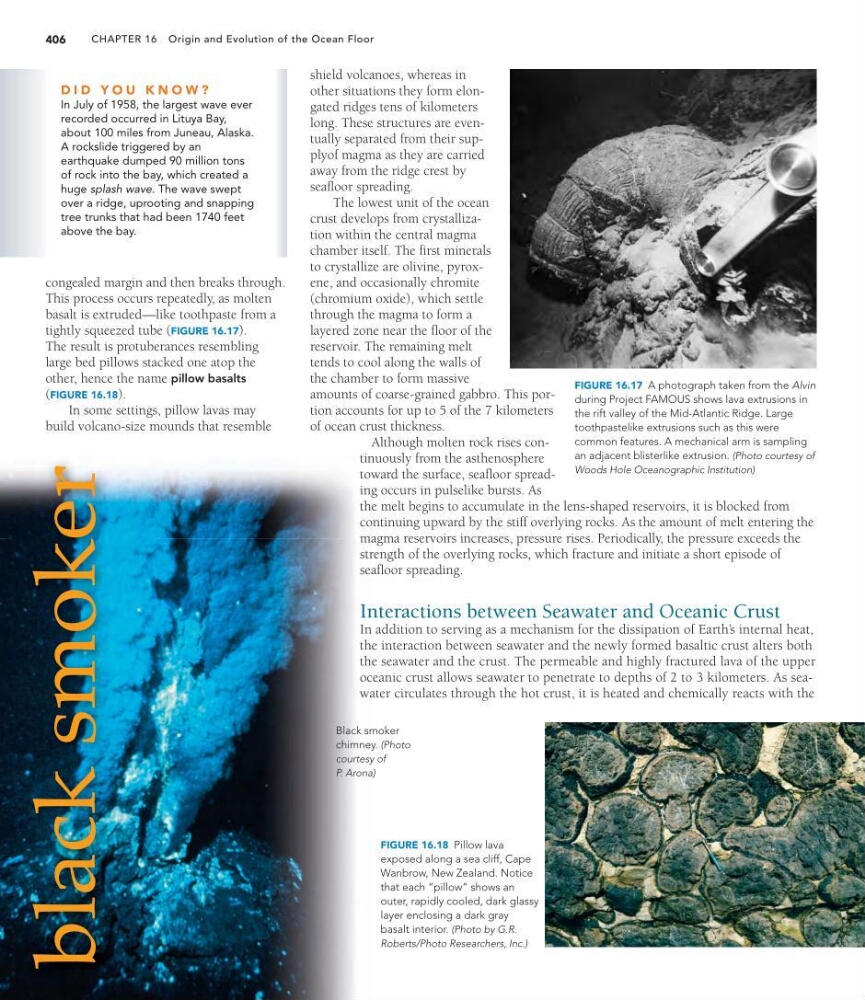
congealed margin and then breaks through.
This process occurs repeatedly, as molten
basalt is extruded—like toothpaste from a
tightly squeezed tube (FIGURE 16.17).
The result is protuberances resembling
large bed pillows stacked one atop the
other, hence the name pillow basalts
(FIGURE 16.18).
In some settings, pillow lavas may
build volcano-size mounds that resemble
shield volcanoes, whereas in
other situations they form elongated ridges tens of kilometers
long. These structures are eventually separated from their supplyof magma as they are carried
away from the ridge crest by
seafloor spreading.
The lowest unit of the ocean
crust develops from crystallization within the central magma
chamber itself. The first minerals
to crystallize are olivine, pyroxene, and occasionally chromite
(chromium oxide), which settle
through the magma to form a
layered zone near the floor of the
reservoir. The remaining melt
tends to cool along the walls of
the chamber to form massive
amounts of coarse-grained gabbro. This portion accounts for up to 5 of the 7 kilometers
of ocean crust thickness.
Although molten rock rises continuously from the asthenosphere
toward the surface, seafloor spreading occurs in pulselike bursts. As
the melt begins to accumulate in the lens-shaped reservoirs, it is blocked from
continuing upward by the stiff overlying rocks. As the amount of melt entering the
magma reservoirs increases, pressure rises. Periodically, the pressure exceeds the
strength of the overlying rocks, which fracture and initiate a short episode of
seafloor spreading.
Interactions between Seawater and Oceanic Crust
In addition to serving as a mechanism for the dissipation of Earth’ s internal heat,
the interaction between seawater and the newly formed basaltic crust alters both
the seawater and the crust. The permeable and highly fractured lava of the upper
oceanic crust allows seawater to penetrate to depths of 2 to 3 kilometers. As seawater circulates through the hot crust, it is heated and chemically reacts with the
FIGURE 16.17 A photograph taken from the Alvin
during Project FAMOUS shows lava extrusions in
the rift valley of the Mid-Atlantic Ridge. Large
toothpastelike extrusions such as this were
common features. A mechanical arm is sampling
an adjacent blisterlike extrusion. (Photo courtesy of
Woods Hole Oceanographic Institution)
FIGURE 16.18 Pillow lava
exposed along a sea cliff, Cape
Wanbrow, New Zealand. Notice
that each “pillow” shows an
outer, rapidly cooled, dark glassy
layer enclosing a dark gray
basalt interior. (Photo by G.R.
Roberts/Photo Researchers, Inc.)
Black smoker
chimney. (Photo
courtesy of
P. Arona)
In July of 1958, the largest wave ever
recorded occurred in Lituya Bay,
about 100 miles from Juneau, Alaska.
A rockslide triggered by an
earthquake dumped 90 million tons
of rock into the bay, which created a
huge splash wave. The wave swept
over a ridge, uprooting and snapping
tree trunks that had been 1740 feet
above the bay.
black smoker
CHAPTER 16 Origin and Evolution of the Ocean Floor
406
congealed margin and then breaks through.
This process occurs repeatedly, as molten
basalt is extruded—like toothpaste from a
tightly squeezed tube (FIGURE 16.17).
The result is protuberances resembling
large bed pillows stacked one atop the
other, hence the name pillow basalts
(FIGURE 16.18).
In some settings, pillow lavas may
build volcano-size mounds that resemble
shield volcanoes, whereas in
other situations they form elongated ridges tens of kilometers
long. These structures are eventually separated from their supplyof magma as they are carried
away from the ridge crest by
seafloor spreading.
The lowest unit of the ocean
crust develops from crystallization within the central magma
chamber itself. The first minerals
to crystallize are olivine, pyroxene, and occasionally chromite
(chromium oxide), which settle
through the magma to form a
layered zone near the floor of the
reservoir. The remaining melt
tends to cool along the walls of
the chamber to form massive
amounts of coarse-grained gabbro. This portion accounts for up to 5 of the 7 kilometers
of ocean crust thickness.
Although molten rock rises continuously from the asthenosphere
toward the surface, seafloor spreading occurs in pulselike bursts. As
the melt begins to accumulate in the lens-shaped reservoirs, it is blocked from
continuing upward by the stiff overlying rocks. As the amount of melt entering the
magma reservoirs increases, pressure rises. Periodically, the pressure exceeds the
strength of the overlying rocks, which fracture and initiate a short episode of
seafloor spreading.
Interactions between Seawater and Oceanic Crust
In addition to serving as a mechanism for the dissipation of Earth’ s internal heat,
the interaction between seawater and the newly formed basaltic crust alters both
the seawater and the crust. The permeable and highly fractured lava of the upper
oceanic crust allows seawater to penetrate to depths of 2 to 3 kilometers. As seawater circulates through the hot crust, it is heated and chemically reacts with the
FIGURE 16.17 A photograph taken from the Alvin
during Project FAMOUS shows lava extrusions in
the rift valley of the Mid-Atlantic Ridge. Large
toothpastelike extrusions such as this were
common features. A mechanical arm is sampling
an adjacent blisterlike extrusion. (Photo courtesy of
Woods Hole Oceanographic Institution)
FIGURE 16.18 Pillow lava
exposed along a sea cliff, Cape
Wanbrow, New Zealand. Notice
that each “pillow” shows an
outer, rapidly cooled, dark glassy
layer enclosing a dark gray
basalt interior. (Photo by G.R.
Roberts/Photo Researchers, Inc.)
Black smoker
chimney. (Photo
courtesy of
P. Arona)