

405
The Nature of Oceanic Crust
The Nature of Oceanic Crust
An interesting aspect of oceanic crust is that its thickness and structure are remarkably
consistent throughout the entire ocean basin. Seismic soundings indicate that its thickness
averages only about 7 kilometers (5 miles). Furthermore, it is composed almost entirely of
mafic (basaltic) rocks that are underlain by a layer of the ultramafic rock peridotite, which
forms the lithospheric mantle.
Although most oceanic crust forms out of view, far below sea level, geologists have been
able to examine the structure of the ocean floor firsthand. In such locations as Newfoundland, Cyprus, Oman, and California, slivers of oceanic crust have been thrust high above sea
level. From these exposures, and core samples collected by deep-sea drilling ships,
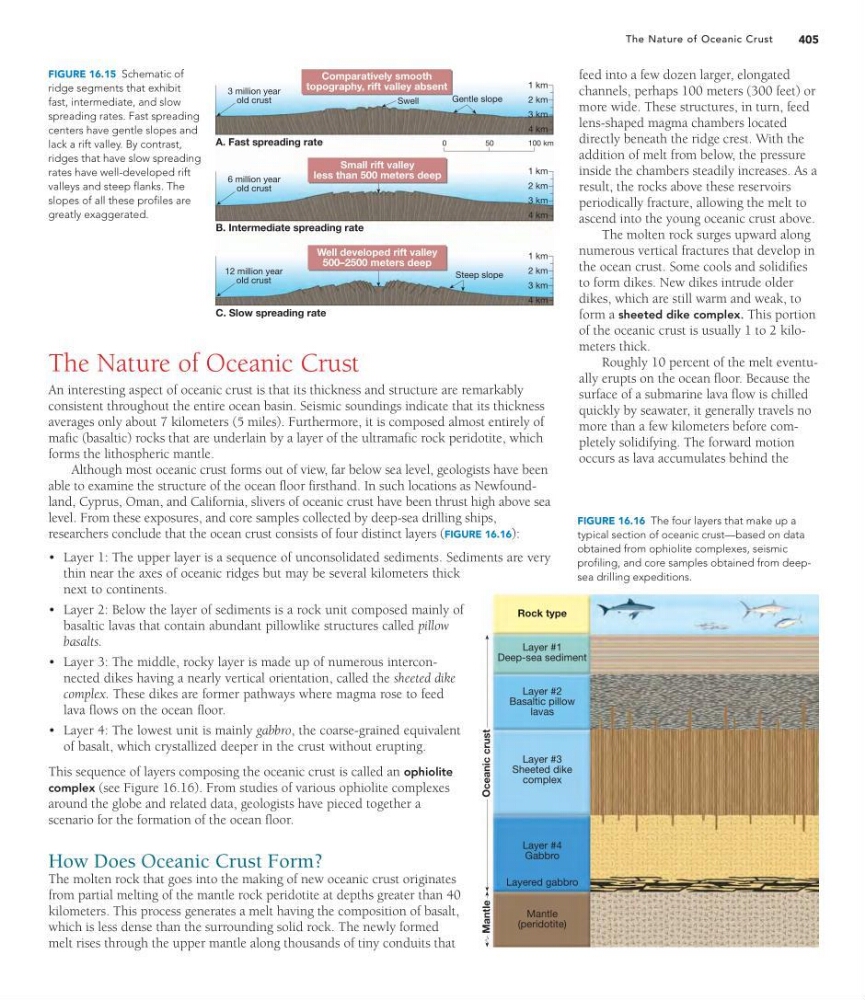
researchers conclude that the ocean crust consists of four distinct layers (FIGURE 16.16):
• Layer 1: The upper layer is a sequence of unconsolidated sediments. Sediments are very
thin near the axes of oceanic ridges but may be several kilometers thick
next to continents.
• Layer 2: Below the layer of sediments is a rock unit composed mainly of
basaltic lavas that contain abundant pillowlike structures called pillow
basalts.
• Layer 3: The middle, rocky layer is made up of numerous interconnected dikes having a nearly vertical orientation, called the sheeted dike
complex. These dikes are former pathways where magma rose to feed
lava flows on the ocean floor.
• Layer 4: The lowest unit is mainly gabbro, the coarse-grained equivalent
of basalt, which crystallized deeper in the crust without erupting.
This sequence of layers composing the oceanic crust is called an ophiolite
complex (see Figure 16.16). From studies of various ophiolite complexes
around the globe and related data, geologists have pieced together a
scenario for the formation of the ocean floor.
How Does Oceanic Crust Form?
The molten rock that goes into the making of new oceanic crust originates
from partial melting of the mantle rock peridotite at depths greater than 40
kilometers. This process generates a melt having the composition of basalt,
which is less dense than the surrounding solid rock. The newly formed
melt rises through the upper mantle along thousands of tiny conduits that
A. Fast spreading rate
Comparatively smooth
topography, rift valley absent
B. Intermediate spreading rate
C. Slow spreading rate
Small rift valley
less than 500 meters deep
Well developed rift valley
500–2500 meters deep
Gentle slope
Swell
Steep slope
3 million year
old crust
6 million year
old crust
12 million year
old crust
1 km
2 km
3 km
4 km
1 km
2 km
3 km
4 km
1 km
2 km
3 km
4 km
0
50
100 km
FIGURE 16.15 Schematic of
ridge segments that exhibit
fast, intermediate, and slow
spreading rates. Fast spreading
centers have gentle slopes and
lack a rift valley. By contrast,
ridges that have slow spreading
rates have well-developed rift
valleys and steep flanks. The
slopes of all these profiles are
greatly exaggerated.
Rock type
Layer #1
Deep-sea sediment
Layer #2
Basaltic pillow
lavas
Layer #3
Sheeted dike
complex
Layer #4
Gabbro
Layered gabbro
Mantle
(peridotite)
Mantle
Oceanic crust
feed into a few dozen larger, elongated
channels, perhaps 100 meters (300 feet) or
more wide. These structures, in turn, feed
lens-shaped magma chambers located
directly beneath the ridge crest. With the
addition of melt from below, the pressure
inside the chambers steadily increases. As a
result, the rocks above these reservoirs
periodically fracture, allowing the melt to
ascend into the young oceanic crust above.
The molten rock surges upward along
numerous vertical fractures that develop in
the ocean crust. Some cools and solidifies
to form dikes. New dikes intrude older
dikes, which are still warm and weak, to
form a sheeted dike complex. This portion
of the oceanic crust is usually 1 to 2 kilometers thick.
Roughly 10 percent of the melt eventually erupts on the ocean floor. Because the
surface of a submarine lava flow is chilled
quickly by seawater, it generally travels no
more than a few kilometers before completely solidifying. The forward motion
occurs as lava accumulates behind the
FIGURE 16.16 The four layers that make up a
typical section of oceanic crust—based on data
obtained from ophiolite complexes, seismic
profiling, and core samples obtained from deepsea drilling expeditions.
The Nature of Oceanic Crust
The Nature of Oceanic Crust
An interesting aspect of oceanic crust is that its thickness and structure are remarkably
consistent throughout the entire ocean basin. Seismic soundings indicate that its thickness
averages only about 7 kilometers (5 miles). Furthermore, it is composed almost entirely of
mafic (basaltic) rocks that are underlain by a layer of the ultramafic rock peridotite, which
forms the lithospheric mantle.
Although most oceanic crust forms out of view, far below sea level, geologists have been
able to examine the structure of the ocean floor firsthand. In such locations as Newfoundland, Cyprus, Oman, and California, slivers of oceanic crust have been thrust high above sea
level. From these exposures, and core samples collected by deep-sea drilling ships,
researchers conclude that the ocean crust consists of four distinct layers (FIGURE 16.16):
• Layer 1: The upper layer is a sequence of unconsolidated sediments. Sediments are very
thin near the axes of oceanic ridges but may be several kilometers thick
next to continents.
• Layer 2: Below the layer of sediments is a rock unit composed mainly of
basaltic lavas that contain abundant pillowlike structures called pillow
basalts.
• Layer 3: The middle, rocky layer is made up of numerous interconnected dikes having a nearly vertical orientation, called the sheeted dike
complex. These dikes are former pathways where magma rose to feed
lava flows on the ocean floor.
• Layer 4: The lowest unit is mainly gabbro, the coarse-grained equivalent
of basalt, which crystallized deeper in the crust without erupting.
This sequence of layers composing the oceanic crust is called an ophiolite
complex (see Figure 16.16). From studies of various ophiolite complexes
around the globe and related data, geologists have pieced together a
scenario for the formation of the ocean floor.
How Does Oceanic Crust Form?
The molten rock that goes into the making of new oceanic crust originates
from partial melting of the mantle rock peridotite at depths greater than 40
kilometers. This process generates a melt having the composition of basalt,
which is less dense than the surrounding solid rock. The newly formed
melt rises through the upper mantle along thousands of tiny conduits that
A. Fast spreading rate
Comparatively smooth
topography, rift valley absent
B. Intermediate spreading rate
C. Slow spreading rate
Small rift valley
less than 500 meters deep
Well developed rift valley
500–2500 meters deep
Gentle slope
Swell
Steep slope
3 million year
old crust
6 million year
old crust
12 million year
old crust
1 km
2 km
3 km
4 km
1 km
2 km
3 km
4 km
1 km
2 km
3 km
4 km
0
50
100 km
FIGURE 16.15 Schematic of
ridge segments that exhibit
fast, intermediate, and slow
spreading rates. Fast spreading
centers have gentle slopes and
lack a rift valley. By contrast,
ridges that have slow spreading
rates have well-developed rift
valleys and steep flanks. The
slopes of all these profiles are
greatly exaggerated.
Rock type
Layer #1
Deep-sea sediment
Layer #2
Basaltic pillow
lavas
Layer #3
Sheeted dike
complex
Layer #4
Gabbro
Layered gabbro
Mantle
(peridotite)
Mantle
Oceanic crust
feed into a few dozen larger, elongated
channels, perhaps 100 meters (300 feet) or
more wide. These structures, in turn, feed
lens-shaped magma chambers located
directly beneath the ridge crest. With the
addition of melt from below, the pressure
inside the chambers steadily increases. As a
result, the rocks above these reservoirs
periodically fracture, allowing the melt to
ascend into the young oceanic crust above.
The molten rock surges upward along
numerous vertical fractures that develop in
the ocean crust. Some cools and solidifies
to form dikes. New dikes intrude older
dikes, which are still warm and weak, to
form a sheeted dike complex. This portion
of the oceanic crust is usually 1 to 2 kilometers thick.
Roughly 10 percent of the melt eventually erupts on the ocean floor. Because the
surface of a submarine lava flow is chilled
quickly by seawater, it generally travels no
more than a few kilometers before completely solidifying. The forward motion
occurs as lava accumulates behind the
FIGURE 16.16 The four layers that make up a
typical section of oceanic crust—based on data
obtained from ophiolite complexes, seismic
profiling, and core samples obtained from deepsea drilling expeditions.