

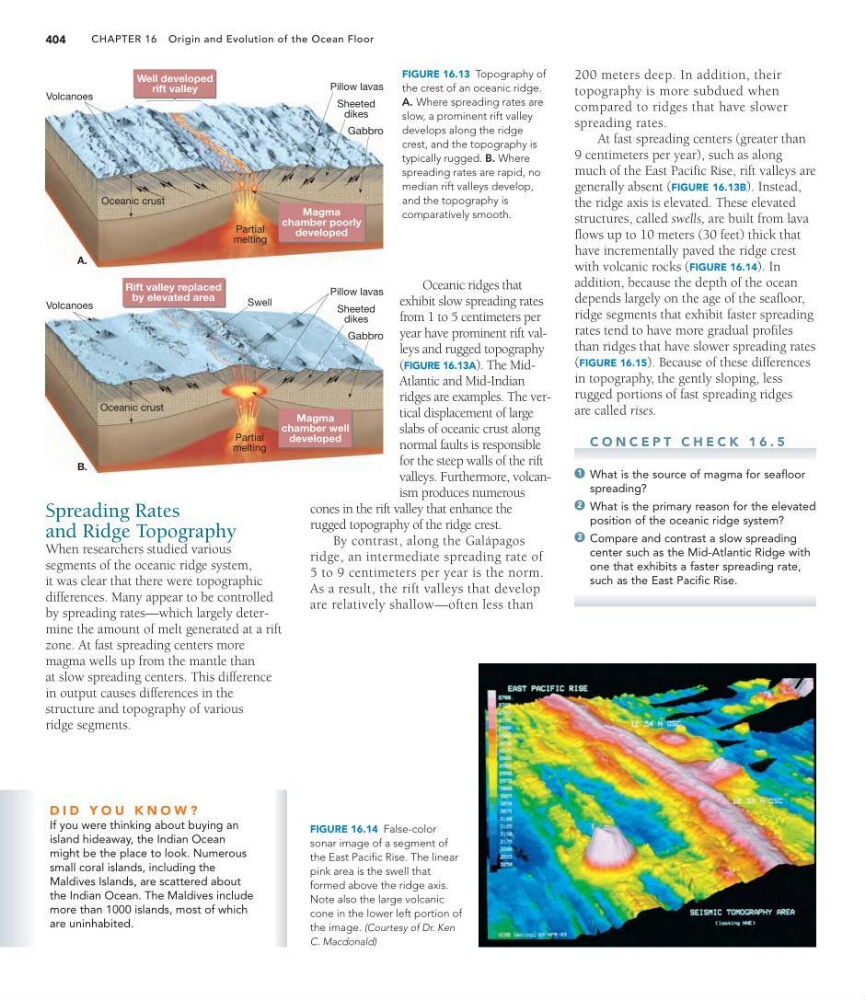
Oceanic ridges that
exhibit slow spreading rates
from 1 to 5 centimeters per
year have prominent rift valleys and rugged topography
(FIGURE 16.13A). The MidAtlantic and Mid-Indian
ridges are examples. The vertical displacement of large
slabs of oceanic crust along
normal faults is responsible
for the steep walls of the rift
valleys. Furthermore, volcanism produces numerous
cones in the rift valley that enhance the
rugged topography of the ridge crest.
By contrast, along the Galápagos
ridge, an intermediate spreading rate of
5 to 9 centimeters per year is the norm.
As a result, the rift valleys that develop
are relatively shallow—often less than
Spreading Rates
and Ridge Topography
When researchers studied various
segments of the oceanic ridge system,
it was clear that there were topographic
differences. Many appear to be controlled
by spreading rates—which largely determine the amount of melt generated at a rift
zone. At fast spreading centers more
magma wells up from the mantle than
at slow spreading centers. This difference
in output causes differences in the
structure and topography of various
ridge segments.
FIGURE 16.14 False-color
sonar image of a segment of
the East Pacific Rise. The linear
pink area is the swell that
formed above the ridge axis.
Note also the large volcanic
cone in the lower left portion of
the image. (Courtesy of Dr. Ken
C. Macdonald)
CHAPTER 16 Origin and Evolution of the Ocean Floor
404
Partial
melting
Oceanic crust
Gabbro
Partial
melting
Oceanic crust
Sheeted
dikes
Pillow lavas
Swell
Volcanoes
A.
B.
Volcanoes
Rift valley replaced
by elevated area
Well developed
rift valley
Magma
chamber well
developed
Magma
chamber poorly
developed
Gabbro
Sheeted
dikes
Pillow lavas
FIGURE 16.13 Topography of
the crest of an oceanic ridge.
A. Where spreading rates are
slow, a prominent rift valley
develops along the ridge
crest, and the topography is
typically rugged. B. Where
spreading rates are rapid, no
median rift valleys develop,
and the topography is
comparatively smooth.
D I D Y O U K N O W ?
If you were thinking about buying an
island hideaway, the Indian Ocean
might be the place to look. Numerous
small coral islands, including the
Maldives Islands, are scattered about
the Indian Ocean. The Maldives include
more than 1000 islands, most of which
are uninhabited.
200 meters deep. In addition, their
topography is more subdued when
compared to ridges that have slower
spreading rates.
At fast spreading centers (greater than
9 centimeters per year), such as along
much of the East Pacific Rise, rift valleys are
generally absent (FIGURE 16.13B). Instead,
the ridge axis is elevated. These elevated
structures, called swells, are built from lava
flows up to 10 meters (30 feet) thick that
have incrementally paved the ridge crest
with volcanic rocks (FIGURE 16.14). In
addition, because the depth of the ocean
depends largely on the age of the seafloor,
ridge segments that exhibit faster spreading
rates tend to have more gradual profiles
than ridges that have slower spreading rates
(FIGURE 16.15). Because of these differences
in topography, the gently sloping, less
rugged portions of fast spreading ridges
are called rises.
C O N C E P T C H E C K 1 6 . 5
What is the source of magma for seafloor
spreading?
What is the primary reason for the elevated
position of the oceanic ridge system?
Compare and contrast a slow spreading
center such as the Mid-Atlantic Ridge with
one that exhibits a faster spreading rate,
such as the East Pacific Rise.
3
2
1
exhibit slow spreading rates
from 1 to 5 centimeters per
year have prominent rift valleys and rugged topography
(FIGURE 16.13A). The MidAtlantic and Mid-Indian
ridges are examples. The vertical displacement of large
slabs of oceanic crust along
normal faults is responsible
for the steep walls of the rift
valleys. Furthermore, volcanism produces numerous
cones in the rift valley that enhance the
rugged topography of the ridge crest.
By contrast, along the Galápagos
ridge, an intermediate spreading rate of
5 to 9 centimeters per year is the norm.
As a result, the rift valleys that develop
are relatively shallow—often less than
Spreading Rates
and Ridge Topography
When researchers studied various
segments of the oceanic ridge system,
it was clear that there were topographic
differences. Many appear to be controlled
by spreading rates—which largely determine the amount of melt generated at a rift
zone. At fast spreading centers more
magma wells up from the mantle than
at slow spreading centers. This difference
in output causes differences in the
structure and topography of various
ridge segments.
FIGURE 16.14 False-color
sonar image of a segment of
the East Pacific Rise. The linear
pink area is the swell that
formed above the ridge axis.
Note also the large volcanic
cone in the lower left portion of
the image. (Courtesy of Dr. Ken
C. Macdonald)
CHAPTER 16 Origin and Evolution of the Ocean Floor
404
Partial
melting
Oceanic crust
Gabbro
Partial
melting
Oceanic crust
Sheeted
dikes
Pillow lavas
Swell
Volcanoes
A.
B.
Volcanoes
Rift valley replaced
by elevated area
Well developed
rift valley
Magma
chamber well
developed
Magma
chamber poorly
developed
Gabbro
Sheeted
dikes
Pillow lavas
FIGURE 16.13 Topography of
the crest of an oceanic ridge.
A. Where spreading rates are
slow, a prominent rift valley
develops along the ridge
crest, and the topography is
typically rugged. B. Where
spreading rates are rapid, no
median rift valleys develop,
and the topography is
comparatively smooth.
D I D Y O U K N O W ?
If you were thinking about buying an
island hideaway, the Indian Ocean
might be the place to look. Numerous
small coral islands, including the
Maldives Islands, are scattered about
the Indian Ocean. The Maldives include
more than 1000 islands, most of which
are uninhabited.
200 meters deep. In addition, their
topography is more subdued when
compared to ridges that have slower
spreading rates.
At fast spreading centers (greater than
9 centimeters per year), such as along
much of the East Pacific Rise, rift valleys are
generally absent (FIGURE 16.13B). Instead,
the ridge axis is elevated. These elevated
structures, called swells, are built from lava
flows up to 10 meters (30 feet) thick that
have incrementally paved the ridge crest
with volcanic rocks (FIGURE 16.14). In
addition, because the depth of the ocean
depends largely on the age of the seafloor,
ridge segments that exhibit faster spreading
rates tend to have more gradual profiles
than ridges that have slower spreading rates
(FIGURE 16.15). Because of these differences
in topography, the gently sloping, less
rugged portions of fast spreading ridges
are called rises.
C O N C E P T C H E C K 1 6 . 5
What is the source of magma for seafloor
spreading?
What is the primary reason for the elevated
position of the oceanic ridge system?
Compare and contrast a slow spreading
center such as the Mid-Atlantic Ridge with
one that exhibits a faster spreading rate,
such as the East Pacific Rise.
3
2
1