

gas hydrates
403
Oceanic Ridges and Seafloor Spreading
Oceanic Ridges and Seafloor Spreading
Divergent Boundaries
Oceanic Ridges and Seafloor Spreading
The greatest volume of magma (more than 60 percent of Earth’ s total yearly output)
is produced along the oceanic ridge system in association with seafloor spreading.
As plates diverge, fractures created in the oceanic crust fill with molten rock that
gradually wells up from the hot mantle below. This molten material slowly cools and
crystallizes, producing new slivers of seafloor. This process repeats itself in episodic
bursts, generating new lithosphere that moves away from the ridge crest in a
conveyor belt fashion.
Seafloor Spreading
Harry Hess of Princeton University formulated the concept of seafloor spreading in
the early 1960s. Later, geologists were able to verify Hess’ s view that seafloor spreading occurs along the crests of oceanic ridges where hot mantle rock rises to replace
the material that has shifted horizontally. Recall from Chapter 3 that as rock rises it
experiences a decrease in confining pressure that may lead to decompression melting.
Partial melting of mantle rock produces basaltic magma that has a surprisingly
consistent chemical composition. The newly formed melt separates from the mantle
rock and rises toward the surface. Along some ridge segments, the melt collects in
small elongated reservoirs located just beneath the ridge crest. Eventually, about
10 percent migrates upward along fissures to erupt as lava flows on the ocean floor
(Figure 16.12). This activity continuously adds new basaltic rock to diverging plate
margins, temporarily welding them together, only to be broken as spreading continues. Along some ridges, outpourings of bulbous lavas build submerged shield volcanoes (seamounts) as well as elongated lava ridges. At other locations, more
voluminous lava flows create a relatively subdued topography.
GEODe
ESSENTIALS
OF GEOLOGY
Why Are Oceanic
Ridges Elevated?
The primary reason for the elevated position of the
ridge system is that newly created oceanic lithosphere is hot and therefore less dense than cooler
rocks of the deep-ocean basin. As the newly formed
basaltic crust travels away from the ridge crest, it is
cooled from above as seawater circulates through
the pore spaces and fractures in the rock. In addition, it cools because it gets farther and farther
from the zone of hot mantle upwelling. As a result,
the lithosphere gradually cools, contracts, and
becomes more dense. This thermal contraction
accounts for the greater ocean depths that occur
away from the ridge. It takes almost 80 million
years of cooling and contraction for rock that was
once part of an elevated ocean-ridge system to
relocate to the deep-ocean basin.
North
America
Africa
Europe
Partial
melting
L it h o s p h e re
A s th e n o s p h e re
Rift
valley
Spreading
center
Oceanic crust
Asthenosphere
M id - A t la n t i c
R
i d g e
Upwelling
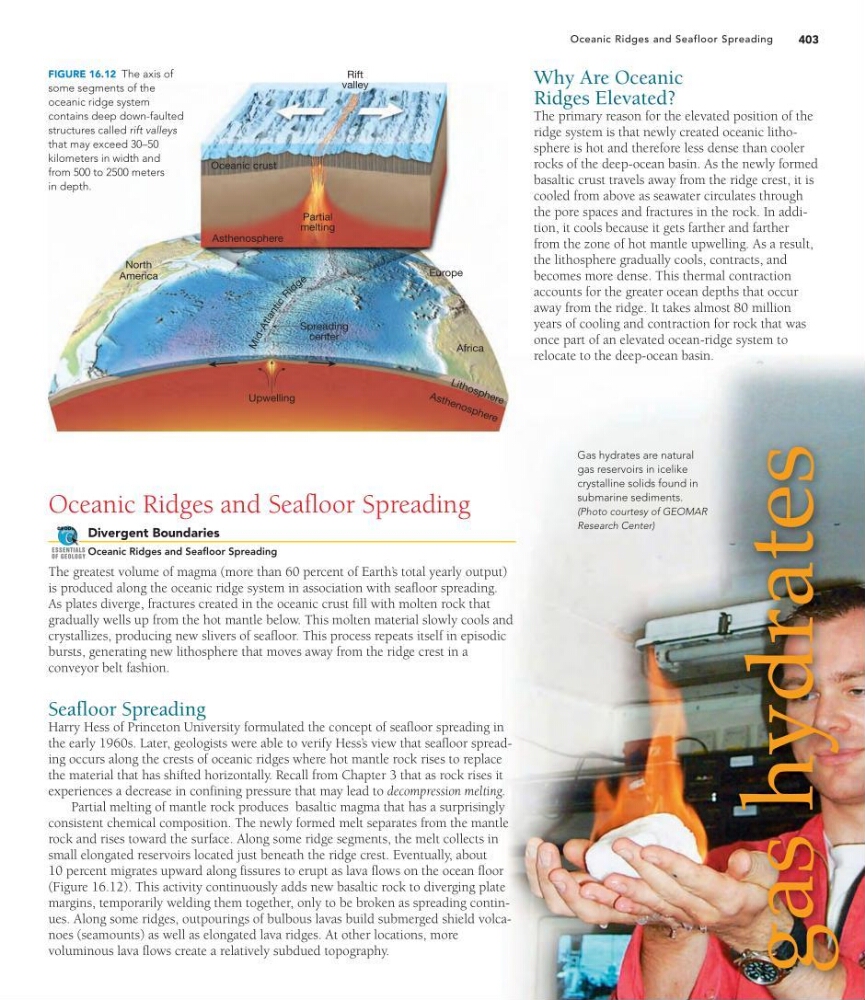
FIGURE 16.12 The axis of
some segments of the
oceanic ridge system
contains deep down-faulted
structures called rift valleys
that may exceed 30–50
kilometers in width and
from 500 to 2500 meters
in depth.
Gas hydrates are natural
gas reservoirs in icelike
crystalline solids found in
submarine sediments.
(Photo courtesy of GEOMAR
Research Center)
403
Oceanic Ridges and Seafloor Spreading
Oceanic Ridges and Seafloor Spreading
Divergent Boundaries
Oceanic Ridges and Seafloor Spreading
The greatest volume of magma (more than 60 percent of Earth’ s total yearly output)
is produced along the oceanic ridge system in association with seafloor spreading.
As plates diverge, fractures created in the oceanic crust fill with molten rock that
gradually wells up from the hot mantle below. This molten material slowly cools and
crystallizes, producing new slivers of seafloor. This process repeats itself in episodic
bursts, generating new lithosphere that moves away from the ridge crest in a
conveyor belt fashion.
Seafloor Spreading
Harry Hess of Princeton University formulated the concept of seafloor spreading in
the early 1960s. Later, geologists were able to verify Hess’ s view that seafloor spreading occurs along the crests of oceanic ridges where hot mantle rock rises to replace
the material that has shifted horizontally. Recall from Chapter 3 that as rock rises it
experiences a decrease in confining pressure that may lead to decompression melting.
Partial melting of mantle rock produces basaltic magma that has a surprisingly
consistent chemical composition. The newly formed melt separates from the mantle
rock and rises toward the surface. Along some ridge segments, the melt collects in
small elongated reservoirs located just beneath the ridge crest. Eventually, about
10 percent migrates upward along fissures to erupt as lava flows on the ocean floor
(Figure 16.12). This activity continuously adds new basaltic rock to diverging plate
margins, temporarily welding them together, only to be broken as spreading continues. Along some ridges, outpourings of bulbous lavas build submerged shield volcanoes (seamounts) as well as elongated lava ridges. At other locations, more
voluminous lava flows create a relatively subdued topography.
GEODe
ESSENTIALS
OF GEOLOGY
Why Are Oceanic
Ridges Elevated?
The primary reason for the elevated position of the
ridge system is that newly created oceanic lithosphere is hot and therefore less dense than cooler
rocks of the deep-ocean basin. As the newly formed
basaltic crust travels away from the ridge crest, it is
cooled from above as seawater circulates through
the pore spaces and fractures in the rock. In addition, it cools because it gets farther and farther
from the zone of hot mantle upwelling. As a result,
the lithosphere gradually cools, contracts, and
becomes more dense. This thermal contraction
accounts for the greater ocean depths that occur
away from the ridge. It takes almost 80 million
years of cooling and contraction for rock that was
once part of an elevated ocean-ridge system to
relocate to the deep-ocean basin.
North
America
Africa
Europe
Partial
melting
L it h o s p h e re
A s th e n o s p h e re
Rift
valley
Spreading
center
Oceanic crust
Asthenosphere
M id - A t la n t i c
R
i d g e
Upwelling
FIGURE 16.12 The axis of
some segments of the
oceanic ridge system
contains deep down-faulted
structures called rift valleys
that may exceed 30–50
kilometers in width and
from 500 to 2500 meters
in depth.
Gas hydrates are natural
gas reservoirs in icelike
crystalline solids found in
submarine sediments.
(Photo courtesy of GEOMAR
Research Center)